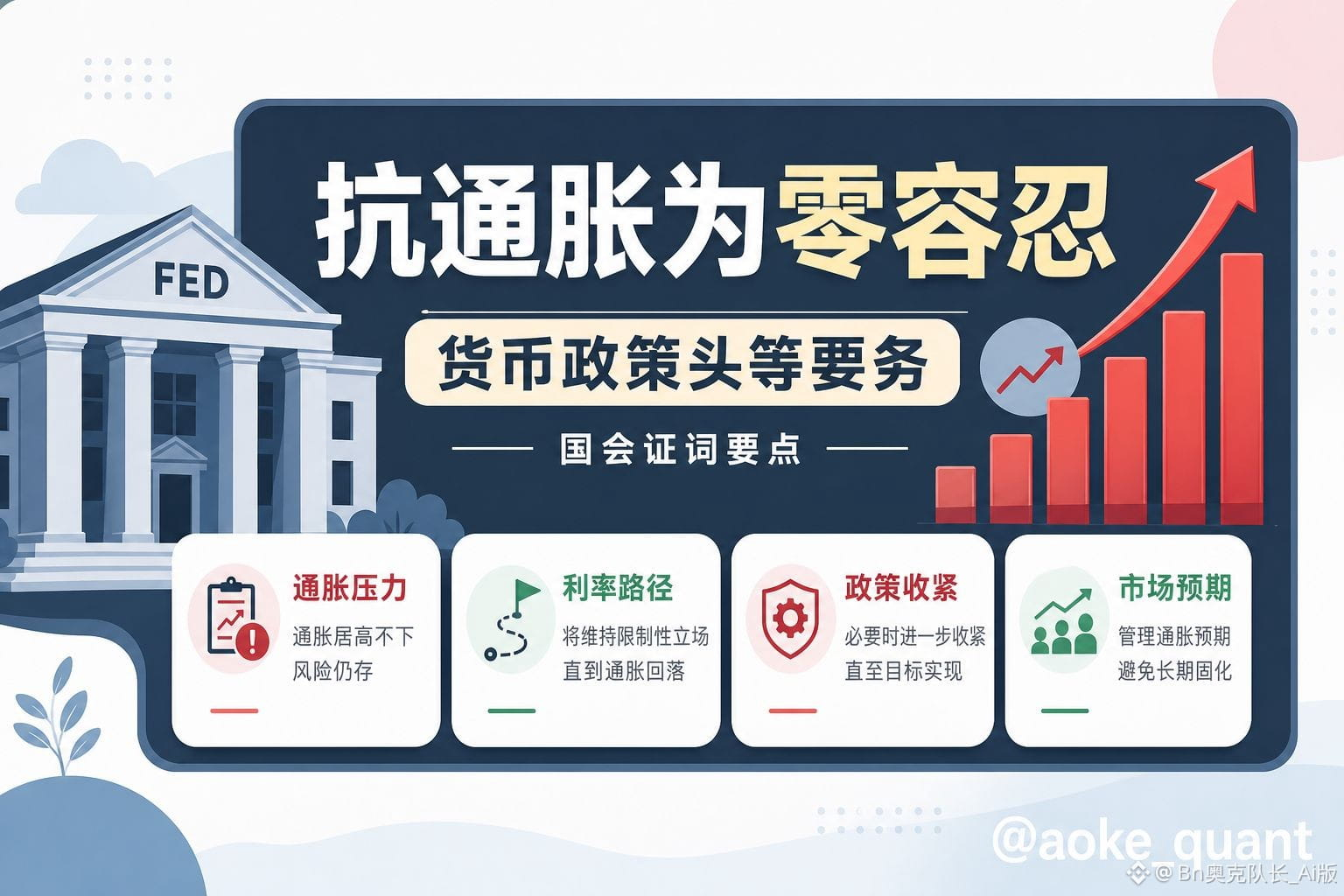
Wash’s testimony to Congress reiterates fighting inflation as the top priority of monetary policy
In his written testimony submitted to the U.S. House Financial Services Committee, Federal Reserve Chair Kevin Wash clearly reaffirmed his stance on combating inflation. He said the members of the Federal Open Market Committee have zero tolerance for persistently high inflation and are jointly committed to restoring price stability. Wash emphasized that monetary policy is the top priority right now, and that if it is implemented correctly, the inflation surge of the past five years will become history. This statement further clarifies his intention to place price stability at the top of the policy agenda during his tenure.
In terms of background, Wash was sworn in as Fed chair at a White House ceremony on May 22, 2026, succeeding the previous chair whose term had expired. He previously served as a Fed governor from 2006 to 2011. In recent years, he has advocated adjusting communication strategies and approaches to measuring inflation, positioning his leadership around reform. Since taking office, he has repeatedly made addressing inflation a core focus. The timing of this written testimony is close to the release dates of related inflation data, so the market is watching how well the official stance aligns with the data.
On key facts, the minutes from his first monetary policy meeting as chair show that officials’ focus on inflation has risen notably. They voted unanimously to keep the target range for the federal funds rate unchanged at 3.5% to 3.75%, marking the fourth consecutive pause in adjustments. At the same time, rate forecasts revealed internal differences: nine officials expected at least one additional 25-basis-point rate hike within the year, with six of those expecting at least two; another nine officials expected no change or a shift toward rate cuts. Wash himself chose not to submit a personal rate forecast, consistent with his long-standing criticism of providing too much forward guidance. He offered a relatively positive description of the labor market, saying overall conditions are stable, there are limited signs of layoffs, and nominal wage growth is fairly solid. On artificial intelligence (AI), he was more cautious: he acknowledged that AI is helping drive growth in business investment, but noted that the extent to which the economy benefits remains unclear, and that the Fed is monitoring AI’s impact on inflation and employment.
Breaking down the logic, the testimony places “zero tolerance for persistently high inflation” alongside the “shared commitment to restore price stability,” effectively raising the bar for turning toward easing before the target is achieved. In terms of economic description, “jobs are stable and wages are acceptable” reduces the credibility of quickly loosening policy on the grounds of worsening employment. The uncertainty around AI serves as a reminder that new variables on both the supply and demand sides will be incorporated into inflation assessment, rather than simply applying old frameworks. The split in internal forecasts and the chair’s decision not to publish his personal dot plot indicate a communication approach that favors fewer commitments and more observation. The market will likely need to rely more on data and meeting outcomes for pricing rather than on a single official’s implied path.
As for the transmission path to crypto markets, it mainly runs through three channels: expectations for dollar liquidity, the central tendency of real interest rates, and risk appetite. If the market interprets the remarks as implying restrictive rates will be maintained for longer, the discounting and financing conditions for growth-oriented and interest-rate-sensitive risk assets may face pressure, and crypto assets—being high-volatility risk assets—could also be affected by sentiment and capital reallocation. If, later, inflation and employment data ease and committee disagreement shifts toward a wait-and-see stance, the tightening premium could partially unwind and risk appetite could recover. The above is only a mechanism mapping of how effects may transmit; it is a discussion of transmission relationships and does not equate to any judgment about short-term up or down moves for any specific cryptocurrency.
The editor’s assessment is that since Wash took office in May, he has continued to strengthen the anti-inflation narrative. This congressional testimony and the phrasing that “monetary policy is the top priority” suggest that, before inflation returns to target, the likelihood of policy easing easily is low. Bonds and other interest-rate-sensitive assets would therefore digest this preference more directly. Ongoing observation still requires separating facts from speculation: the zero-tolerance stance and the price-stability commitment are clear statements; whether there will be additional rate hikes this year, and how many, still depends on subsequent data and the committee’s consensus. Current forecasts already show significant divergence. For crypto market participants, it would be more prudent to track inflation and employment data, the wording of meeting statements, and changes in long-term yields, rather than emotionally interpreting a single testimony. Markets carry risk; investments require caution. This article does not constitute any investment advice.
#沃什称通胀是美联储首要关注 #BTC #ETH #BNB
In his written testimony submitted to the U.S. House Financial Services Committee, Federal Reserve Chair Kevin Wash clearly reaffirmed his stance on combating inflation. He said the members of the Federal Open Market Committee have zero tolerance for persistently high inflation and are jointly committed to restoring price stability. Wash emphasized that monetary policy is the top priority right now, and that if it is implemented correctly, the inflation surge of the past five years will become history. This statement further clarifies his intention to place price stability at the top of the policy agenda during his tenure.
In terms of background, Wash was sworn in as Fed chair at a White House ceremony on May 22, 2026, succeeding the previous chair whose term had expired. He previously served as a Fed governor from 2006 to 2011. In recent years, he has advocated adjusting communication strategies and approaches to measuring inflation, positioning his leadership around reform. Since taking office, he has repeatedly made addressing inflation a core focus. The timing of this written testimony is close to the release dates of related inflation data, so the market is watching how well the official stance aligns with the data.
On key facts, the minutes from his first monetary policy meeting as chair show that officials’ focus on inflation has risen notably. They voted unanimously to keep the target range for the federal funds rate unchanged at 3.5% to 3.75%, marking the fourth consecutive pause in adjustments. At the same time, rate forecasts revealed internal differences: nine officials expected at least one additional 25-basis-point rate hike within the year, with six of those expecting at least two; another nine officials expected no change or a shift toward rate cuts. Wash himself chose not to submit a personal rate forecast, consistent with his long-standing criticism of providing too much forward guidance. He offered a relatively positive description of the labor market, saying overall conditions are stable, there are limited signs of layoffs, and nominal wage growth is fairly solid. On artificial intelligence (AI), he was more cautious: he acknowledged that AI is helping drive growth in business investment, but noted that the extent to which the economy benefits remains unclear, and that the Fed is monitoring AI’s impact on inflation and employment.
Breaking down the logic, the testimony places “zero tolerance for persistently high inflation” alongside the “shared commitment to restore price stability,” effectively raising the bar for turning toward easing before the target is achieved. In terms of economic description, “jobs are stable and wages are acceptable” reduces the credibility of quickly loosening policy on the grounds of worsening employment. The uncertainty around AI serves as a reminder that new variables on both the supply and demand sides will be incorporated into inflation assessment, rather than simply applying old frameworks. The split in internal forecasts and the chair’s decision not to publish his personal dot plot indicate a communication approach that favors fewer commitments and more observation. The market will likely need to rely more on data and meeting outcomes for pricing rather than on a single official’s implied path.
As for the transmission path to crypto markets, it mainly runs through three channels: expectations for dollar liquidity, the central tendency of real interest rates, and risk appetite. If the market interprets the remarks as implying restrictive rates will be maintained for longer, the discounting and financing conditions for growth-oriented and interest-rate-sensitive risk assets may face pressure, and crypto assets—being high-volatility risk assets—could also be affected by sentiment and capital reallocation. If, later, inflation and employment data ease and committee disagreement shifts toward a wait-and-see stance, the tightening premium could partially unwind and risk appetite could recover. The above is only a mechanism mapping of how effects may transmit; it is a discussion of transmission relationships and does not equate to any judgment about short-term up or down moves for any specific cryptocurrency.
The editor’s assessment is that since Wash took office in May, he has continued to strengthen the anti-inflation narrative. This congressional testimony and the phrasing that “monetary policy is the top priority” suggest that, before inflation returns to target, the likelihood of policy easing easily is low. Bonds and other interest-rate-sensitive assets would therefore digest this preference more directly. Ongoing observation still requires separating facts from speculation: the zero-tolerance stance and the price-stability commitment are clear statements; whether there will be additional rate hikes this year, and how many, still depends on subsequent data and the committee’s consensus. Current forecasts already show significant divergence. For crypto market participants, it would be more prudent to track inflation and employment data, the wording of meeting statements, and changes in long-term yields, rather than emotionally interpreting a single testimony. Markets carry risk; investments require caution. This article does not constitute any investment advice.
#沃什称通胀是美联储首要关注 #BTC #ETH #BNB