Relax the stop loss by a factor of two under leverage—why isn’t that just a matter of having a bit more patience?
Relaxing the stop loss by a factor of two under leverage sounds like simply giving the market a little more room; why, for the account, does it often mean agreeing to lose twice as much first?
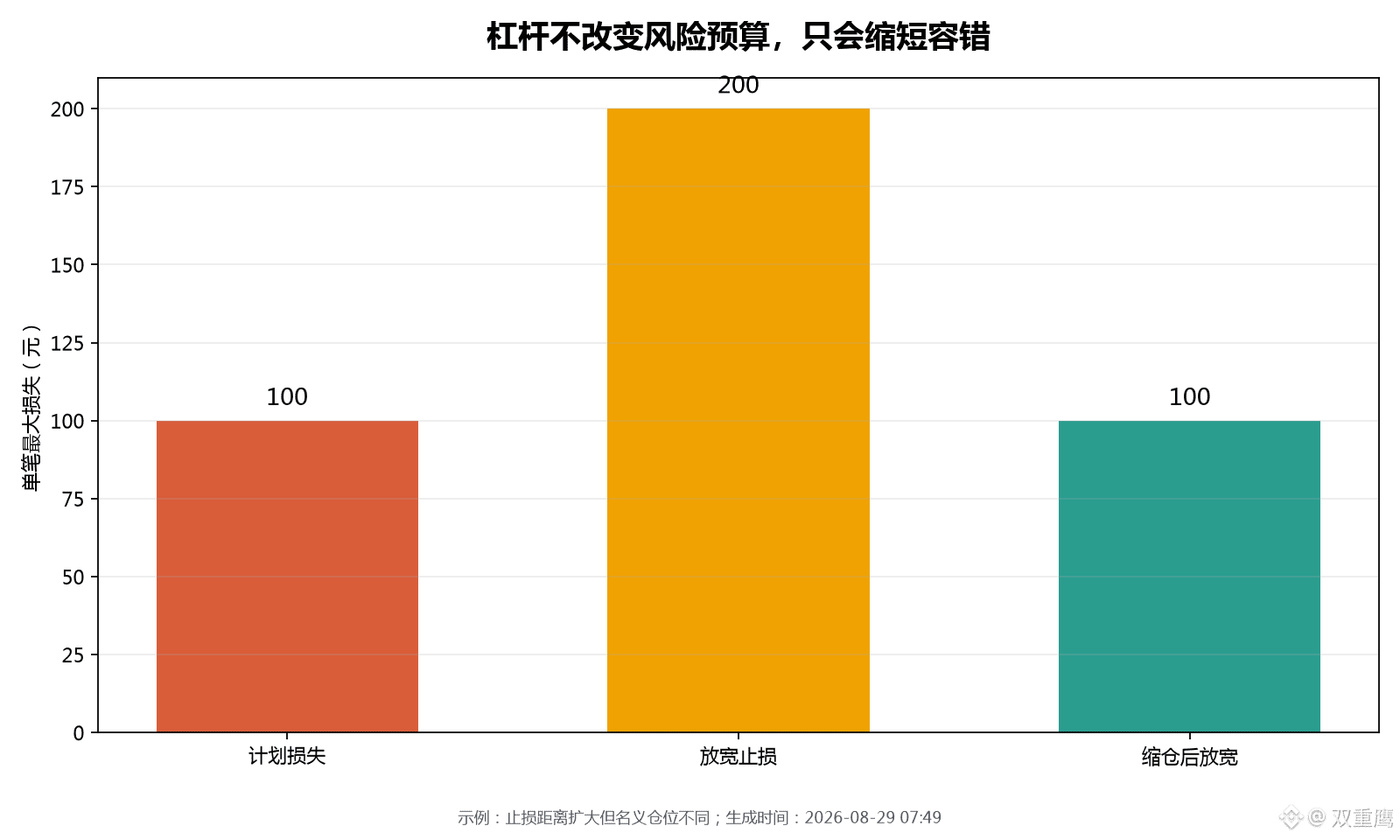
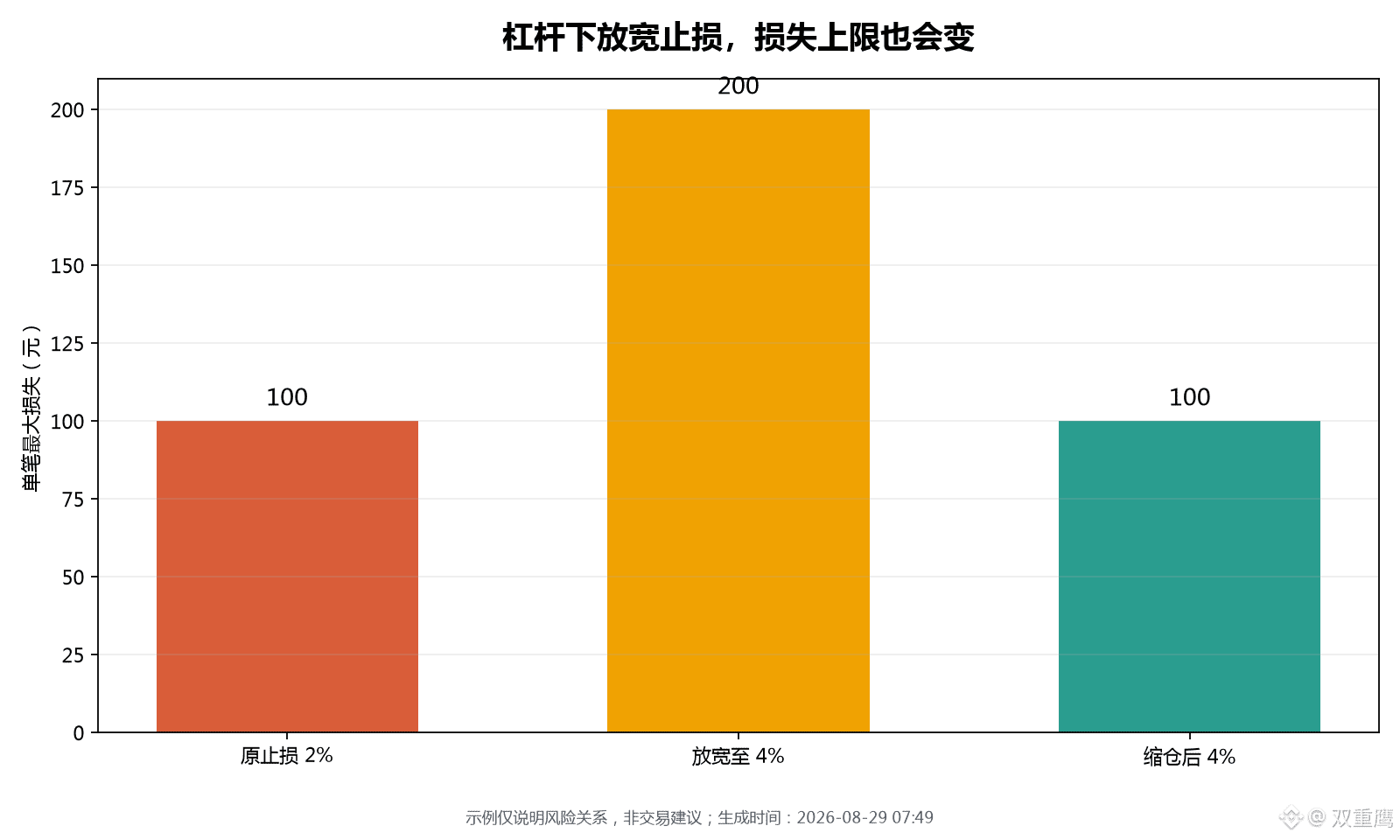
The numbers are not complicated: with a 10,000 yuan account, if a position originally matches the stop loss, the maximum loss is 100 yuan. When market volatility increases and you change the stop-loss distance from 2% to 4% while keeping the notional position size the same, then when the price hits the new stop loss, the theoretical loss becomes 200 yuan. Leverage doesn’t reduce that 200 yuan for you—it only makes the notional position larger and the buffer narrower.
The fact: stop-loss distance, position size, and the amount you can lose per trade are three sides of the same equation. Expanding the distance is not absolutely wrong; when volatility rises, the original stop loss may indeed have been too tight. The fix is to reduce the position size to half so the maximum loss remains 100 yuan—not to “bet” with the account that the price will turn back at a farther point.
The most common mistake ordinary traders make is mistaking “avoiding being stopped out” for “having lower risk.” After a streak of losses, many people increase leverage or keep large positions, then move the stop loss farther away. Long traders say it will rebound a little more; short traders say it will pull back a little more. But once your judgment is still wrong, the clear invalidation point you originally had becomes an open-ended wait.
My guess: If a trade can only work by repeatedly loosening the stop loss, the issue may not be that the stop loss is too close, but that the entry conditions don’t have an edge. The next thing to confirm is whether volatility has truly increased, whether the structure has changed, and whether the trade is still worth taking after reducing the position.
My view: I’d rather miss out once because my stop loss got hit than trade fixed risk for a vague hope. Stop losses can be adjusted with volatility, but every adjustment should first be calculated as the loss amount.
Risk warning: contracts, leverage, and slippage will all amplify real losses.
#交易认知 #risk management
Trading principle: before loosening the stop loss, first reduce the position size.
Don’t want to watch the charts all day? You can first use a smaller amount to observe my positions and drawdowns.
👉 Click the profile picture to go to my homepage and see my trading/managed order projects
Relaxing the stop loss by a factor of two under leverage sounds like simply giving the market a little more room; why, for the account, does it often mean agreeing to lose twice as much first?
The numbers are not complicated: with a 10,000 yuan account, if a position originally matches the stop loss, the maximum loss is 100 yuan. When market volatility increases and you change the stop-loss distance from 2% to 4% while keeping the notional position size the same, then when the price hits the new stop loss, the theoretical loss becomes 200 yuan. Leverage doesn’t reduce that 200 yuan for you—it only makes the notional position larger and the buffer narrower.
The fact: stop-loss distance, position size, and the amount you can lose per trade are three sides of the same equation. Expanding the distance is not absolutely wrong; when volatility rises, the original stop loss may indeed have been too tight. The fix is to reduce the position size to half so the maximum loss remains 100 yuan—not to “bet” with the account that the price will turn back at a farther point.
The most common mistake ordinary traders make is mistaking “avoiding being stopped out” for “having lower risk.” After a streak of losses, many people increase leverage or keep large positions, then move the stop loss farther away. Long traders say it will rebound a little more; short traders say it will pull back a little more. But once your judgment is still wrong, the clear invalidation point you originally had becomes an open-ended wait.
My guess: If a trade can only work by repeatedly loosening the stop loss, the issue may not be that the stop loss is too close, but that the entry conditions don’t have an edge. The next thing to confirm is whether volatility has truly increased, whether the structure has changed, and whether the trade is still worth taking after reducing the position.
My view: I’d rather miss out once because my stop loss got hit than trade fixed risk for a vague hope. Stop losses can be adjusted with volatility, but every adjustment should first be calculated as the loss amount.
Risk warning: contracts, leverage, and slippage will all amplify real losses.
#交易认知 #risk management
Trading principle: before loosening the stop loss, first reduce the position size.
Don’t want to watch the charts all day? You can first use a smaller amount to observe my positions and drawdowns.
👉 Click the profile picture to go to my homepage and see my trading/managed order projects