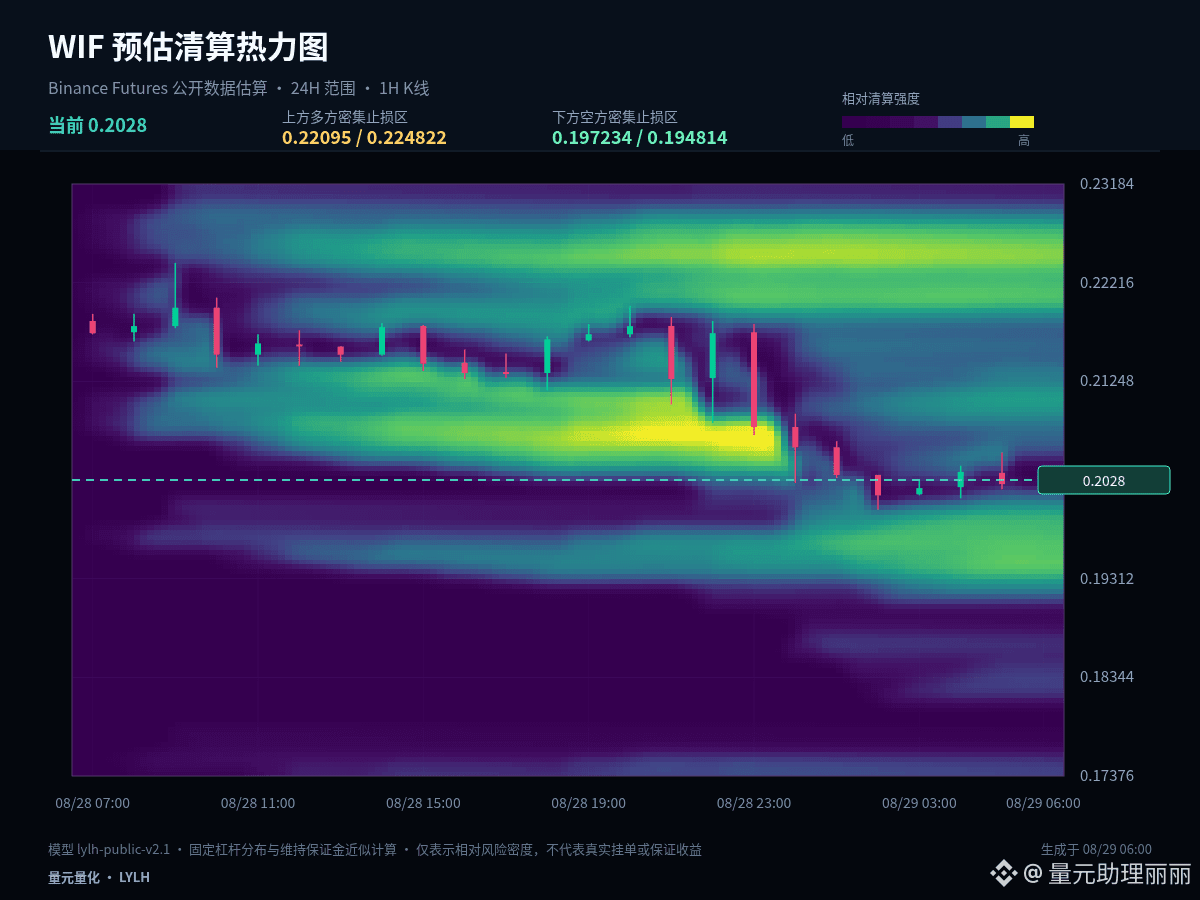
$WIF #WIF Do a structural review. Current price is 0.2028, 1 hour +0.15%, 24 hours -7.52%, and the recent 24-hour swing amplitude is about 11.7%.
The current price is close to the lower bound of the past 24 hours’ volatility. It’s up 0.15% in the last hour and down 7.52% over 24 hours. The key in analyzing the low isn’t anticipating a bottom call; it’s watching whether, after a break, the price can quickly reclaim. If it can reclaim, it indicates sell pressure is absorbed. If it remains below the lower bound, it means weakness hasn’t ended.
Key levels to review: 0.21195 determines short-term initiative. 0.2238 is used to confirm upside potential. 0.2001 is for observing downside defense. You don’t need to guess every next step afterward—just check whether your original view still holds when price passes through these levels.
If the market matches expectations, manage profits in stages and continue moving protective stops upward. If it doesn’t match expectations, promptly admit the change in conditions. Professional trading isn’t about always being right—it’s about staying consistent in execution after the information is updated.
Positioning should distinguish between spot and futures. If you already hold spot, manage it in stages around key levels; don’t frequently switch direction due to a single 1-hour candlestick. If you’re in cash, wait for confirmation, then enter in batches more calmly. Futures require more focus on entry location and invalidation conditions. When volatility amplifies, actively reduce position size to avoid turning a short-term judgment into passive holding.
Risk control still comes before the conclusion: only execute when conditions appear. If the price invalidates your assumption, reassess immediately. The greater the volatility, the more restrained you must be with any single position. The above is a scenario-based analysis based on the current 1-hour and 24-hour data and does not constitute a promise of returns.
#WarshSaysInflationIsFedTopFocus
The current price is close to the lower bound of the past 24 hours’ volatility. It’s up 0.15% in the last hour and down 7.52% over 24 hours. The key in analyzing the low isn’t anticipating a bottom call; it’s watching whether, after a break, the price can quickly reclaim. If it can reclaim, it indicates sell pressure is absorbed. If it remains below the lower bound, it means weakness hasn’t ended.
Key levels to review: 0.21195 determines short-term initiative. 0.2238 is used to confirm upside potential. 0.2001 is for observing downside defense. You don’t need to guess every next step afterward—just check whether your original view still holds when price passes through these levels.
If the market matches expectations, manage profits in stages and continue moving protective stops upward. If it doesn’t match expectations, promptly admit the change in conditions. Professional trading isn’t about always being right—it’s about staying consistent in execution after the information is updated.
Positioning should distinguish between spot and futures. If you already hold spot, manage it in stages around key levels; don’t frequently switch direction due to a single 1-hour candlestick. If you’re in cash, wait for confirmation, then enter in batches more calmly. Futures require more focus on entry location and invalidation conditions. When volatility amplifies, actively reduce position size to avoid turning a short-term judgment into passive holding.
Risk control still comes before the conclusion: only execute when conditions appear. If the price invalidates your assumption, reassess immediately. The greater the volatility, the more restrained you must be with any single position. The above is a scenario-based analysis based on the current 1-hour and 24-hour data and does not constitute a promise of returns.
#WarshSaysInflationIsFedTopFocus