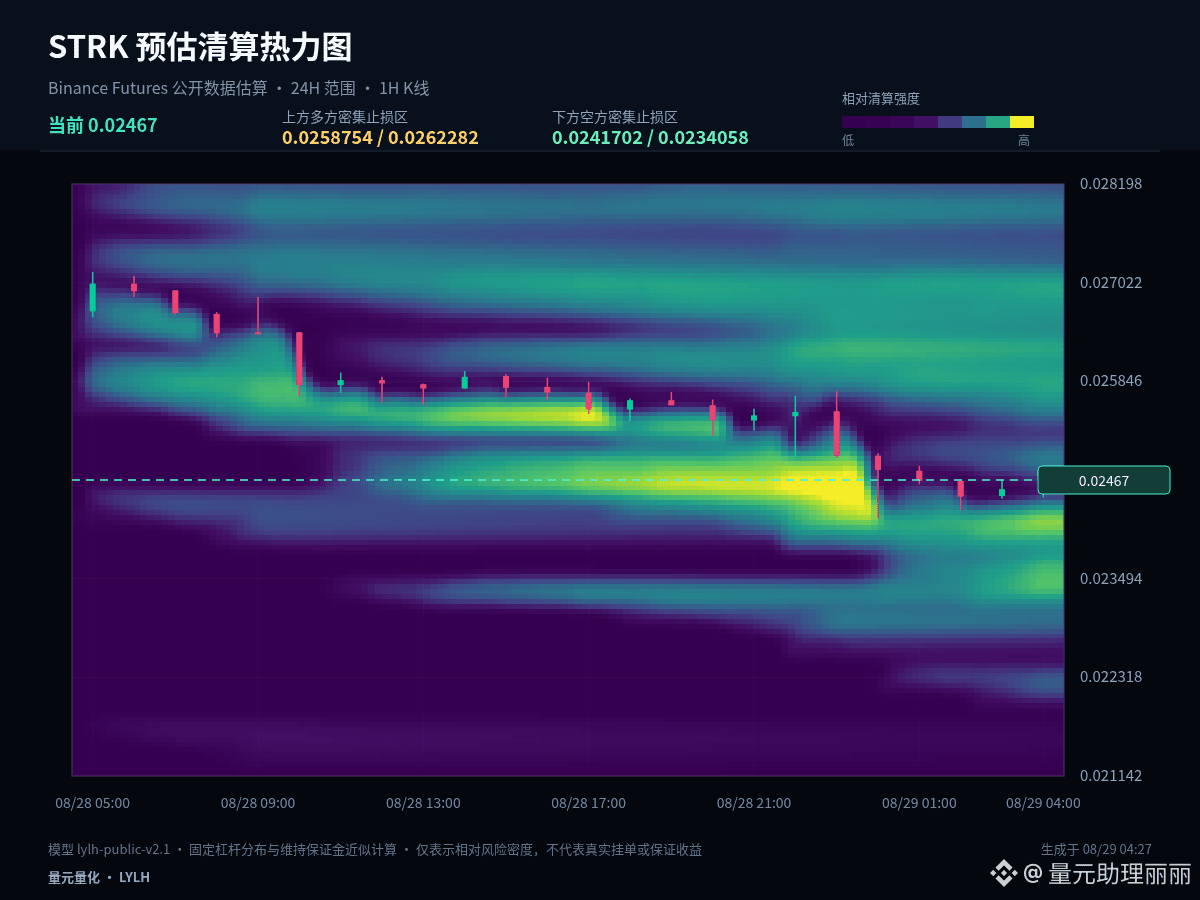
$STRK #STRK In the past 24 hours, the high-low amplitude is about 11.8%, and the current price is 0.02468. This is not a calm market suitable for a casual entry. When volatility expands, you should adjust your position first, then discuss direction.
$STRK #STRK has returned to the vicinity of the 24-hour low. Next, watch for the selling pressure to fade and confirm support. Without a stop-fall (price-stabilization) structure, don’t rush to predict a reversal.
The current price is near the lower band of the last 24-hour range: 1-hour +0.45%, 24-hour -8.15%. The key in analyzing the lows is not to bottom-pick early, but to observe whether, after a break, price can quickly reclaim. If it can reclaim, it indicates the selling pressure has been absorbed. If it keeps lingering below the lower band, it means the weakness has not ended.
For key levels: 0.025705 is the current structure’s midline and the first standard to judge whether the pullback is healthy. As long as price can stabilize above it, bulls still have the initiative. On the upside, first look at 0.02716. If price falls back below the midline, then shift attention to a second support/consolidation at 0.02425.
In a high-volatility phase, the execution principles are to reduce single-entry exposure, avoid chasing prices back and forth in the middle of a range, and write down invalidation conditions before entering. If price hasn’t provided confirmation, it’s better to do less than make up uncertainty with a larger position.
My scenario analysis isn’t betting on only one direction. A breakout above 0.02716 and the ability to hold it means upside space has been reopened. A breakdown below 0.02425 with no successful retest indicates the structure is further weakening. If price trades between the two, continue observing the closing behavior on both sides of 0.025705.
The focus of the contract is not to predict every single K-line. It’s to ensure there is a basis for entry, position reduction, and exit. If there’s no confirmation, do less. If a key level fails, redo the plan. First control single-trade risk, then talk about subsequent upside/downside potential.
#QatarExtendsLNGForceMajeureByOneMonth
$STRK #STRK has returned to the vicinity of the 24-hour low. Next, watch for the selling pressure to fade and confirm support. Without a stop-fall (price-stabilization) structure, don’t rush to predict a reversal.
The current price is near the lower band of the last 24-hour range: 1-hour +0.45%, 24-hour -8.15%. The key in analyzing the lows is not to bottom-pick early, but to observe whether, after a break, price can quickly reclaim. If it can reclaim, it indicates the selling pressure has been absorbed. If it keeps lingering below the lower band, it means the weakness has not ended.
For key levels: 0.025705 is the current structure’s midline and the first standard to judge whether the pullback is healthy. As long as price can stabilize above it, bulls still have the initiative. On the upside, first look at 0.02716. If price falls back below the midline, then shift attention to a second support/consolidation at 0.02425.
In a high-volatility phase, the execution principles are to reduce single-entry exposure, avoid chasing prices back and forth in the middle of a range, and write down invalidation conditions before entering. If price hasn’t provided confirmation, it’s better to do less than make up uncertainty with a larger position.
My scenario analysis isn’t betting on only one direction. A breakout above 0.02716 and the ability to hold it means upside space has been reopened. A breakdown below 0.02425 with no successful retest indicates the structure is further weakening. If price trades between the two, continue observing the closing behavior on both sides of 0.025705.
The focus of the contract is not to predict every single K-line. It’s to ensure there is a basis for entry, position reduction, and exit. If there’s no confirmation, do less. If a key level fails, redo the plan. First control single-trade risk, then talk about subsequent upside/downside potential.
#QatarExtendsLNGForceMajeureByOneMonth