


Aristimuño Herrera & Asociados states that full dollarization does not constitute the appropriate or optimal mechanism to achieve solid, lasting, and growth-oriented macroeconomic stabilization in Venezuela.
In the ongoing debate about Venezuela’s economic future, there remains a dilemma that is often framed in absolute terms: whether it is advisable to move toward full official dollarization versus the insistence on schemes of forced de-dollarization.
In this context of differing opinions about the future of the national monetary system, the technical premise we uphold at Aristimuño Herrera & Asociados is clear: full dollarization does not constitute the appropriate or optimal mechanism to achieve solid, lasting, and growth-oriented macroeconomic stabilization.
On the contrary, the evidence and the country’s economic structure indicate that the most efficient and pragmatic path is the consolidation of a formal, transparent, fully functional bimonetary system, where the bolívar and the dollar coexist under clear market rules.
The strength of a monetary sign is not imposed by decree, nor is it recovered by artificially restricting the circulation of other currencies.
If economic management applies a sound policy, eliminates deficit monetary financing, and guarantees price stability, economic agents will naturally demand more bolívares; meanwhile, the dollar must continue to play its role as a facilitator of liquidity, a store of value, and a means of payment.
The loss of the Central Bank’s role as lender of last resort, which increases the fragility of the financial system in periods of stress or with possible deposit outflows.
The disadvantages of full dollarization
Adopting the dollar as the single currency may seem, at first glance, like an attractive shortcut to extinguish inflation at its root and anchor expectations. However, this approach introduces an institutional rigidity that is almost irreversible and shifts disproportionate costs onto the productive apparatus, especially in an economy highly exposed to external shocks.
By completely renouncing monetary and exchange-rate sovereignty, the country loses the ability to cushion international fluctuations.
For a nation whose income depends significantly on the energy market, a sudden drop in oil prices under a dollarized scheme translates immediately into a severe contraction of domestic liquidity, pushing the economy toward recession, shortages, and traumatic adjustment in employment and real wages.
Likewise, full dollarization weakens efforts to diversify non-traditional tradable goods, because it leaves the productive apparatus defenseless against appreciation of the dollar or devaluations in competitor countries in the region.
Added to this is the loss of the Central Bank’s role as lender of last resort, which increases the fragility of the financial system in periods of tension or with possible deposit outflows.
Nor does it, by itself, guarantee fiscal discipline, since, given the impossibility of printing money, chronic budget imbalances usually lead to costly overborrowing or to the precarious issuance of debt instruments that end up functioning as devalued quasi-currencies.
Overcoming frictions
In contrast to the rigidities of formal dollarization, measures aimed at coercively restricting the use of foreign currencies have shown that they generate undesirable frictions in commercial activity and society overall.
Building operational channels to mobilize foreign currency —such as logistics for supplying banknotes in appropriate denominations, reactivating correspondent relationships, and normalizing authorized financial circuits— must not be interpreted as a prelude to abandoning the bolívar.
It is, in reality, the basic and indispensable infrastructure needed to order and make transparent a transactional reality that the market has already adopted out of necessity.
It is essential to eliminate the surcharges and special taxes that burden transactions in foreign currency, even as an economic stimulus for productive sectors.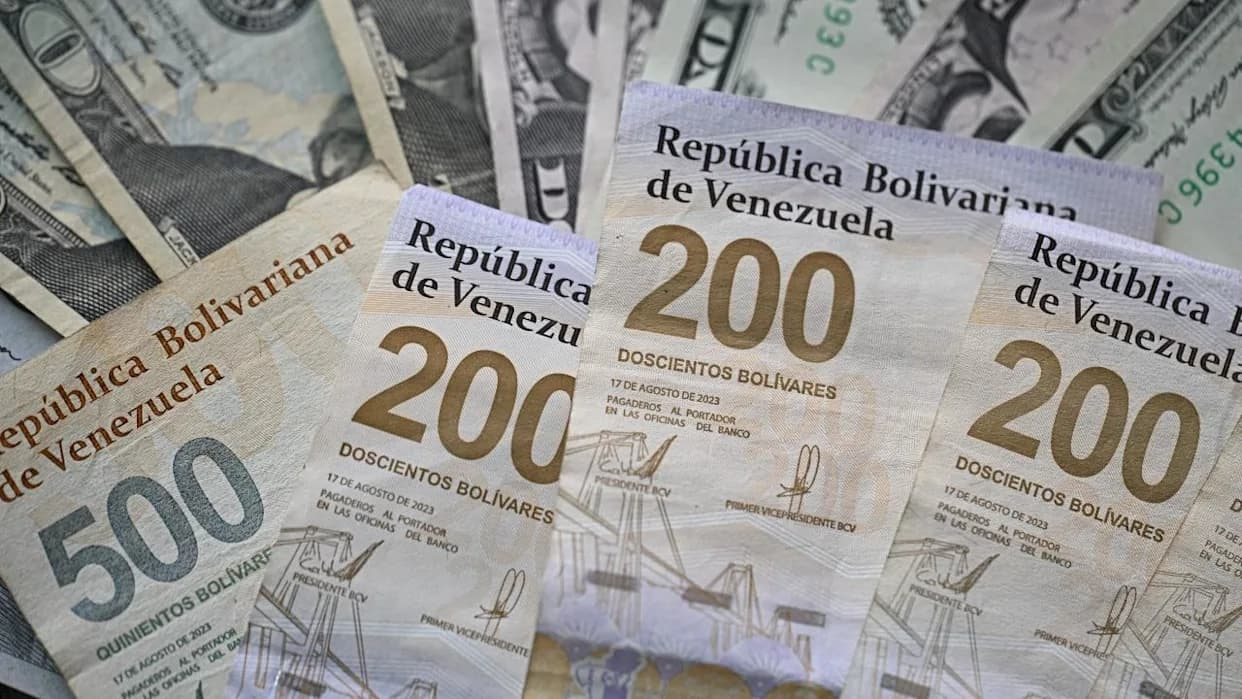
Toward transparent bimonetarism: Freedom, clearing, and credit
The sensible alternative lies in abandoning regulatory ambiguities and giving bimonetarism a framework of institutional certainty. This requires decisively moving toward operational deregulation and integrating foreign currencies into the domestic banking circuit through three fundamental dimensions.
First of all, it is essential to eliminate the surcharges and special taxes that burden transactions in foreign currency, even as an economic stimulus for productive sectors.
Taxing foreign-currency transactions only distorts price formation, penalizes the formal consumer, and incentivizes the use of opaque payment mechanisms outside the banking system, which concentrates the dollar liquidity’s financial inclusion within that off-system realm.
Secondly, it is a priority to establish an interbank electronic clearing and settlement chamber for dollars within the national financial system.
Enabling transfers between customers of different entities, and even within the same banking institution, to be carried out in real time and through secure platforms drastically reduces dependence on physical cash, lowers operating costs for businesses, and streamlines the flow of the supply chain across the country, relieving pressure on the currency’s price.
Thirdly, stabilization requires immediately reactivating credit intermediation in foreign currency.
Today, a significant volume of resources, more than 2,500 million dollars, remains practically immobilized in freely convertible accounts. Allowing commercial banks to channel these deposits into commercial loans, working capital, and productive investment projects, under well-designed macroprudential matching and risk rules, is a very powerful mechanism to reactivate the installed capacity of industry, agriculture, and national commerce, which would also reduce pressure on the exchange rate.
Central Bank reinforces exchange-rate intervention
A formal bimonetary system, with full transactional freedom and the capacity for bank credit in foreign currencies, would provide the immediate stability that the economy requires.
Rebuilding trust
International experience shows that various economies with a past of high dollarization managed to bring down inflation and rebuild the value of their local currencies without needing to eliminate their national sign.
The success of these processes did not rely on bans or exchange-rate straitjackets, but on the strict application of fiscal discipline, the definitive end of monetary financing of public deficits, and strengthening the technical autonomy of the issuing bank.
At the same time, cases of dollarization recorded in recent decades show that this decision does not shield countries’ economies from turmoil, crisis periods and economic contraction, volatility, or difficulties sustaining growth.
In an environment characterized by stable prices, orderly public finances, and free convertibility, the bolívar will gradually regain its attributes as a unit of account and a store of value, due to the sheer convenience for citizens and businesses.
A formal bimonetary system, with full transactional freedom and the capacity for bank credit in foreign currencies, would provide the immediate stability the economy requires and would preserve the policy tools needed for long-term development.