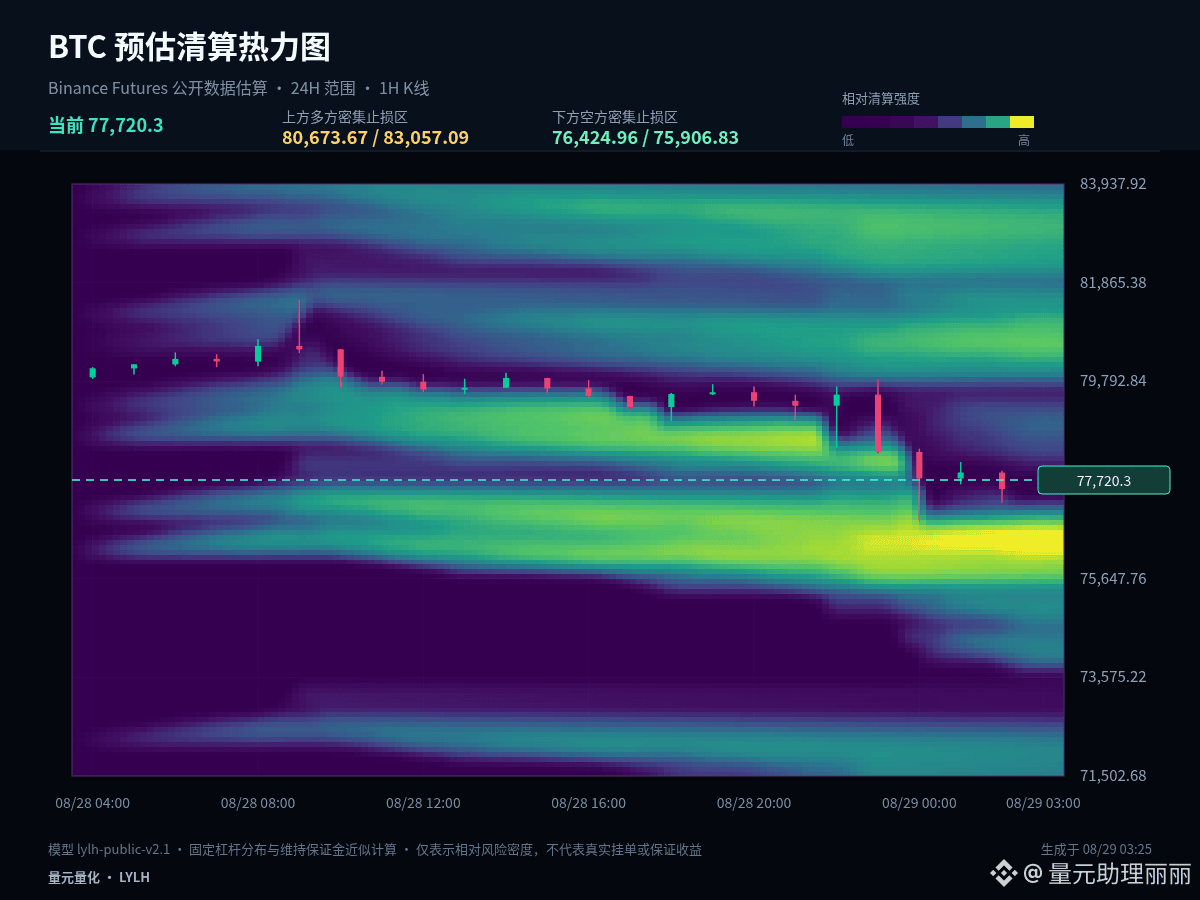
$BTC #BTC Now it looks more like a range with hand-to-hand trading; you don’t need to interpret every 1-hour candlestick as a brand-new trend. Current price: 77,756. 1-hour: +0.26%; 24-hour: -2.95%.
With the 1-hour at +0.26% and the 24-hour at -2.95%, the two cycles have not formed sufficiently clear, same-direction coordination. In a ranging market, the tolerance for chasing and selling off is lower. It’s more suitable to confirm direction using the upper boundary, confirm acceptance using the lower boundary, and treat the midline only as a strength/weakness divider.
Upper boundary: 81,478.87; lower boundary: 76,888; midline: 79,183.44. Watch for breakout quality near the upper boundary; watch for acceptance near the lower boundary. Around the midline, reduce frequent trading—because it’s not far enough from either side, neither direction nor risk-reward is clear.
The signals truly worth acting on are: after a price breaks the boundary, it’s willing to stay within the new range; or after it probes the boundary downward, it quickly snaps back. Without such confirmation, continue treating it as consolidation and don’t change the overall plan due to brief intraday fluctuations.
For those with existing positions, focus on managing whether support has failed, rather than being carried along by every fluctuation. For those in cash with no position, prioritize waiting for a breakout plus a retest, or for support confirmation. Spot positions can be scaled in batches; for futures, shorten the decision chain—first fix the stop-loss level, then decide whether to participate.
The key with contracts isn’t to predict every single candlestick. It’s to ensure you have justification for entry, de-risking, and exiting. Do less without confirmation; if key levels fail, redo the plan. Control single-trade risk first, then discuss potential upside.
#KospiFallsAsAITradingEuphoriaCools
With the 1-hour at +0.26% and the 24-hour at -2.95%, the two cycles have not formed sufficiently clear, same-direction coordination. In a ranging market, the tolerance for chasing and selling off is lower. It’s more suitable to confirm direction using the upper boundary, confirm acceptance using the lower boundary, and treat the midline only as a strength/weakness divider.
Upper boundary: 81,478.87; lower boundary: 76,888; midline: 79,183.44. Watch for breakout quality near the upper boundary; watch for acceptance near the lower boundary. Around the midline, reduce frequent trading—because it’s not far enough from either side, neither direction nor risk-reward is clear.
The signals truly worth acting on are: after a price breaks the boundary, it’s willing to stay within the new range; or after it probes the boundary downward, it quickly snaps back. Without such confirmation, continue treating it as consolidation and don’t change the overall plan due to brief intraday fluctuations.
For those with existing positions, focus on managing whether support has failed, rather than being carried along by every fluctuation. For those in cash with no position, prioritize waiting for a breakout plus a retest, or for support confirmation. Spot positions can be scaled in batches; for futures, shorten the decision chain—first fix the stop-loss level, then decide whether to participate.
The key with contracts isn’t to predict every single candlestick. It’s to ensure you have justification for entry, de-risking, and exiting. Do less without confirmation; if key levels fail, redo the plan. Control single-trade risk first, then discuss potential upside.
#KospiFallsAsAITradingEuphoriaCools