Analyze Tron’s $TRX investment logic and value
Today I’m writing my analysis of Tron mainly to challenge my own biases.
Over the past one or two years, most altcoins have continued to weaken. Even SOL and BNB have seen significant pullbacks, and SUI, APT, ADA, and others have fallen even more. And among the top ten by market cap, the only ones that have truly managed to maintain an uptrend are HYPE and TRX.
TRX has stayed relatively low-key in China. Many people have played with crypto for years but never really gotten to know it. Meme coin players mainly hang around SOL, ETH, and BNB, while contract traders focus on BTC, ETH, and various “weird” coins. And because of controversy involving Justin Sun, many people have also chosen to avoid Tron actively.
But what really supports TRX is not market sentiment—it’s stablecoin payments.
Since 2019, Tron has focused its core strategy on USDT transfers and payments. Back then, Ethereum’s transfer fees were costly, and TRON—thanks to its low fees—quickly captured market share. Today, in regions such as Southeast Asia and Latin America, TRON has become an important infrastructure for stablecoin transfers. On-chain, it carries about half of the USDT supply and around 40% of USDT transaction volume—this market share is not small.
In real life, many users simply use it to get paid, run businesses, and make cross-border transfers. They don’t understand Web3 concepts, and they won’t advertise TRX online every day. But precisely these users form Tron’s most stable base. Combined with the energy mechanism, users can stake TRX to reduce or even eliminate transfer fees, further increasing stickiness.
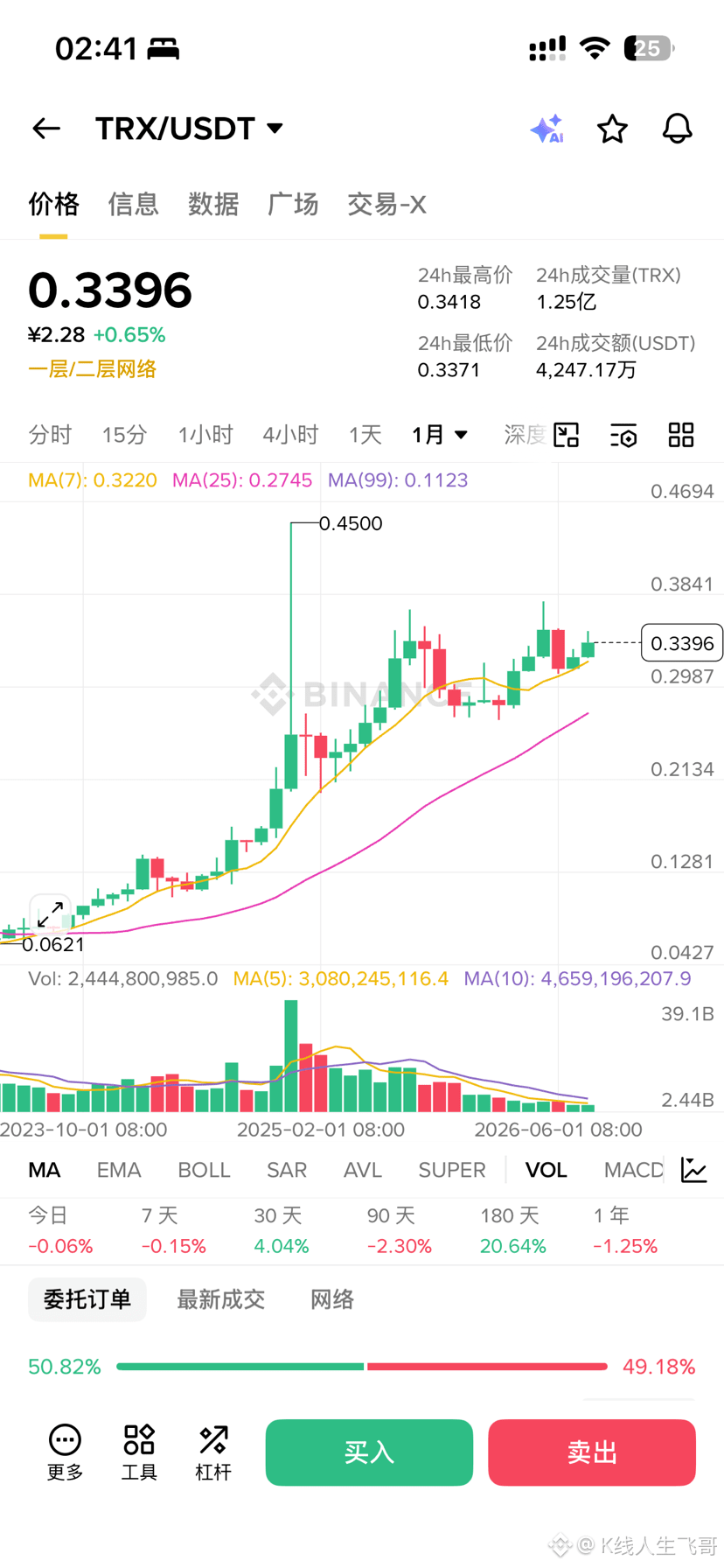
From an investment perspective, projects that truly have real-world use cases and ongoing usage often have more staying power than those that rely solely on telling stories. TRX has risen from a bear-market low of $0.044 to today’s $0.34, with a cumulative increase of more than 10x. It hasn’t just outperformed many mainstream altcoins; it’s also one of the few large-cap tokens that broke through the previous bull market high (around $0.18 in 2021).
Of course, TRX isn’t without issues. Its relatively high level of centralization, controversies around Justin Sun, regulatory risks, and certain historical negative events are all reasons the market has criticized it.
But at least in terms of results, TRX has proven one thing: a blockchain with real demand, cash flow, and users can still chart its own course even without riding on hot narratives.
Today I’m writing my analysis of Tron mainly to challenge my own biases.
Over the past one or two years, most altcoins have continued to weaken. Even SOL and BNB have seen significant pullbacks, and SUI, APT, ADA, and others have fallen even more. And among the top ten by market cap, the only ones that have truly managed to maintain an uptrend are HYPE and TRX.
TRX has stayed relatively low-key in China. Many people have played with crypto for years but never really gotten to know it. Meme coin players mainly hang around SOL, ETH, and BNB, while contract traders focus on BTC, ETH, and various “weird” coins. And because of controversy involving Justin Sun, many people have also chosen to avoid Tron actively.
But what really supports TRX is not market sentiment—it’s stablecoin payments.
Since 2019, Tron has focused its core strategy on USDT transfers and payments. Back then, Ethereum’s transfer fees were costly, and TRON—thanks to its low fees—quickly captured market share. Today, in regions such as Southeast Asia and Latin America, TRON has become an important infrastructure for stablecoin transfers. On-chain, it carries about half of the USDT supply and around 40% of USDT transaction volume—this market share is not small.
In real life, many users simply use it to get paid, run businesses, and make cross-border transfers. They don’t understand Web3 concepts, and they won’t advertise TRX online every day. But precisely these users form Tron’s most stable base. Combined with the energy mechanism, users can stake TRX to reduce or even eliminate transfer fees, further increasing stickiness.
From an investment perspective, projects that truly have real-world use cases and ongoing usage often have more staying power than those that rely solely on telling stories. TRX has risen from a bear-market low of $0.044 to today’s $0.34, with a cumulative increase of more than 10x. It hasn’t just outperformed many mainstream altcoins; it’s also one of the few large-cap tokens that broke through the previous bull market high (around $0.18 in 2021).
Of course, TRX isn’t without issues. Its relatively high level of centralization, controversies around Justin Sun, regulatory risks, and certain historical negative events are all reasons the market has criticized it.
But at least in terms of results, TRX has proven one thing: a blockchain with real demand, cash flow, and users can still chart its own course even without riding on hot narratives.