


The Federal Reserve chair Powell on Friday reignited market expectations for rate hikes with remarks at the Jackson Hole annual symposium. While he did not directly provide policy guidance for the September meeting, he clearly said that policymakers must be confident that underlying inflation is falling back toward the 2% target in a “clear and sufficiently rapid” manner; otherwise, the Fed “still has work to do.”
The statement quickly changed pricing in the interest-rate market. Media reports said market moves indicated traders restarted bets on a single 25-basis-point rate hike later this year, and leaned toward expecting two hikes by March 2027. CME-related data showed the probability of a September hike rose from about 35% before Powell’s remarks to 50%, while other market data at one point suggested the probability increased to around 55%. Later reporting also said market data showed the probability briefly reached about 60%.
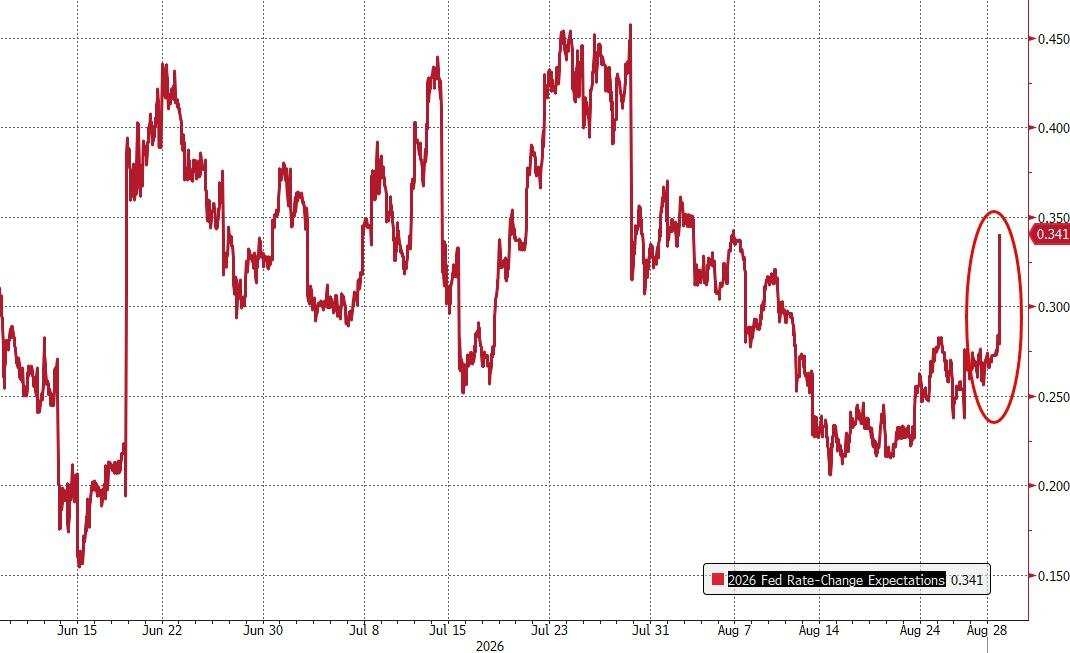
The probability priced by the futures market for a September Fed rate hike rises above 50%.
The reason the market is again pricing in a rate hike is not because Waller explicitly announced a “September rate hike,” but because for the first time as Fed chair he laid out his policy-response standards in a systematic way: the 2% inflation target is a “firm, fixed” goal; recent inflation data are not yet enough to prove that the underlying trend has clearly improved; and U.S. financial conditions are also not tightening. Under this policy framework, if inflation continues to run above target, rate hikes naturally become a realistic option again.
“We still have work to do,” and the market is again pricing in a September rate hike
What the market was most focused on in Waller's remarks was the following passage:
“We have to be confident that underlying inflation is moving in the direction of our goal—and moving clearly and fast enough. Otherwise, we still have work to do.”
Waller did not directly define “we still have work to do” as “we need to raise rates,” but the market clearly interpreted it as leaving open the possibility of keeping policy tightening.
Bloomberg market data shows that after Waller's remarks, the SOFR futures implied yield rose by as much as about 6.5 basis points at one point compared with before his speech. Traders recalibrated to prepare for a 25-basis-point rate hike once within the year, and began to lean toward betting that there could be two rate hikes by March 2027.
And the change in the probability of a rate hike at the September meeting is the most pronounced.
Reuters reports that after Waller’s remarks, market bets on a September rate hike heated up noticeably, with the relevant probability rising from about 35% before the speech to about 50%. It climbed as high as about 55% during the session, and subsequent Reuters-reported market data showed that the probability had at one point reached about 60%. This means that the market’s view on the September 16 meeting has shifted quickly from “a clearly low likelihood of a rate hike” to at least a “roughly 50-50” call.
At the same time, another set of Reuters market data shown during the trading session indicates that the probability of a September rate hike once rose to 55.7%. There are differences in quotes at different points in time, but they all point in the same direction: Waller's remarks significantly increased the market’s bets on a September rate hike.
The market is simultaneously betting on two rate hikes before March 2027
Market changes are not limited to the September meeting.
Bloomberg data shows that traders are not only resetting expectations for a 25-basis-point rate hike once within the year, but are also beginning to lean toward betting that there could be two rate hikes by March 2027.
In other words, Waller’s remarks changed not only expectations for whether the next meeting will raise rates, but to a certain extent also changed the market’s view of the policy path across several future FOMC meetings.
This change is closely related to Waller's assessment of the economy in these remarks.
Waller thinks the U.S. economy still has strong resilience: business capital expenditure growth is robust, business profits are growing by about 20%, consumption growth is close to 3%, the unemployment rate is about 4.1%, and initial jobless claims are also at a relatively low level.
At the same time, he said:
“It’s hard for me to describe the overall financial conditions as having a limiting effect.”
If inflation remains above target and there is no clear economic slowdown and no clear tightening in the financial environment, then the market would naturally assume that the Fed has room to raise rates further.
Waller did not make a “September rate hike” commitment; he emphasized “discipline” rather than specific decisions
However, it is worth noting that the market re-pricing a rate hike does not mean that Waller has clearly committed to a September rate hike.
On the contrary, one of the standout features of Waller's remarks this time is that he opposes traditional forward guidance in the usual sense.
He said:
“A quieter Federal Reserve with more targeted communication can achieve its objectives more effectively.”
Waller believes the Federal Reserve should not let the market rely too heavily on its descriptions of the future policy path, nor should it issue a mechanized policy reaction function.
At the end of his remarks, Waller further said he is “committed to following a discipline, rather than (pre-committing to) a particular decision.”
This means that, in practice, Waller is telling the market: he can state clear policy principles, but he will not tell the market in advance whether the next meeting will raise rates or keep rates unchanged.
Therefore, whether the September meeting ultimately includes a rate hike will still depend on the inflation and employment data released over the coming weeks.
Future data will be key to the September meeting
Waller's remarks gave the market a clearer policy “discipline,” but did not provide a concrete policy “answer.”
At the moment, what the market truly needs to focus on is whether the inflation data to be released will make the “underlying inflation” Waller referred to show a clear and sufficiently fast trend back toward the 2% target.
If the data continue to show that inflation is sticky, then the remarks have already left enough room for further rate hikes; conversely, if inflation cools meaningfully in the future, bets on a September rate hike could quickly fade.
Therefore, the most important impact of this Jackson Hole speech is not that Waller “announced” a September rate hike, but that he put rate hikes back into the market’s baseline scenario discussion.
As of now, the market has quickly moved from about a 35% probability for a September rate hike before the speech to around 50% or even higher, and has begun to bet that two rate hikes could occur in the coming months. In other words, Waller did not provide a clear interest-rate path, yet he succeeded in getting the market to start pricing in “higher rates” again.
