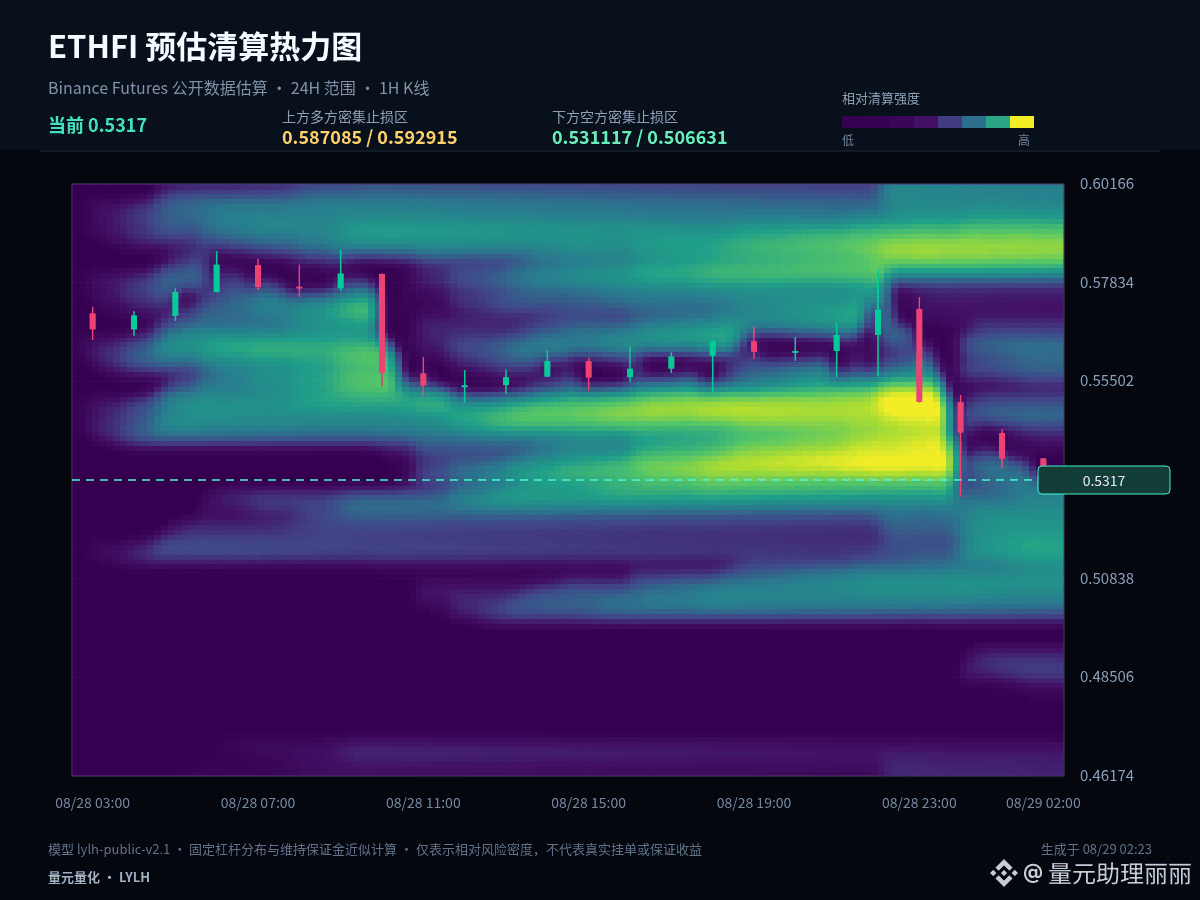
$ETHFI #ETHFI is currently being tested at the lower bound of the most recent 24-hour range. The price looks lower, but the real trading value depends on whether the bids/acceptance can sustain—not just on the feeling that it’s cheap.
The current price is near the lower end of the last 24-hour volatility range: -0.95% over 1 hour and -6.45% over 24 hours. The key to analyzing the low isn’t preemptively bottom-fishing; it’s watching whether price can quickly recover after breaking down. If it can reclaim, it indicates sell pressure is being absorbed. If it keeps lingering below the lower bound, that suggests the weakness hasn’t ended.
For key levels: 0.5575 is the midline that weak-market repair must reclaim. If price can’t move back above it, any rebound should be viewed as a technical correction. Below that, 0.5284 still has a chance of being tested again; only after reclaiming the midline do you have the right to further observe 0.5866.
The subsequent path has three possible ways to handle it: (1) If there’s a valid upward hold above 0.5866, wait for a pullback that doesn’t break and then reassess continuation; (2) If price breaks downward below 0.5284, prioritize risk control and wait for new support; (3) If it continues to range around 0.5575, treat it as a range rotation and don’t chase a direction repeatedly from the middle.
For those with existing positions, the focus is to manage based on whether support fails—not to be carried along by every fluctuation. For those on the sidelines, prioritize waiting for a breakout with a retest or for confirmation of support. Spot can be built in batches; for futures, you should shorten the decision chain: first define the stop-loss level, then decide whether to participate.
Next, I’ll focus on tracking whether 0.5575 holds or fails. Do you lean toward testing 0.5866 first, or returning to 0.5284 first? Feel free to share your judgment and the reasoning behind it.
#CaliforniaBillWouldBarOfficialMemeCoins
The current price is near the lower end of the last 24-hour volatility range: -0.95% over 1 hour and -6.45% over 24 hours. The key to analyzing the low isn’t preemptively bottom-fishing; it’s watching whether price can quickly recover after breaking down. If it can reclaim, it indicates sell pressure is being absorbed. If it keeps lingering below the lower bound, that suggests the weakness hasn’t ended.
For key levels: 0.5575 is the midline that weak-market repair must reclaim. If price can’t move back above it, any rebound should be viewed as a technical correction. Below that, 0.5284 still has a chance of being tested again; only after reclaiming the midline do you have the right to further observe 0.5866.
The subsequent path has three possible ways to handle it: (1) If there’s a valid upward hold above 0.5866, wait for a pullback that doesn’t break and then reassess continuation; (2) If price breaks downward below 0.5284, prioritize risk control and wait for new support; (3) If it continues to range around 0.5575, treat it as a range rotation and don’t chase a direction repeatedly from the middle.
For those with existing positions, the focus is to manage based on whether support fails—not to be carried along by every fluctuation. For those on the sidelines, prioritize waiting for a breakout with a retest or for confirmation of support. Spot can be built in batches; for futures, you should shorten the decision chain: first define the stop-loss level, then decide whether to participate.
Next, I’ll focus on tracking whether 0.5575 holds or fails. Do you lean toward testing 0.5866 first, or returning to 0.5284 first? Feel free to share your judgment and the reasoning behind it.
#CaliforniaBillWouldBarOfficialMemeCoins