
Mr Max
465 Posts

Mr Max
🔹I am Max 🔹 Spot Trader 🔹X:- Max_786m🔹 Airdrop & Campaign Hunter 🔹Coin Analyst 🔹5 Years Experience in Online Field
High-Frequency Trader
7.8 Months
470 Following
17.8K+ Followers
3.6K+ Liked
Posts
All
Live
PINNED
🎁 Claim your Gift 🎁
🧧🧧🧧🧧🧧
🧧🧧🧧🧧🧧
Join chat Group for Daily 🧧....
Hint:- { 786 }...................
$SNDK $BTC $ETH
#ETH🔥🔥🔥🔥🔥🔥 #SNDKUSDT #BTC走势分析 #HEMI #CaliforniaBillWouldBarOfficialMemeCoins
🧧🧧🧧🧧🧧
🧧🧧🧧🧧🧧
Join chat Group for Daily 🧧....
Hint:- { 786 }...................
$SNDK $BTC $ETH
#ETH🔥🔥🔥🔥🔥🔥 #SNDKUSDT #BTC走势分析 #HEMI #CaliforniaBillWouldBarOfficialMemeCoins

🎁 Claim Your Gift 🎁
🧧🧧🧧🧧🧧
🧧🧧🧧🧧🧧
Join chat group for Daliy 🧧....
Hint : { yes } .....................
$SNDKB $SOL $SHIB
#SNDK #SNDK前有七巨头 #CaliforniaBillWouldBarOfficialMemeCoins #GoldRisesAbout14%InAugust #USCorporateProfitsHitRecordHigh
🧧🧧🧧🧧🧧
🧧🧧🧧🧧🧧
Join chat group for Daliy 🧧....
Hint : { yes } .....................
$SNDKB $SOL $SHIB
#SNDK #SNDK前有七巨头 #CaliforniaBillWouldBarOfficialMemeCoins #GoldRisesAbout14%InAugust #USCorporateProfitsHitRecordHigh

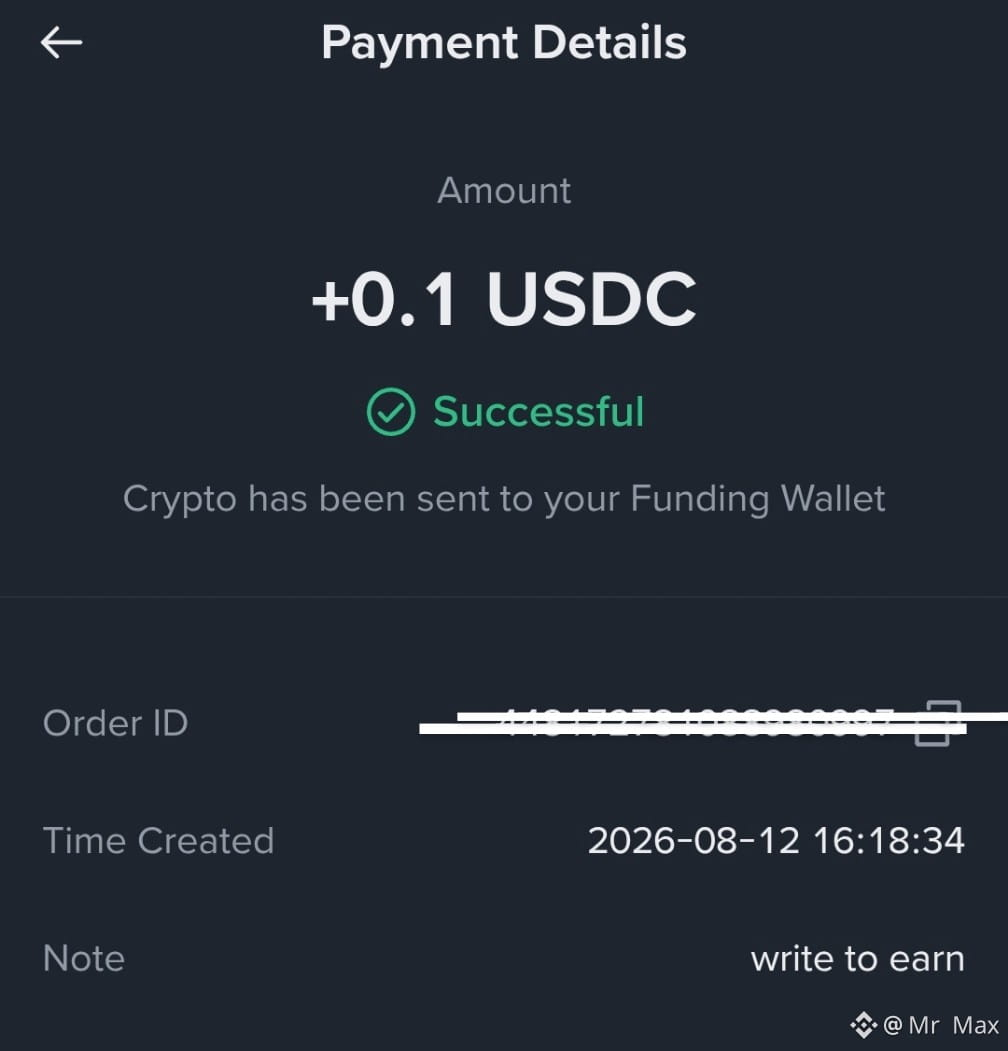
Wednesday is the payout day from the Binance square
Now accidentally i open my notification page & my past week payment received from the Write ✍🏻 to Earn from Binance Square
You should also write on Binance square but your content should be original
$BTC
$USDC
Now accidentally i open my notification page & my past week payment received from the Write ✍🏻 to Earn from Binance Square
You should also write on Binance square but your content should be original
$BTC
$USDC

Verified
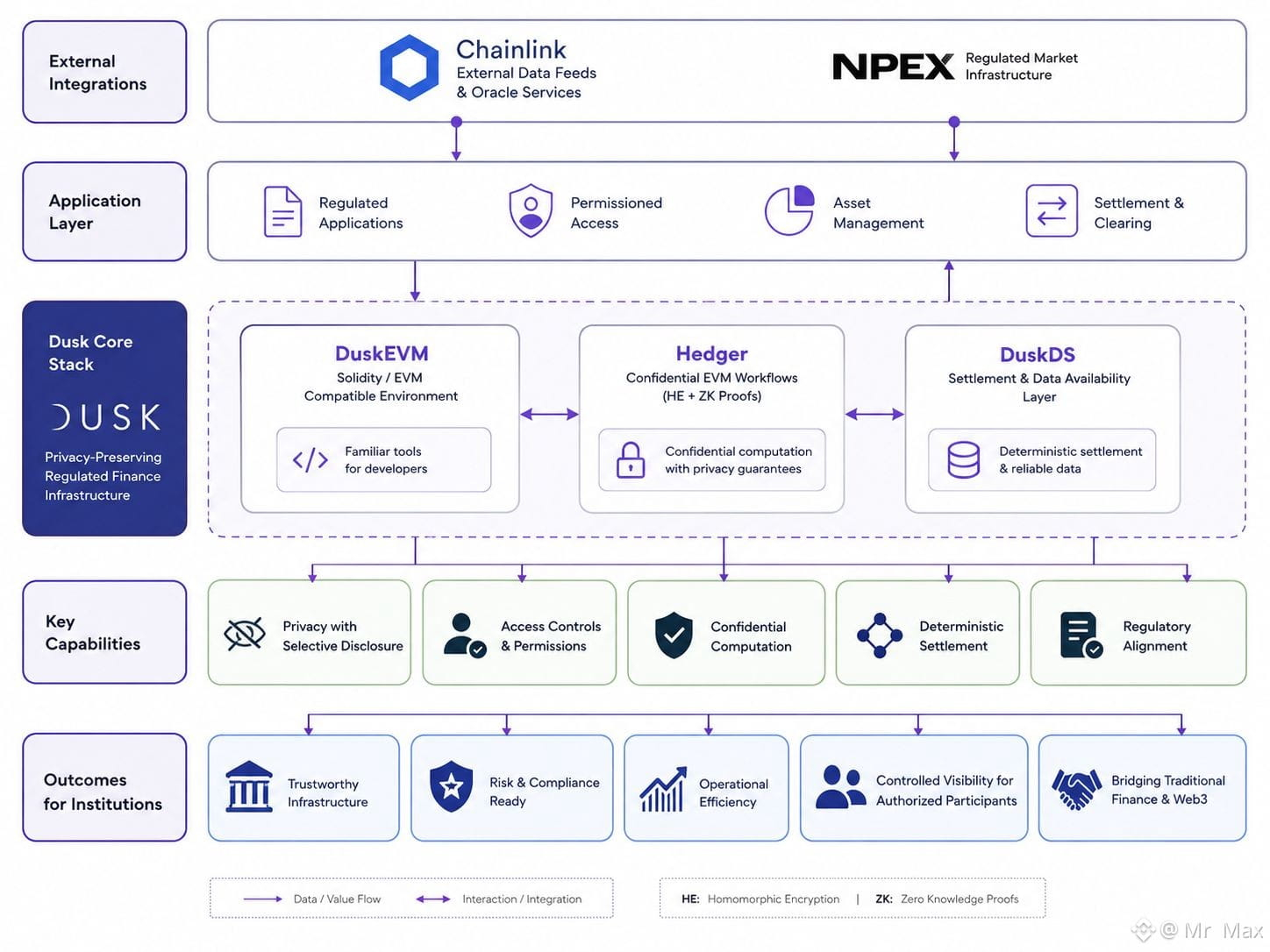
#dusk $DUSK @Dusk I still think the interesting part of @Dusk isn’t the cryptography alone. I went down the DuskEVM/Hedger rabbit hole, then started looking at how those pieces fit the regulated finance story and that’s where I noticed the real tension.
DuskEVM gives builders a familiar Solidity/EVM environment, while Hedger is designed for confidential EVM workflows using homomorphic encryption and zero knowledge proofs. DuskDS provides the settlement and data availability foundation.
But Dusk isn’t treating privacy as simple transaction invisibility. The goal is privacy alongside selective disclosure, access controls and deterministic settlement.
That matters when the assets being moved are regulated. Dusk’s work with NPEX points toward regulated market infrastructure, while its work with Chainlink connects Dusk to external data infrastructure. Suddenly, confidentiality alone isn’t enough authorized participants still need visibility, permissions and reliable settlement.
So I keep coming back to this when all of these have to coexist, which part of the stack will institutions ultimately trust most?
DuskEVM gives builders a familiar Solidity/EVM environment, while Hedger is designed for confidential EVM workflows using homomorphic encryption and zero knowledge proofs. DuskDS provides the settlement and data availability foundation.
But Dusk isn’t treating privacy as simple transaction invisibility. The goal is privacy alongside selective disclosure, access controls and deterministic settlement.
That matters when the assets being moved are regulated. Dusk’s work with NPEX points toward regulated market infrastructure, while its work with Chainlink connects Dusk to external data infrastructure. Suddenly, confidentiality alone isn’t enough authorized participants still need visibility, permissions and reliable settlement.
So I keep coming back to this when all of these have to coexist, which part of the stack will institutions ultimately trust most?

🎁 Claim your Gift 🎁
🧧🧧🧧🧧🧧
🧧🧧🧧🧧🧧
Join chat Group for Daily 🧧....
Hint:- { 786 }...................
$SNDK $XRP $SOL
#BitcoinOpenInterestFallsToTwoMonthLow
#SP500FuturesFall
#BrentDrops1.87%
#SamsungFalls8.97%DraggingKospiDown3.24%
#AIHardwareStocksFallPreMarketAAOIDown11.66%
🧧🧧🧧🧧🧧
🧧🧧🧧🧧🧧
Join chat Group for Daily 🧧....
Hint:- { 786 }...................
$SNDK $XRP $SOL
#BitcoinOpenInterestFallsToTwoMonthLow
#SP500FuturesFall
#BrentDrops1.87%
#SamsungFalls8.97%DraggingKospiDown3.24%
#AIHardwareStocksFallPreMarketAAOIDown11.66%

30D trade $DUSK 5.1K USDT
The more I look at @Dusk ’s neobroker setup, the more I notice a risk that sits outside the blockchain itself.
The idea of bringing regulated assets on-chain is interesting, but the underlying assets can still depend on real-world brokers, custodians, and other intermediaries.
That matters because Dusk can make the on-chain side work smoothly while problems elsewhere still affect the user. If one custody partner faces operational issues, financial stress, or restrictions, accessing the underlying asset may become much harder than the blockchain experience suggests.
This is the part I think deserves more attention. Tokenization can improve how assets are represented and settled, but it doesn’t make counterparty risk disappear. The blockchain can be running perfectly while the real bottleneck sits somewhere off-chain.
For Dusk, I’m more interested in how this whole structure behaves under pressure.
Who holds the assets, how access is maintained, and how quickly problems can be resolved are just as important as the technology itself. The RWA story is exciting, but the plumbing underneath it matters more than the headline.
#dusk $DUSK @Dusk
The idea of bringing regulated assets on-chain is interesting, but the underlying assets can still depend on real-world brokers, custodians, and other intermediaries.
That matters because Dusk can make the on-chain side work smoothly while problems elsewhere still affect the user. If one custody partner faces operational issues, financial stress, or restrictions, accessing the underlying asset may become much harder than the blockchain experience suggests.
This is the part I think deserves more attention. Tokenization can improve how assets are represented and settled, but it doesn’t make counterparty risk disappear. The blockchain can be running perfectly while the real bottleneck sits somewhere off-chain.
For Dusk, I’m more interested in how this whole structure behaves under pressure.
Who holds the assets, how access is maintained, and how quickly problems can be resolved are just as important as the technology itself. The RWA story is exciting, but the plumbing underneath it matters more than the headline.
#dusk $DUSK @Dusk
·
--
🎙️ Dusk Volume Campaign Reward Dusk Market Analysis
End
01 h 14 m 57 s
179
DUSKUSDT
Perp
Limit/Long
0

I keep coming back to @TermMax because the gap between the story and the numbers is hard to ignore.
The marketing makes TermMax sound like institutional fixed income infrastructure already finding its place on Wall Street.
The actual numbers tell a quieter story.
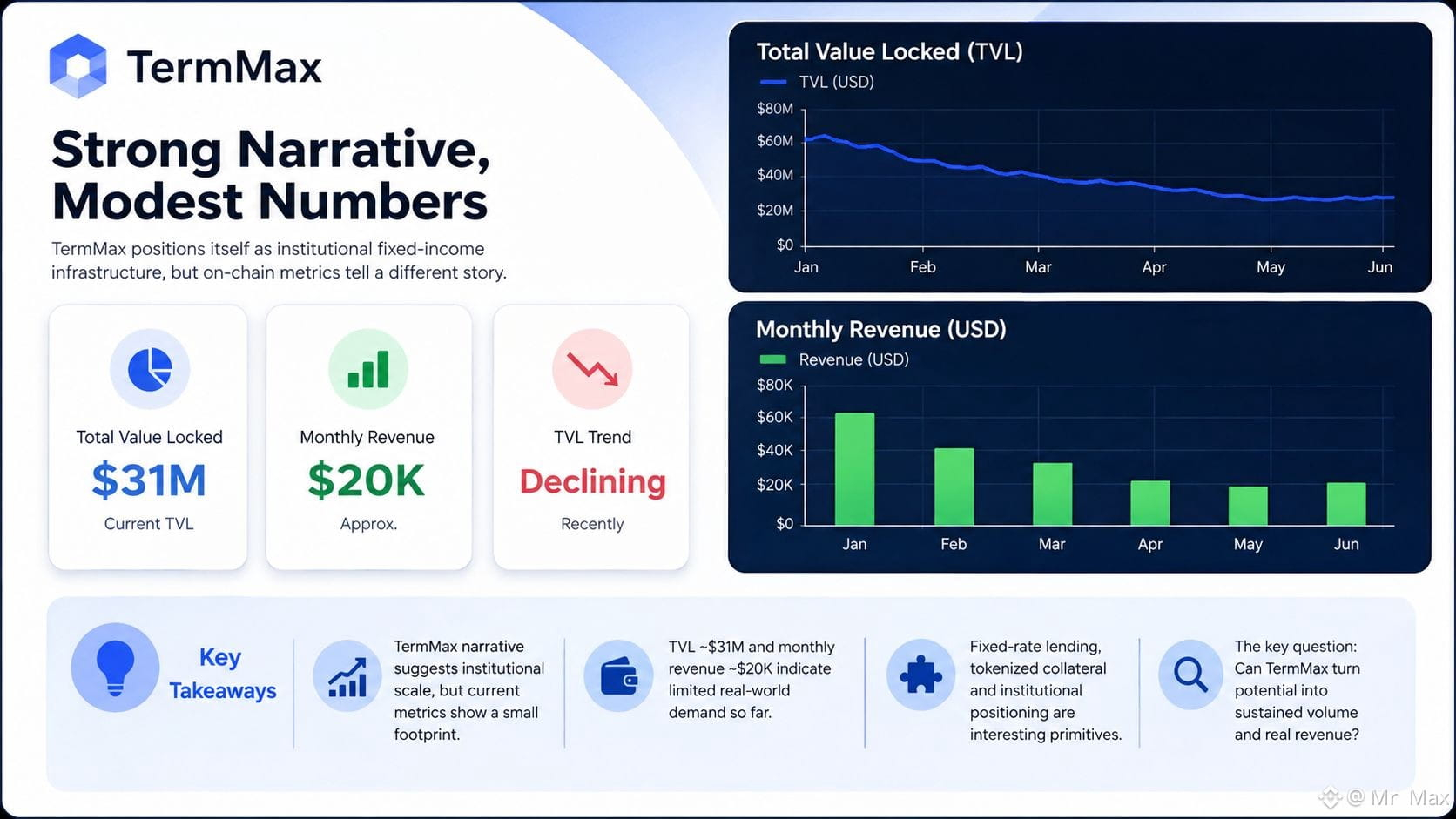
TVL is around $31M, monthly revenue is only around $20K, and TVL has been trending lower recently. That’s still a small footprint compared with the lending protocols that dominate the market.
None of this means the product is bad. I actually think the fixed rate lending idea is one of the more interesting parts of the thesis.
But there’s a difference between having a good financial primitive and having enough demand to make that primitive economically meaningful.
That’s the part I’m watching.
Can TermMax turn tokenized collateral, fixed rate borrowing and institutional positioning into sustained volume and real revenue?
For now, I’m less interested in the announcements and more interested in whether the numbers start catching up with the narrative.
The product may have potential. The numbers just haven’t proved the story yet.
#termmax @TermMax
$BTW
$SNDK
$ETH
The marketing makes TermMax sound like institutional fixed income infrastructure already finding its place on Wall Street.
The actual numbers tell a quieter story.
TVL is around $31M, monthly revenue is only around $20K, and TVL has been trending lower recently. That’s still a small footprint compared with the lending protocols that dominate the market.
None of this means the product is bad. I actually think the fixed rate lending idea is one of the more interesting parts of the thesis.
But there’s a difference between having a good financial primitive and having enough demand to make that primitive economically meaningful.
That’s the part I’m watching.
Can TermMax turn tokenized collateral, fixed rate borrowing and institutional positioning into sustained volume and real revenue?
For now, I’m less interested in the announcements and more interested in whether the numbers start catching up with the narrative.
The product may have potential. The numbers just haven’t proved the story yet.
#termmax @TermMax
$BTW
$SNDK
$ETH
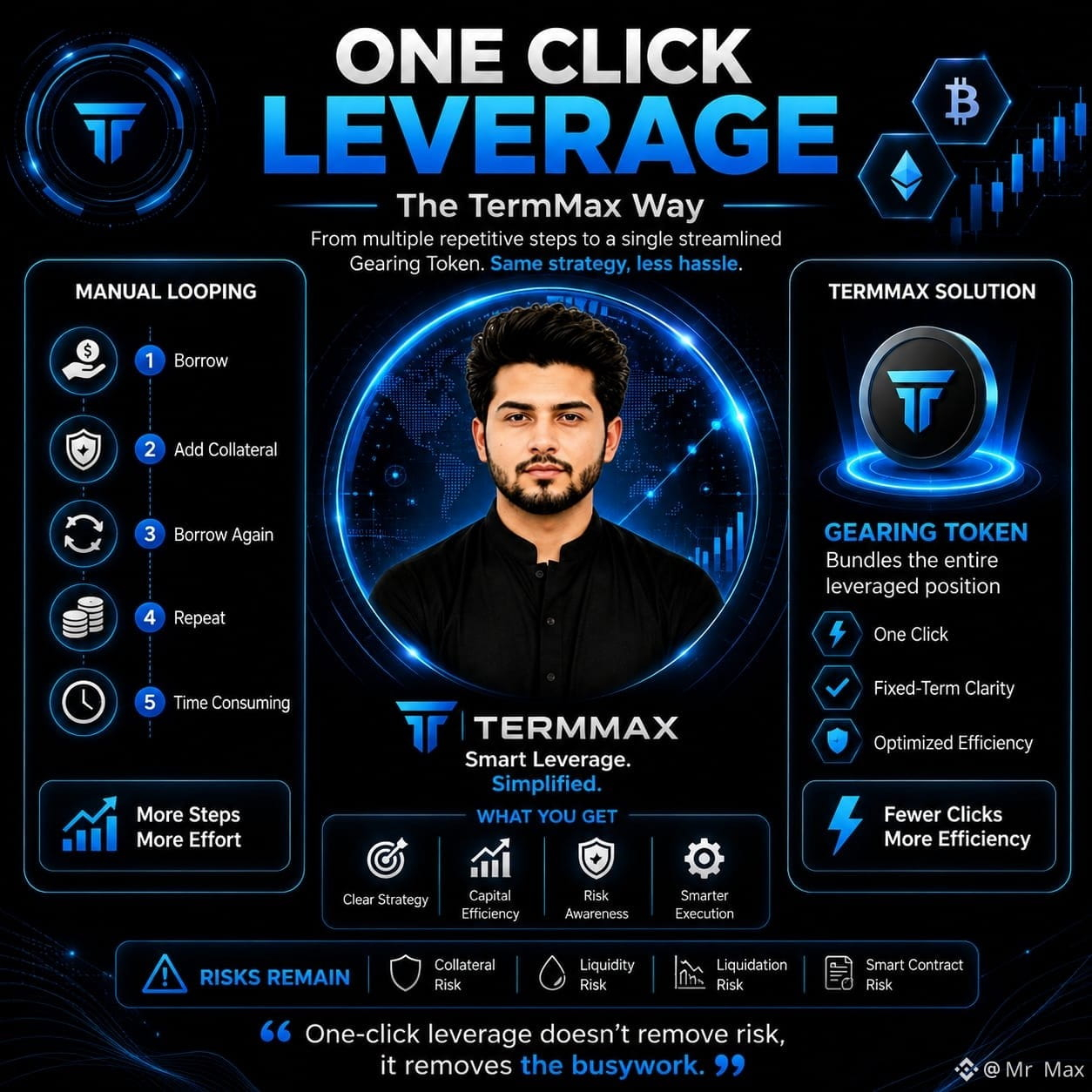
I’ve been noticing how much unnecessary work can sit behind a simple leverage strategy, and that’s what made TermMax interesting to me.
With manual looping, you borrow, add collateral, borrow again, and repeat. On paper it looks straightforward, but doing it several times can become tedious surprisingly quickly.
That’s where it gets interesting.
TermMax uses Gearing Tokens to bundle the leveraged position, instead of asking users to handle every borrowing and redepositing step themselves.
It reminds me of combining several small errands into one trip. You are not changing the destination; you are just cutting out some of the back-and-forth.
What I find more interesting is the capital side. Fixed-term borrowing can give the strategy a clearer financing structure than repeatedly dealing with changing borrowing rates.
But fewer clicks do not mean fewer risks.
Collateral, liquidity, maturity, liquidation conditions, and smart-contract risk still matter underneath the simpler experience.
That trade-off is easy to overlook.
Experienced users may appreciate the reduced operational work, while newer users might mistake convenience for safety.
So I keep asking myself: does one-click leverage really improve capital efficiency, or does it simply make a complicated strategy easier to use? @TermMax #termmax
$BTC
$ETH
$SOL
With manual looping, you borrow, add collateral, borrow again, and repeat. On paper it looks straightforward, but doing it several times can become tedious surprisingly quickly.
That’s where it gets interesting.
TermMax uses Gearing Tokens to bundle the leveraged position, instead of asking users to handle every borrowing and redepositing step themselves.
It reminds me of combining several small errands into one trip. You are not changing the destination; you are just cutting out some of the back-and-forth.
What I find more interesting is the capital side. Fixed-term borrowing can give the strategy a clearer financing structure than repeatedly dealing with changing borrowing rates.
But fewer clicks do not mean fewer risks.
Collateral, liquidity, maturity, liquidation conditions, and smart-contract risk still matter underneath the simpler experience.
That trade-off is easy to overlook.
Experienced users may appreciate the reduced operational work, while newer users might mistake convenience for safety.
So I keep asking myself: does one-click leverage really improve capital efficiency, or does it simply make a complicated strategy easier to use? @TermMax #termmax
$BTC
$ETH
$SOL
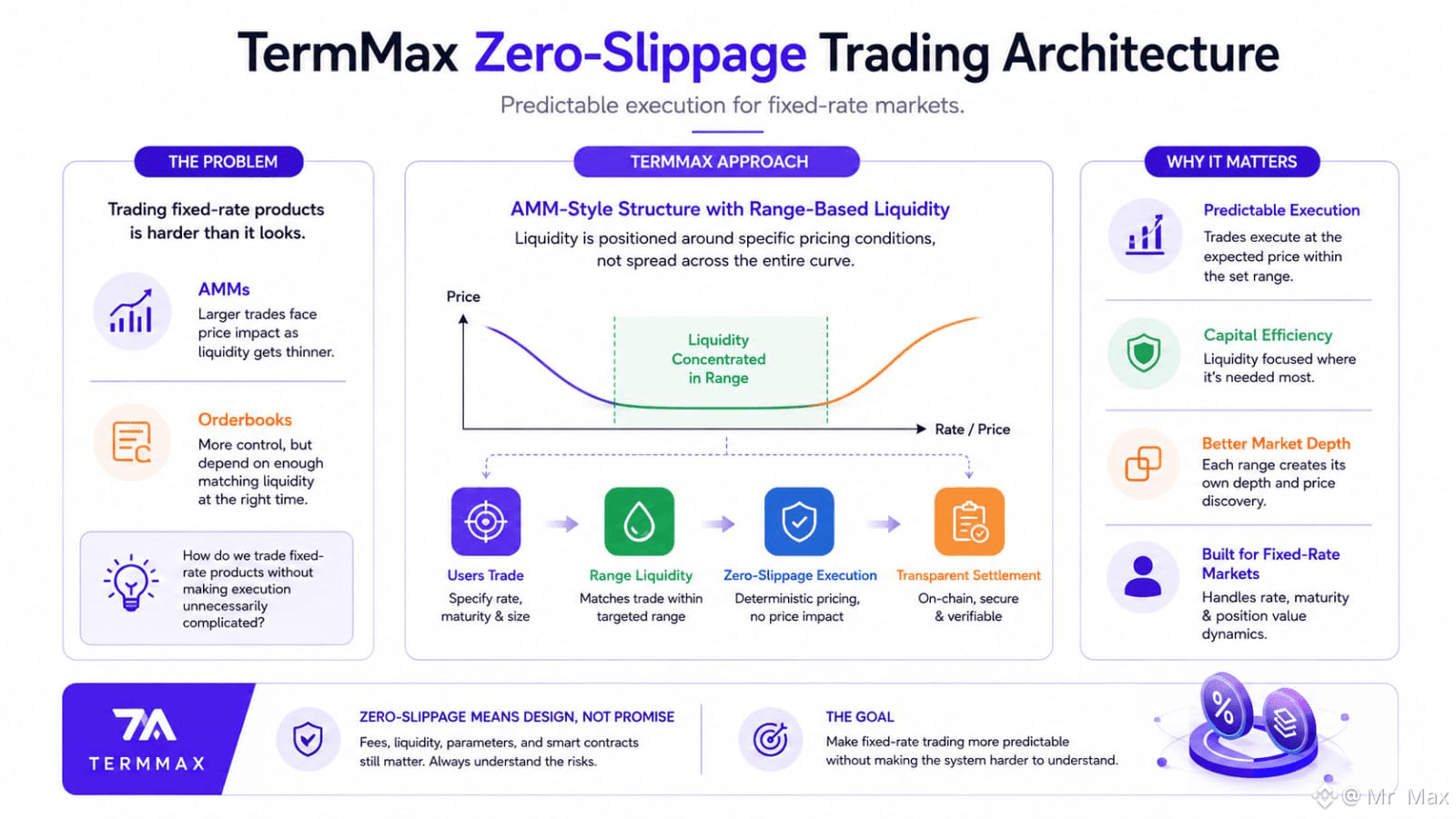
I’ve been looking at @TermMax ’s zero-slippage trading architecture, and the part that interests me most is the problem behind it: how do you trade fixed-rate products without making execution unnecessarily complicated?
Traditional AMMs are simple, but larger trades can face price impact as liquidity gets thinner. Orderbooks offer more control, yet they depend on enough matching liquidity being available at the right time.
TermMax takes a different route, using an AMM-style structure with range-based liquidity. Instead of spreading liquidity across the entire curve, liquidity can be positioned around specific pricing conditions.
That detail is easy to miss.
For fixed-term markets, the challenge is bigger than simply exchanging two assets. Rate, maturity, and the changing value of a position all matter, so the trading mechanism has to account for more than a normal spot swap. #TermMax
I also think “zero-slippage” needs context. It describes the mechanism’s design, not a guarantee of zero fees, execution risk, or smart-contract risk. Liquidity, parameters, and market conditions still matter.
That’s what makes TermMax interesting to me. If its architecture can make fixed-rate trading more predictable without making the system harder to understand, it could address one of the less obvious problems in on-chain fixed income. #termmax
Traditional AMMs are simple, but larger trades can face price impact as liquidity gets thinner. Orderbooks offer more control, yet they depend on enough matching liquidity being available at the right time.
TermMax takes a different route, using an AMM-style structure with range-based liquidity. Instead of spreading liquidity across the entire curve, liquidity can be positioned around specific pricing conditions.
That detail is easy to miss.
For fixed-term markets, the challenge is bigger than simply exchanging two assets. Rate, maturity, and the changing value of a position all matter, so the trading mechanism has to account for more than a normal spot swap. #TermMax
I also think “zero-slippage” needs context. It describes the mechanism’s design, not a guarantee of zero fees, execution risk, or smart-contract risk. Liquidity, parameters, and market conditions still matter.
That’s what makes TermMax interesting to me. If its architecture can make fixed-rate trading more predictable without making the system harder to understand, it could address one of the less obvious problems in on-chain fixed income. #termmax
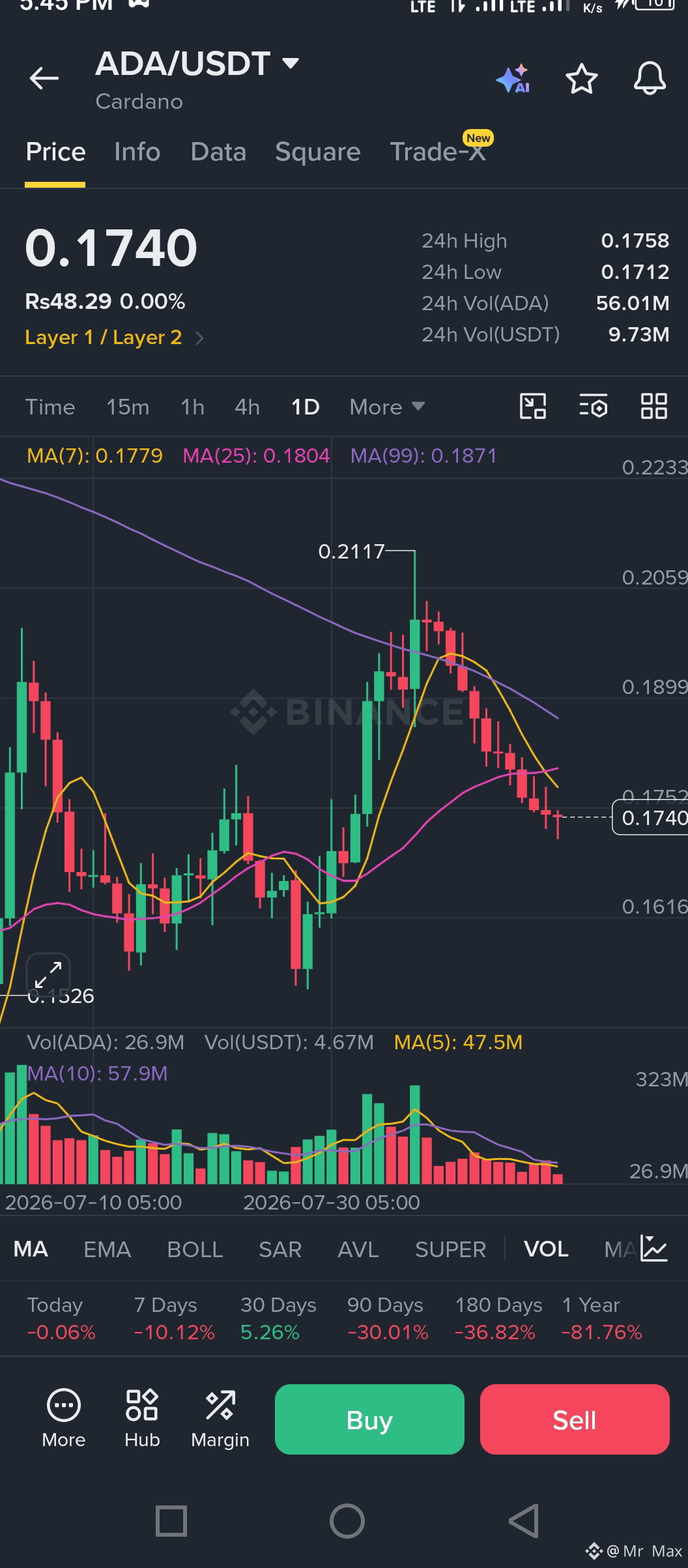
This is one of the strongest long-term plays right now.
Add ADA to your portfolio today.
Tomorrow you will thank me for this call.
Current Price:
ADA → $0.178
Cardano is research-driven and peer-reviewed from day one.
It runs on Ouroboros, the first provably secure Proof-of-Stake protocol.
Extended UTXO model + native assets make it highly secure and efficient.
Formal methods and Haskell deliver high-assurance code that few chains can match.
Strong focus on sustainability, scalability and true on-chain governance.
This is a solid entry zone for ADA. DYOR
Add ADA to your portfolio today.
Tomorrow you will thank me for this call.
Current Price:
ADA → $0.178
Cardano is research-driven and peer-reviewed from day one.
It runs on Ouroboros, the first provably secure Proof-of-Stake protocol.
Extended UTXO model + native assets make it highly secure and efficient.
Formal methods and Haskell deliver high-assurance code that few chains can match.
Strong focus on sustainability, scalability and true on-chain governance.
This is a solid entry zone for ADA. DYOR
This is a pure finance-focused powerhouse.
Add INJ to your portfolio today.
Tomorrow you will thank me for this call.
Current Price:
INJ → $4.18
Injective is a Layer-1 built specifically for finance.
It features a fully on-chain orderbook with shared liquidity across all apps.
MEV-resistant Frequent Batch Auctions protect traders.
Sub-second finality, MultiVM (WASM + EVM) and extremely low fees.
Add INJ to your portfolio today.
Tomorrow you will thank me for this call.
Current Price:
INJ → $4.18
Injective is a Layer-1 built specifically for finance.
It features a fully on-chain orderbook with shared liquidity across all apps.
MEV-resistant Frequent Batch Auctions protect traders.
Sub-second finality, MultiVM (WASM + EVM) and extremely low fees.



Log in to explore more content