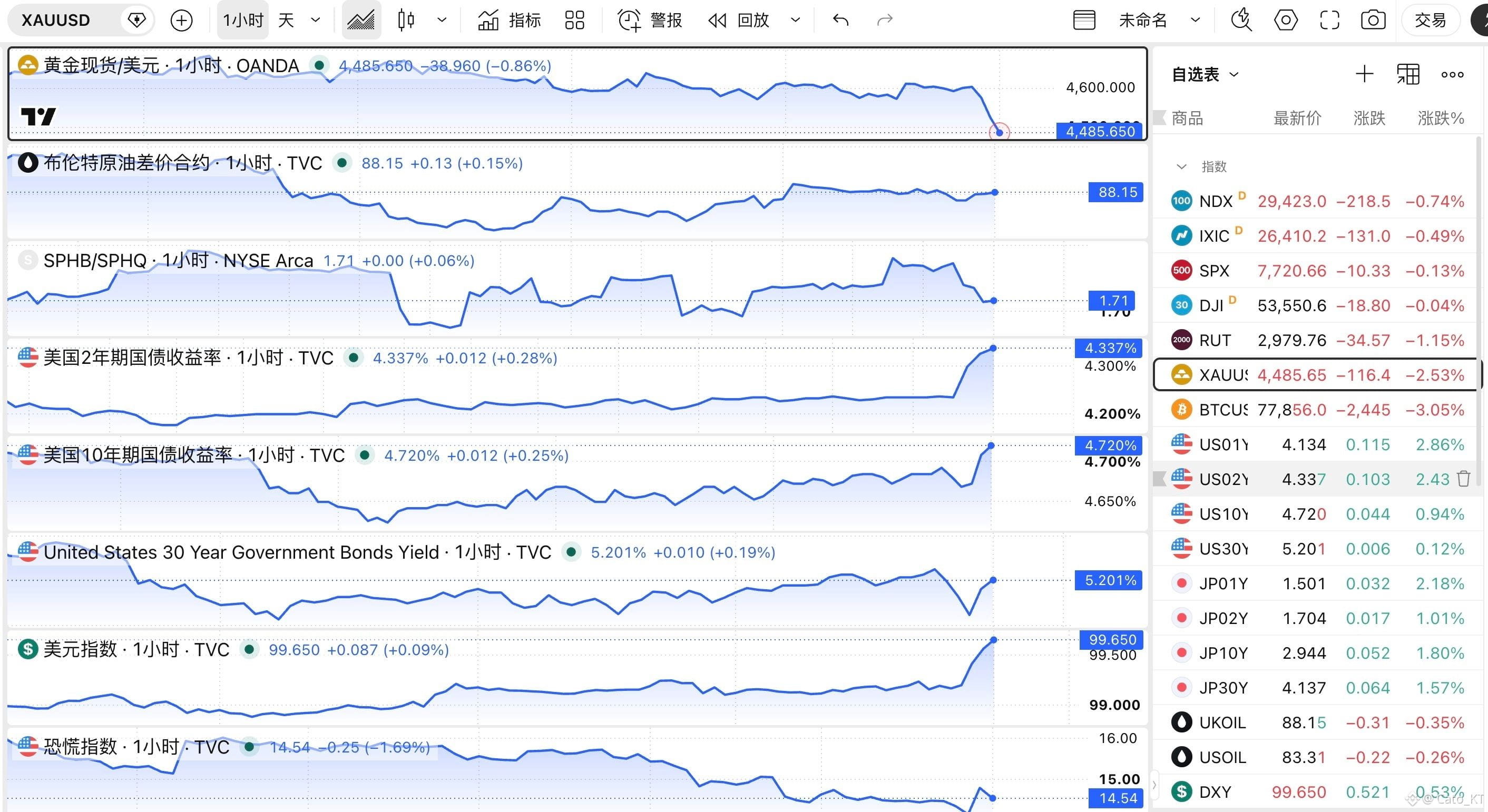
Tonight, there is an interesting development in the U.S. Treasury market. After Waller’s remarks, the 2-year yield first surged, followed by the 10-year yield. Meanwhile, the increase in yields on 30-year Treasuries was slower compared with the 2-year and 10-year.
Clearly, the slowdown in long-end Treasury yields is mainly driven by two factors: one is Bessent’s September 9 long-dated repo operations, and the other is recent economic data combined with weaker crude oil prices, which have led to a cooling in expectations for future inflation.
Obviously, concerns about short- and medium-term inflation still remain in the market. However, long-term inflation pressure appears to be easing, because current economic data supports the expectation that inflation growth will weaken.
The rise in rate-hike expectations is still very evident in how it suppresses risk assets and risk appetite for U.S. stocks. But there is one upside: it has caused gold prices to drop quickly. If gold can return to the 4000–4100 range, then over the next three months it would be a very solid asset allocation candidate.
In my view, in the coming months, rate-hike expectations may once again become extreme. Also, if the August data once again confirms a deterioration in consumption, gold would be one of the very good assets to hedge against economic risks.#沃什称通胀是美联储首要关注
Clearly, the slowdown in long-end Treasury yields is mainly driven by two factors: one is Bessent’s September 9 long-dated repo operations, and the other is recent economic data combined with weaker crude oil prices, which have led to a cooling in expectations for future inflation.
Obviously, concerns about short- and medium-term inflation still remain in the market. However, long-term inflation pressure appears to be easing, because current economic data supports the expectation that inflation growth will weaken.
The rise in rate-hike expectations is still very evident in how it suppresses risk assets and risk appetite for U.S. stocks. But there is one upside: it has caused gold prices to drop quickly. If gold can return to the 4000–4100 range, then over the next three months it would be a very solid asset allocation candidate.
In my view, in the coming months, rate-hike expectations may once again become extreme. Also, if the August data once again confirms a deterioration in consumption, gold would be one of the very good assets to hedge against economic risks.#沃什称通胀是美联储首要关注