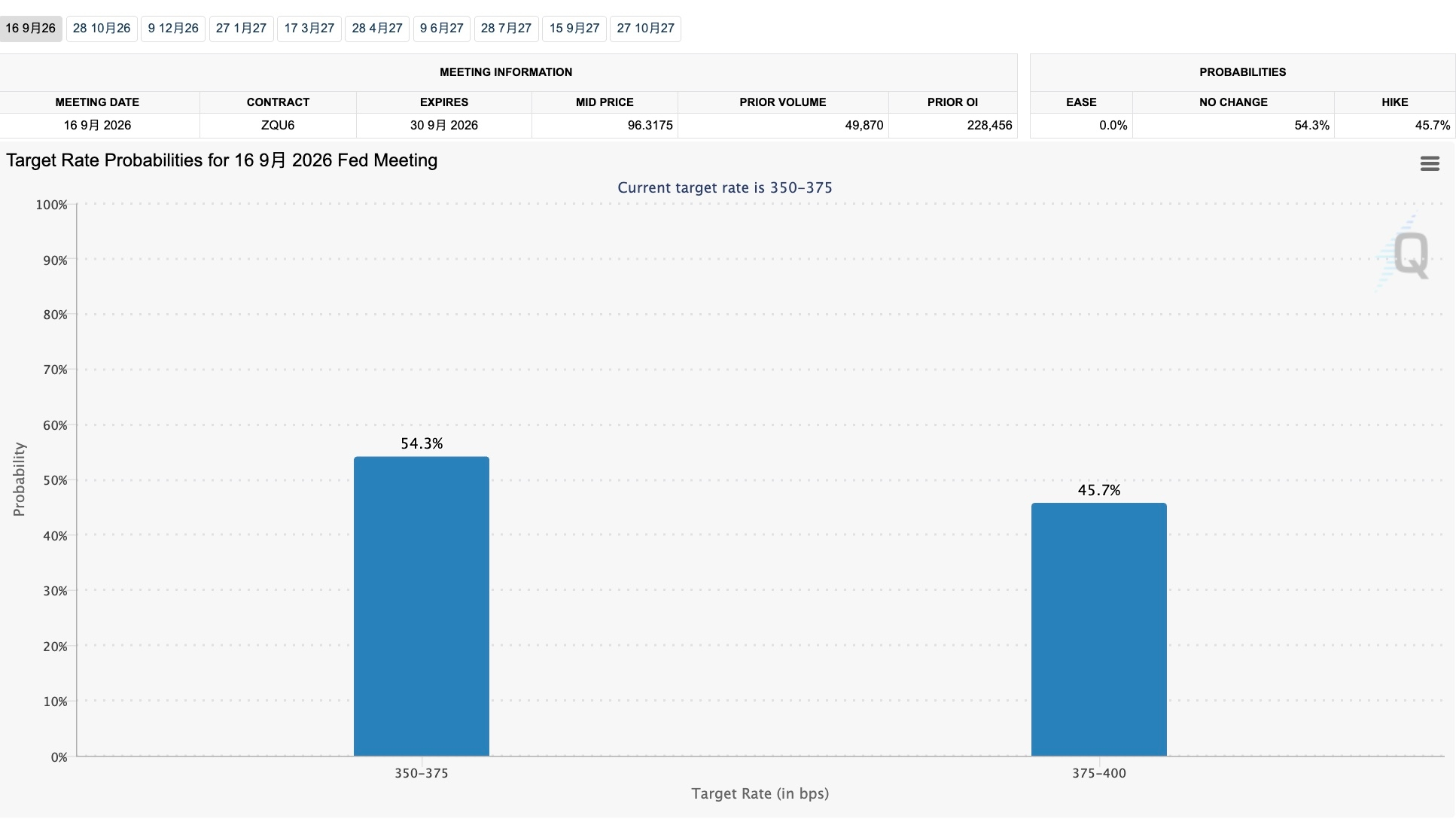
The worst-case interest rate outlook: before the Working Group of the Fed announces its first data, it will be very difficult—if not impossible—to see the arrival of rate cuts in the Warde era. The market’s biggest optimism is that the rate-hike expectations for all of 2026 will gradually weaken.
Key view: given the current U.S. financial conditions and economic situation, any further rate hikes would necessarily trigger an increased probability of an economic and financial risk. The Warde cannot afford that consequence. So delaying rate cuts is only to wait for new data, and to opportunistically change the current Fed’s data-anchoring structure.
Therefore, in my view, the most pessimistic scenario is that rate cuts in 2026 may not appear until December, unless on the way there the economic data provides a piece of evidence that Warde cannot refute.
For example, good data: the core PCE year-over-year rate falls below 3%, and CPI falls close to 3% or below 3%. For example, bad data: unemployment surges, and nonfarm payroll growth stays in the 10k–50k range. For example, GDP data weakens, consumption cools.
In simple terms, either inflation turns rapidly more optimistic, or the economy faces recession and stagflation risk. Otherwise, I believe the current data truly cannot change Warde’s position.
A decline in crude oil prices can indeed ease concerns about future inflation, but its influence on the weakening of core PCE is still insufficient. So, expectations for further rate hikes will be scaled back in September and October, and expectations for rate cuts will be increased in December. This may be the main monetary policy rhythm for the second half of the year.#黄金8月上涨约14%
Key view: given the current U.S. financial conditions and economic situation, any further rate hikes would necessarily trigger an increased probability of an economic and financial risk. The Warde cannot afford that consequence. So delaying rate cuts is only to wait for new data, and to opportunistically change the current Fed’s data-anchoring structure.
Therefore, in my view, the most pessimistic scenario is that rate cuts in 2026 may not appear until December, unless on the way there the economic data provides a piece of evidence that Warde cannot refute.
For example, good data: the core PCE year-over-year rate falls below 3%, and CPI falls close to 3% or below 3%. For example, bad data: unemployment surges, and nonfarm payroll growth stays in the 10k–50k range. For example, GDP data weakens, consumption cools.
In simple terms, either inflation turns rapidly more optimistic, or the economy faces recession and stagflation risk. Otherwise, I believe the current data truly cannot change Warde’s position.
A decline in crude oil prices can indeed ease concerns about future inflation, but its influence on the weakening of core PCE is still insufficient. So, expectations for further rate hikes will be scaled back in September and October, and expectations for rate cuts will be increased in December. This may be the main monetary policy rhythm for the second half of the year.#黄金8月上涨约14%