


Bitcoin has built a reputation for massive rallies, sudden corrections and unpredictable price swings. But one calendar month has repeatedly stood out for the wrong reason: September.
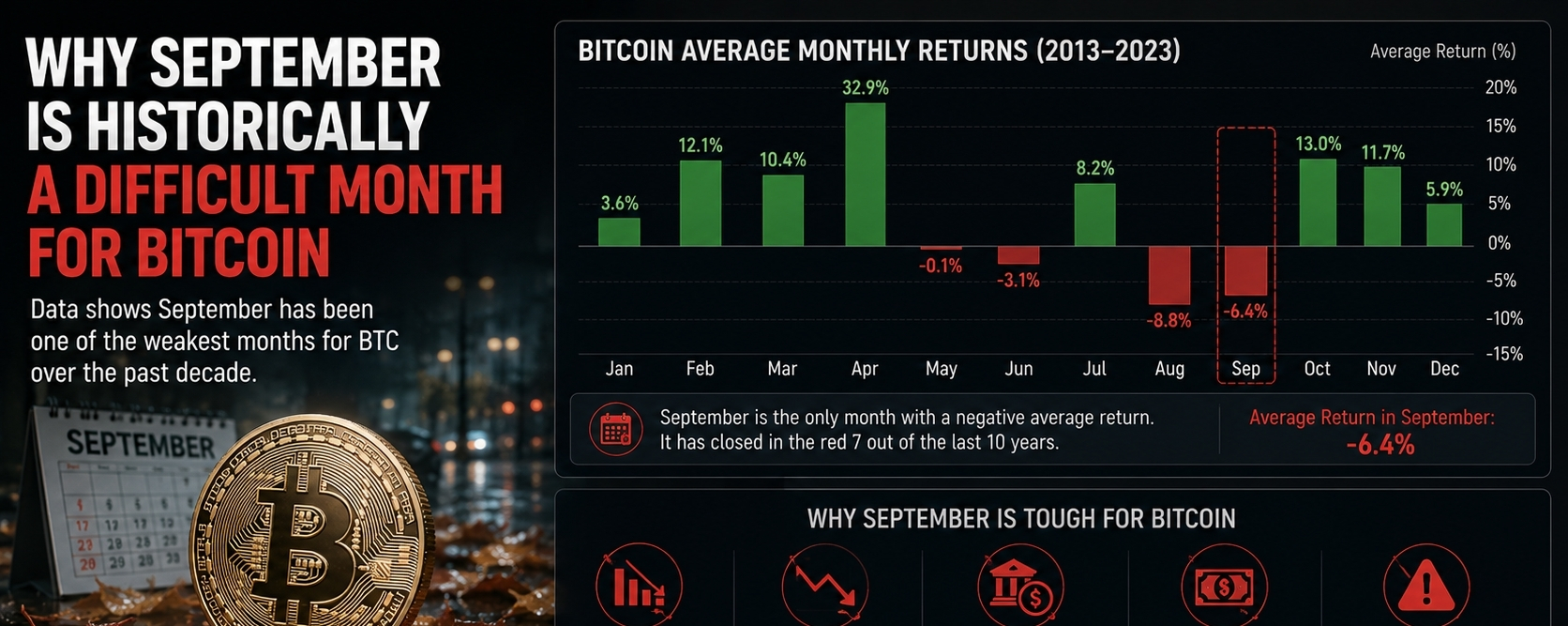
Historical data shows that September has generally been Bitcoin’s weakest month. With September 2026 approaching after a powerful August recovery, traders are once again asking whether history could repeat itself—or whether Bitcoin can finally break the pattern.
September Has a Bad Reputation
The numbers explain why September makes some investors cautious.
Long-term data covering Bitcoin’s trading history through 2026 puts its average September return at roughly -3.3%, the weakest average performance of any month.
Different datasets produce slightly different figures depending on the years included. For example, CoinDesk reported an average September decline of around 6% across a 12-year sample, with Bitcoin finishing September lower in eight of those 12 years.
The exact percentage therefore matters less than the broader pattern: September has historically been unusually difficult for Bitcoin.
Why Does Bitcoin Struggle in September?
There isn't one proven explanation.
Seasonality in financial markets can develop from several factors occurring at roughly the same time each year.
Research from NYDIG notes that trading activity and liquidity have historically weakened during the summer months, while major market catalysts can become less frequent. Bitcoin's seasonal performance has generally deteriorated through summer before reaching its weakest point around September.
Lower liquidity can matter greatly in crypto.
When fewer buyers and sellers are active, large orders can have a greater impact on price. That can contribute to sharper moves in either direction.
It's Not Just a Bitcoin Problem
Interestingly, September weakness isn't unique to crypto.
Traditional U.S. equities have also historically struggled during the month. Current Dow Jones Market Data cited by Barron's shows September as the weakest month historically for major U.S. stock indexes such as the S&P 500 and Dow.
This connection matters because Bitcoin increasingly trades alongside broader risk markets.
Institutional portfolio adjustments, changing liquidity conditions and uncertainty about the economy can therefore affect both traditional markets and crypto.
Macro Events Can Increase September Volatility
September is also often packed with economic developments.
Inflation reports, employment numbers and central-bank decisions can quickly change expectations about interest rates.
Higher-for-longer rates can make speculative assets less attractive because investors have more opportunities to earn returns from lower-risk assets.
More supportive monetary conditions can have the opposite effect.
That's why Bitcoin traders shouldn't focus only on historical monthly returns. The macroeconomic environment surrounding each September can be completely different.
Profit-Taking Can Add Pressure
Another possible factor is simple profit-taking.
When Bitcoin performs strongly before September, some investors may decide to lock in gains rather than continue holding through an uncertain period.
That possibility is particularly relevant in 2026.
Bitcoin has climbed more than 25% during August, meaning traders are entering September after a significant rebound.
Strong previous performance doesn't guarantee a correction, but it can create a larger pool of investors sitting on unrealized gains.
Bitcoin's Volatility Makes Everything Bigger
Bitcoin is naturally more volatile than many traditional financial assets.
A relatively small shift in market sentiment can therefore produce a much larger percentage move.
Fear can also become self-reinforcing.
If enough traders expect September to be bearish simply because previous Septembers were weak, some may reduce exposure before the month even begins.
That selling itself can temporarily add pressure.
This is one reason seasonality can sometimes influence markets even without a single fundamental cause.
But September Isn't Always Red
This is extremely important.
Historical averages describe what happened previously. They don't determine what happens next.
Bitcoin has produced positive Septembers before.
More importantly, the pattern has recently become less consistent. Bitcoin has closed September positively for the past three cycles, according to current CoinGlass-based analysis.
That alone should prevent anyone from assuming that “September = Bitcoin crash.”
Markets evolve.
Bitcoin today has institutional investors, spot ETFs and deeper global liquidity that didn't exist during much of its earlier trading history.
ETFs Could Change the September Story
One of the biggest differences between earlier Bitcoin cycles and 2026 is institutional access.
Spot Bitcoin ETFs allow traditional investors to gain exposure without directly holding BTC.
That creates another source of demand that wasn't present throughout most of Bitcoin's historical September dataset.
If ETF inflows remain strong, institutional buying could potentially offset some seasonal selling pressure.
If ETF flows reverse sharply, however, they could reinforce weakness.
ETF flows could therefore be one of the most useful signals to monitor during September.
Bitcoin Dominance Matters Too
September's performance won't affect Bitcoin alone.
BTC remains the largest cryptocurrency and heavily influences sentiment across the broader market.
If Bitcoin stays strong while moving sideways, investors may become more willing to move capital into Ethereum, Solana and other altcoins.
But if Bitcoin experiences a sharp correction, altcoins can face even greater volatility.
September could therefore become an important month for determining whether the market remains Bitcoin-led or starts experiencing a broader altcoin rotation.
Then Comes October
There is another reason September gets so much attention.
Historically, Bitcoin's seasonal performance has tended to improve dramatically after September.
Older CoinGlass data cited by CoinDesk showed September averaging a loss of about 4.8%, while October and November historically delivered much stronger average returns.
More recent NYDIG research finds the same broad pattern: seasonality historically begins improving in October and becomes more supportive toward the end of the year.
This doesn't mean an October rally is guaranteed either.
But it explains why traders often view September as a transition between weaker summer seasonality and the historically stronger fourth quarter.
Could September 2026 Be Different?
Absolutely.
Bitcoin enters this September under very different conditions from many previous years.
The asset has just experienced a strong August rally, institutional participation is much larger than it was during earlier cycles, and the crypto market has matured considerably.
At the same time, that strong August performance means expectations are already elevated.
That creates an interesting battle.
Historical seasonality says be cautious.
Recent momentum says don't automatically assume history will repeat.
What Really Matters This September
Rather than assuming Bitcoin must fall because the calendar changes, investors can focus on the bigger picture.
Institutional demand, ETF flows, liquidity, inflation, monetary policy and overall market sentiment will probably matter much more than the word “September.”
Historical seasonality should be treated as context—not a prediction.
Bitcoin has repeatedly shown that old patterns can disappear when market conditions change.
So yes, September has historically been difficult for Bitcoin.
But the more interesting question in 2026 is whether Bitcoin is finally strong enough to break that tradition.
This article is for educational and market-analysis purposes only. Historical performance does not guarantee future results.