
冷静的链上数据
270 Posts

冷静的链上数据
公众号:比特西瓜;策略,执行复盘
8 Following
56 Followers
91 Liked
Posts
#比特币24小时跌3.4%至7.74万美元
👉 BTC 跌破 8 万关口,清算还没结束,进群看 48 小时关键位
Bitcoin fell 3.4% in 24 hours, with the price dropping to around $77,400. The key support at 79,000 and the moving averages have all been broken through.
The trigger for the sell-off isn’t the news—it’s leverage. Over the past 24 hours, long positions were forcibly liquidated for $153 million, and liquidations across the whole market totaled nearly $488 million. The excessive leverage built up during the prior upswing was unwound in a single large bearish candle. After the liquidation orders have been smashed through, the price may enter a relatively “clean” range.
This isn’t the first time. After BTC rapidly rallies, the first wave of pullback always first cuts leverage, and only then do you talk about the trend. The key is what happens over the next 48 hours: if levels near 77,000 can hold, then this move is just a shakeout; if it can’t, the next observation point will be 74,000 or even lower.
For retail investors, what you should do now is neither chase a bottom nor panic-sell. Don’t keep trading back and forth during high volatility. Wait until the liquidation cycle ends and volatility contracts—then the direction will become clear naturally.
Click the profile photo to watch the livestream and learn the latest strategy
👉 BTC 跌破 8 万关口,清算还没结束,进群看 48 小时关键位
Bitcoin fell 3.4% in 24 hours, with the price dropping to around $77,400. The key support at 79,000 and the moving averages have all been broken through.
The trigger for the sell-off isn’t the news—it’s leverage. Over the past 24 hours, long positions were forcibly liquidated for $153 million, and liquidations across the whole market totaled nearly $488 million. The excessive leverage built up during the prior upswing was unwound in a single large bearish candle. After the liquidation orders have been smashed through, the price may enter a relatively “clean” range.
This isn’t the first time. After BTC rapidly rallies, the first wave of pullback always first cuts leverage, and only then do you talk about the trend. The key is what happens over the next 48 hours: if levels near 77,000 can hold, then this move is just a shakeout; if it can’t, the next observation point will be 74,000 or even lower.
For retail investors, what you should do now is neither chase a bottom nor panic-sell. Don’t keep trading back and forth during high volatility. Wait until the liquidation cycle ends and volatility contracts—then the direction will become clear naturally.
Click the profile photo to watch the livestream and learn the latest strategy
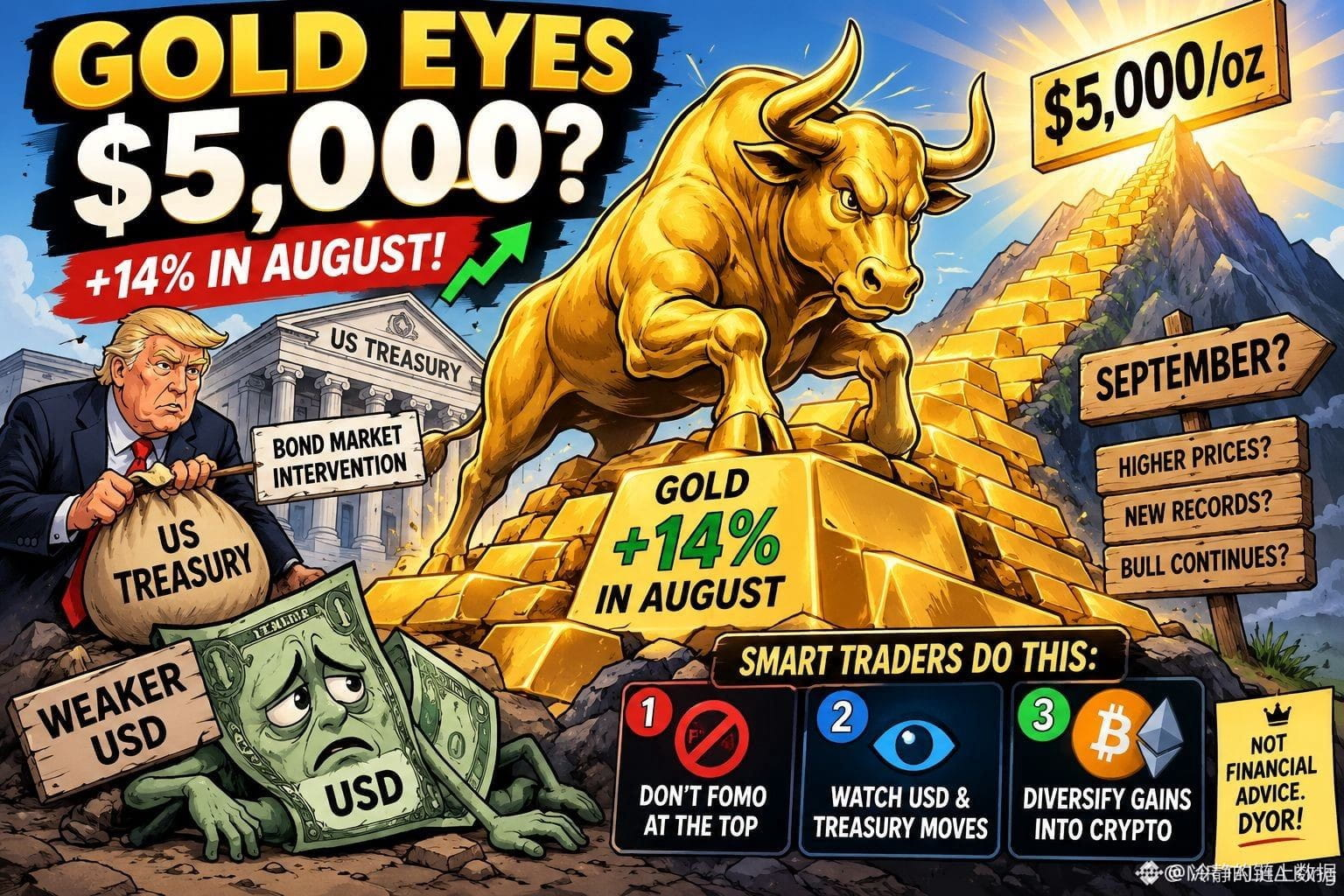
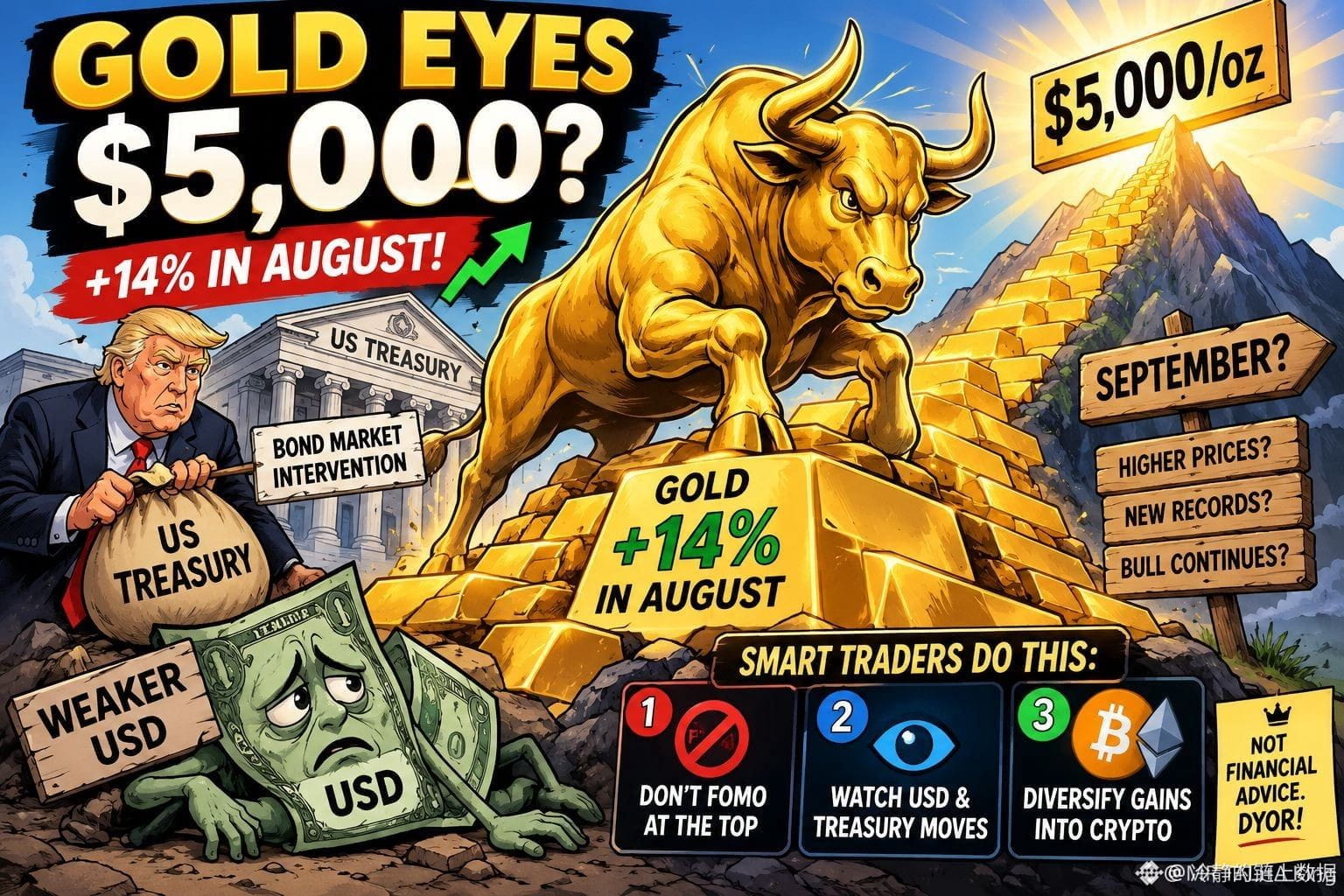
Gold rose 14% in August and prices touched around $4,590.
What’s interesting is that the driving force behind this rally wasn’t the Fed—rate-hike expectations were even heating up. The real catalyst came on August 19: the U.S. Treasury doubled the size of long-dated Treasury repo operations, sending the dollar tumbling to a three-month low. As the opposite of the dollar, gold directly absorbed this surge in funds.
The underlying logic is very clear: the greater the debt pressure, the more unstable long-end yields become, the more the credibility of the dollar is diluted, and the safe-haven value of gold gets repriced upward. On top of that, central banks worldwide have kept setting record highs for gold purchases. This move isn’t just short-term sentiment—structural buying is propping up the bottom.
But stay rational. The 4,590 level corresponds to the extreme range of August’s upside. Chasing higher in the short term isn’t a great risk-reward trade-off. What’s truly worth watching is the Fed’s September meeting—if a rate hike is delivered, gold will likely see a pullback and shakeout; if the Fed stays put, the dollar’s weakness can continue, leaving more room for gold.
Gold is for portfolio allocation, not for all-in bets. On pullbacks, scale in gradually—don’t go all at once. That matters more than trying to predict the exact turning point.
Click the profile picture to watch the live stream and learn the latest strategy
👉 黄金 14% 的月涨幅还能走多远?进群看美联储前的配置节奏
What’s interesting is that the driving force behind this rally wasn’t the Fed—rate-hike expectations were even heating up. The real catalyst came on August 19: the U.S. Treasury doubled the size of long-dated Treasury repo operations, sending the dollar tumbling to a three-month low. As the opposite of the dollar, gold directly absorbed this surge in funds.
The underlying logic is very clear: the greater the debt pressure, the more unstable long-end yields become, the more the credibility of the dollar is diluted, and the safe-haven value of gold gets repriced upward. On top of that, central banks worldwide have kept setting record highs for gold purchases. This move isn’t just short-term sentiment—structural buying is propping up the bottom.
But stay rational. The 4,590 level corresponds to the extreme range of August’s upside. Chasing higher in the short term isn’t a great risk-reward trade-off. What’s truly worth watching is the Fed’s September meeting—if a rate hike is delivered, gold will likely see a pullback and shakeout; if the Fed stays put, the dollar’s weakness can continue, leaving more room for gold.
Gold is for portfolio allocation, not for all-in bets. On pullbacks, scale in gradually—don’t go all at once. That matters more than trying to predict the exact turning point.
Click the profile picture to watch the live stream and learn the latest strategy
👉 黄金 14% 的月涨幅还能走多远?进群看美联储前的配置节奏
#btc触及80000美元
Gold rose 14% in August, with prices touching the $4,590 area.
What’s interesting is that the driver of this rally isn’t the Federal Reserve—rate-hike expectations are still heating up. The real catalyst came on August 19: the U.S. Treasury doubled the size of its long-term Treasury repo operations, and the dollar was pushed down to a three-month low. As the opposite side of the U.S. dollar, gold directly absorbed this inflow of capital.
The logic chain is very clear: the greater the debt pressure, the less stable long-term yields become; as the credibility of the dollar is diluted, gold’s safe-haven value gets repriced higher. On top of that, global central banks have continued to break records in gold purchases—this move isn’t just short-term sentiment; it’s structural buying support from the bottom.
But stay calm. The $4,590 level corresponds to the peak zone of August’s gains, so the risk-reward for chasing at short notice isn’t great. What’s truly worth watching is the Fed’s September meeting—if a rate hike is delivered, gold will likely see a pullback to shake out positions; if the Fed stands pat, dollar weakness could persist and gold would still have room.
Gold is for allocation, not for going all-in. On pullbacks, add in batches—don’t put everything in at once. That matters more than trying to predict exact price levels.
Click the profile picture to watch the livestream and learn the latest strategies
👉 黄金 14% 的月涨幅还能走多远?进群看美联储前的配置节奏
Gold rose 14% in August, with prices touching the $4,590 area.
What’s interesting is that the driver of this rally isn’t the Federal Reserve—rate-hike expectations are still heating up. The real catalyst came on August 19: the U.S. Treasury doubled the size of its long-term Treasury repo operations, and the dollar was pushed down to a three-month low. As the opposite side of the U.S. dollar, gold directly absorbed this inflow of capital.
The logic chain is very clear: the greater the debt pressure, the less stable long-term yields become; as the credibility of the dollar is diluted, gold’s safe-haven value gets repriced higher. On top of that, global central banks have continued to break records in gold purchases—this move isn’t just short-term sentiment; it’s structural buying support from the bottom.
But stay calm. The $4,590 level corresponds to the peak zone of August’s gains, so the risk-reward for chasing at short notice isn’t great. What’s truly worth watching is the Fed’s September meeting—if a rate hike is delivered, gold will likely see a pullback to shake out positions; if the Fed stands pat, dollar weakness could persist and gold would still have room.
Gold is for allocation, not for going all-in. On pullbacks, add in batches—don’t put everything in at once. That matters more than trying to predict exact price levels.
Click the profile picture to watch the livestream and learn the latest strategies
👉 黄金 14% 的月涨幅还能走多远?进群看美联储前的配置节奏
#SOL this week up 20%
🔄 进群聊SOL动态
SOL is up 20% this week—arguably the brightest among the major coins.
On-chain data supports this: trading volume has picked up again, ecosystem projects are issuing tokens in clusters, and capital is flowing from Ethereum into the Solana ecosystem. This isn’t just a mood-driven rebound—there are real buy orders pushing it.
For the crypto market, SOL has a certain pattern whenever it starts moving: first, on-chain data improves; then price confirms; and only after that do retail investors step in. Now we’ve reached the second step—there’s still room ahead, but volatility will also increase.
When it’s rising, don’t rush to chase. When it’s falling, don’t rush to buy the dip. The trend is there—position matters more than courage.
🔄 进群聊SOL动态
SOL is up 20% this week—arguably the brightest among the major coins.
On-chain data supports this: trading volume has picked up again, ecosystem projects are issuing tokens in clusters, and capital is flowing from Ethereum into the Solana ecosystem. This isn’t just a mood-driven rebound—there are real buy orders pushing it.
For the crypto market, SOL has a certain pattern whenever it starts moving: first, on-chain data improves; then price confirms; and only after that do retail investors step in. Now we’ve reached the second step—there’s still room ahead, but volatility will also increase.
When it’s rising, don’t rush to chase. When it’s falling, don’t rush to buy the dip. The trend is there—position matters more than courage.
#“沃什”称通胀是美联储首要关注
🏛️ 进群聊数据动态
The Fed Chair “Wosh” has clearly stated: Inflation remains the top priority. No easing will be on the table until the data hits the target.
Since taking office, the market has been speculating that he would be more dovish. However, two consecutive statements have poured cold water on rate-cut expectations—U.S. Treasury yields jumped, the U.S. dollar index strengthened, and tech stocks and crypto assets were repriced together.
For the crypto market, the weight of this message is not small. Liquidity expectations are the pricing anchor—once the anchor moves, prices have to find new levels. Those who bought at the highs have the most to fear from an expectation reversal.
Don’t bet on the direction—wait for the data to land. The market always swings between hopes and reality. The ones who survive are the ones who watch the data.
🏛️ 进群聊数据动态
The Fed Chair “Wosh” has clearly stated: Inflation remains the top priority. No easing will be on the table until the data hits the target.
Since taking office, the market has been speculating that he would be more dovish. However, two consecutive statements have poured cold water on rate-cut expectations—U.S. Treasury yields jumped, the U.S. dollar index strengthened, and tech stocks and crypto assets were repriced together.
For the crypto market, the weight of this message is not small. Liquidity expectations are the pricing anchor—once the anchor moves, prices have to find new levels. Those who bought at the highs have the most to fear from an expectation reversal.
Don’t bet on the direction—wait for the data to land. The market always swings between hopes and reality. The ones who survive are the ones who watch the data.
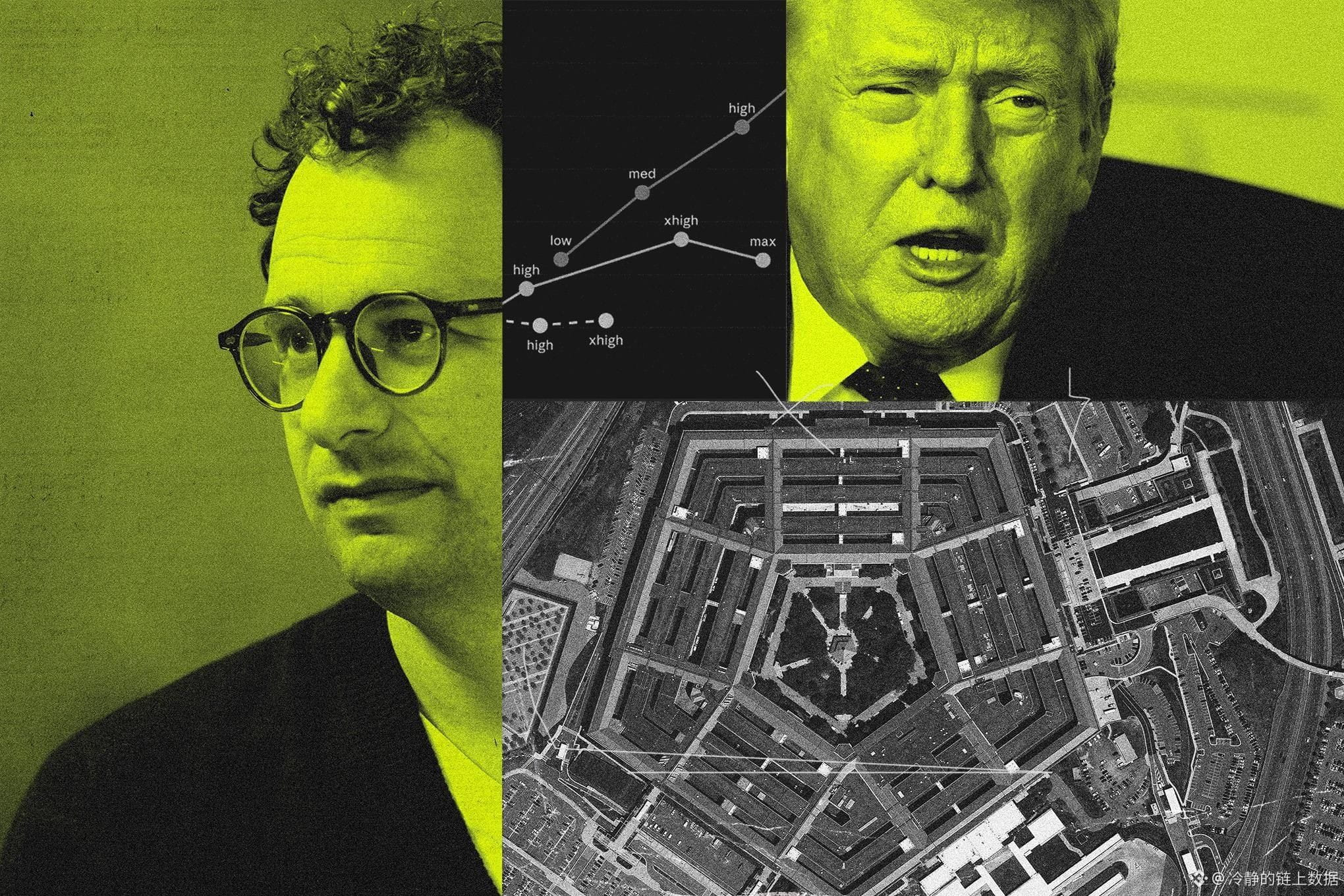
A judge rules that the Trump administration’s blacklisting of Anthropic was illegal: AI regulation is about to change.
From the Department of Defense to executive orders, the U.S. government’s escalating crackdown on Anthropic was settled by the court with a decisive verdict: unlawful. It’s a landmark victory for technology companies in their fight against executive power.
The pendulum of AI regulation has started to swing back.
For the crypto industry, this is an important signal—regulation isn’t a monolith, and the judiciary is actively correcting the boundaries of executive authority. The uncertainty facing crypto projects may not be as terrifying as some imagined.
But don’t get too excited: the big compliance trend won’t change—only the path is becoming clearer.
Clarification in regulation is the true starting point of a bull market.🔮AI×加密,进群跟进
From the Department of Defense to executive orders, the U.S. government’s escalating crackdown on Anthropic was settled by the court with a decisive verdict: unlawful. It’s a landmark victory for technology companies in their fight against executive power.
The pendulum of AI regulation has started to swing back.
For the crypto industry, this is an important signal—regulation isn’t a monolith, and the judiciary is actively correcting the boundaries of executive authority. The uncertainty facing crypto projects may not be as terrifying as some imagined.
But don’t get too excited: the big compliance trend won’t change—only the path is becoming clearer.
Clarification in regulation is the true starting point of a bull market.🔮AI×加密,进群跟进

Trump wants to buy Greenland, and Iceland’s EU referendum is in limbo: geopolitics is stirring up global assets.
The US president’s obsession with Greenland has pushed the Nordic security landscape to the forefront. Iceland’s referendum on whether to join the European Union is therefore full of uncertainties.
Geopolitics is the variable in crypto markets that is easiest to overlook.
Looking back at history: in 2022, during the Russia–Ukraine conflict, Bitcoin first plunged and then surged; in 2023, amid the Israel–Palestine conflict, risk-off sentiment lifted gold—and also helped BTC soar. Geopolitical risk equals rising volatility.
For ordinary investors: geopolitical events hit hard in the short term, but they don’t change the long-term trend. The real opportunity lies in assets that get mispriced during panic.
When others panic, be ready with cash.🌍点击链接进入群聊
The US president’s obsession with Greenland has pushed the Nordic security landscape to the forefront. Iceland’s referendum on whether to join the European Union is therefore full of uncertainties.
Geopolitics is the variable in crypto markets that is easiest to overlook.
Looking back at history: in 2022, during the Russia–Ukraine conflict, Bitcoin first plunged and then surged; in 2023, amid the Israel–Palestine conflict, risk-off sentiment lifted gold—and also helped BTC soar. Geopolitical risk equals rising volatility.
For ordinary investors: geopolitical events hit hard in the short term, but they don’t change the long-term trend. The real opportunity lies in assets that get mispriced during panic.
When others panic, be ready with cash.🌍点击链接进入群聊
Daily Crypto Market Analysis: Full Overview of ETH, XRP, ADA, and BNB, with HYPE Taking Off.
Major coins are collectively consolidating with narrow price swings, as capital waits for Friday’s Federal Reserve speech. ETH is hovering around the support level; XRP has strengthened against the trend, boosted by news of its listing; and BNB is trading sideways in line with the broader market.
A consolidation phase with shrinking volume is the ultimate test of patience.
This kind of market is easiest to lose money in: chase rallies and cut lows, getting hit back and forth, paying a pile of trading fees, and ending up with increasingly messy position sizing. The right approach is to make fewer moves and wait until the direction becomes clear.
Historical experience: before a central bank speech, the market contracts in volume; after the speech, volume will inevitably expand to choose a direction.
Keep your ammunition ready—when the direction is clear, then load the gun.🎯进群聊仓位动态
Major coins are collectively consolidating with narrow price swings, as capital waits for Friday’s Federal Reserve speech. ETH is hovering around the support level; XRP has strengthened against the trend, boosted by news of its listing; and BNB is trading sideways in line with the broader market.
A consolidation phase with shrinking volume is the ultimate test of patience.
This kind of market is easiest to lose money in: chase rallies and cut lows, getting hit back and forth, paying a pile of trading fees, and ending up with increasingly messy position sizing. The right approach is to make fewer moves and wait until the direction becomes clear.
Historical experience: before a central bank speech, the market contracts in volume; after the speech, volume will inevitably expand to choose a direction.
Keep your ammunition ready—when the direction is clear, then load the gun.🎯进群聊仓位动态
#韩股kospi因ai热潮降温下跌
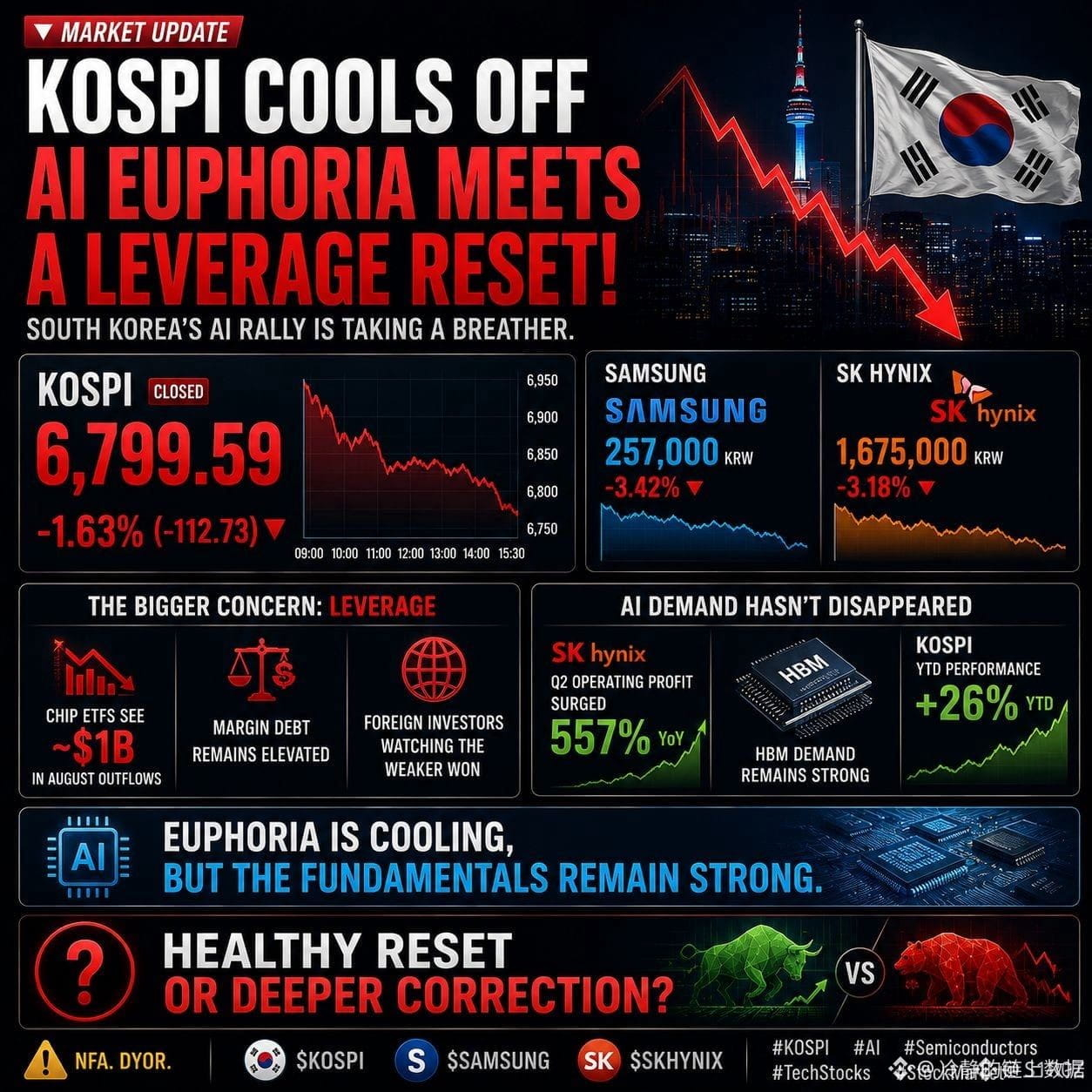
As AI hype fades, South Korea’s KOSPI falls, and the market is repricing.
In the first couple of weeks, AI trading was the brightest star across the market, but this week the wind direction in Korean stocks suddenly shifted. As the KOSPI retreated, funds pulled out from AI themes, and both Samsung and SK hynix came under pressure.
It’s not that the AI thesis has broken—it’s just that it rose too fast and needs to digest. After major U.S. AI players posted earnings, shares surged, lifting the Asia-Pacific markets as well. Once sentiment peaked, a natural pullback followed. The AI sector in crypto is under similar pressure—AI narratives are linked across global markets.
When prices rise, talk about dreams; when they fall, look at the data. The AI fundamentals haven’t changed—the only thing that’s changed is the cost basis of positions.
#韩股kospi因ai热潮降温下跌
进群聊持仓动态
As AI hype fades, South Korea’s KOSPI falls, and the market is repricing.
In the first couple of weeks, AI trading was the brightest star across the market, but this week the wind direction in Korean stocks suddenly shifted. As the KOSPI retreated, funds pulled out from AI themes, and both Samsung and SK hynix came under pressure.
It’s not that the AI thesis has broken—it’s just that it rose too fast and needs to digest. After major U.S. AI players posted earnings, shares surged, lifting the Asia-Pacific markets as well. Once sentiment peaked, a natural pullback followed. The AI sector in crypto is under similar pressure—AI narratives are linked across global markets.
When prices rise, talk about dreams; when they fall, look at the data. The AI fundamentals haven’t changed—the only thing that’s changed is the cost basis of positions.
#韩股kospi因ai热潮降温下跌
进群聊持仓动态
Settlement alert sounds: two days, $3 billion in short positions uncovered, the market is playing with fire.
Data shows that in the past 48 hours, the total liquidation amount across the entire network exceeded $3 billion, with shorts repeatedly crushed. Influencers such as Panda Traders issued warnings one after another.
This isn’t ordinary volatility—liquidations have concentrated at key levels, indicating that leveraged funds are making dense bets on a particular direction.
High leverage is a double-edged sword: get the direction right and wealth doubles; get it wrong and you get wiped out and forced out. The contract market is ruthless and never cares who you are.
BTC surged from 64,100 to 72,000 in just two days—longs made big money and shorts were liquidated. But the faster you push it up, the greater the risk of a pullback.
Respect the market—don’t mistake luck for strength.⚠️进群聊BTC动态
Data shows that in the past 48 hours, the total liquidation amount across the entire network exceeded $3 billion, with shorts repeatedly crushed. Influencers such as Panda Traders issued warnings one after another.
This isn’t ordinary volatility—liquidations have concentrated at key levels, indicating that leveraged funds are making dense bets on a particular direction.
High leverage is a double-edged sword: get the direction right and wealth doubles; get it wrong and you get wiped out and forced out. The contract market is ruthless and never cares who you are.
BTC surged from 64,100 to 72,000 in just two days—longs made big money and shorts were liquidated. But the faster you push it up, the greater the risk of a pullback.
Respect the market—don’t mistake luck for strength.⚠️进群聊BTC动态

Solana aiming for 200? Three forces behind the bounce of $SOL.
On the plaza heat ranking, discussions around SOL’s “next breakout” have surpassed 800,000 views. Data-wise: on-chain active addresses have hit a new yearly high, and ecosystem TVL has visibly rebounded.
There are three reasons behind the rebound: first, market risk appetite is picking up again, with capital rotating into high-beta targets; second, expectations for a SOL ETF continue to build; third, ecosystem projects are starting to ramp up.
But the technical picture isn’t that optimistic—above $200 is a historically dense trading zone with a massive number of trapped positions.
A rebound and a reversal are two different things. To break into $200, you need volume to match—and you also need the broader market environment to cooperate.
First, look at BTC’s mood, then talk about the altcoin main upswing.🌊进群聊BTC动态
On the plaza heat ranking, discussions around SOL’s “next breakout” have surpassed 800,000 views. Data-wise: on-chain active addresses have hit a new yearly high, and ecosystem TVL has visibly rebounded.
There are three reasons behind the rebound: first, market risk appetite is picking up again, with capital rotating into high-beta targets; second, expectations for a SOL ETF continue to build; third, ecosystem projects are starting to ramp up.
But the technical picture isn’t that optimistic—above $200 is a historically dense trading zone with a massive number of trapped positions.
A rebound and a reversal are two different things. To break into $200, you need volume to match—and you also need the broader market environment to cooperate.
First, look at BTC’s mood, then talk about the altcoin main upswing.🌊进群聊BTC动态
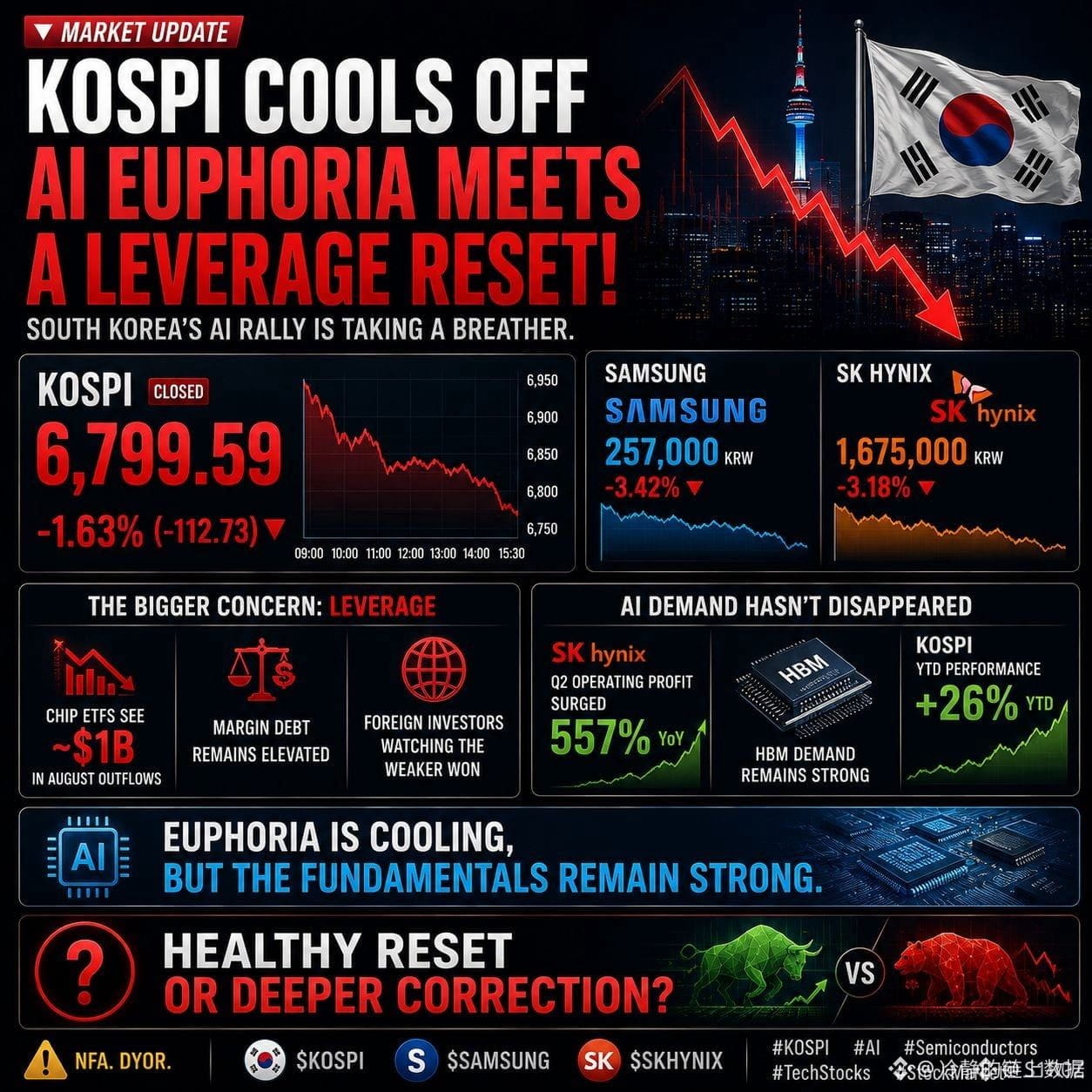
As AI hype fades, South Korea’s KOSPI falls, and the market is repricing.
In the first two weeks, AI trading was still the brightest star across the whole market, but this week the tide turned for Korean stocks. With the KOSPI slipping, capital pulled out of AI-related themes.
It’s not that the AI logic is broken—it's just that it rose too quickly and needs to digest. After a surge in earnings reports from U.S. AI giants, markets across Asia followed higher. Once sentiment peaked, a natural pullback followed. The AI sector in the crypto market faces similar pressure—AI narratives are linked across global markets.
When things are rising, talk about dreams; when things fall, look at the data. AI fundamentals haven’t changed—what’s changed is the cost basis of positions.
#KospiFallsAsAITradingEuphoriaCools
#KospiFallsAsAITradingEuphoriaCools进群聊持仓动态
In the first two weeks, AI trading was still the brightest star across the whole market, but this week the tide turned for Korean stocks. With the KOSPI slipping, capital pulled out of AI-related themes.
It’s not that the AI logic is broken—it's just that it rose too quickly and needs to digest. After a surge in earnings reports from U.S. AI giants, markets across Asia followed higher. Once sentiment peaked, a natural pullback followed. The AI sector in the crypto market faces similar pressure—AI narratives are linked across global markets.
When things are rising, talk about dreams; when things fall, look at the data. AI fundamentals haven’t changed—what’s changed is the cost basis of positions.
#KospiFallsAsAITradingEuphoriaCools
#KospiFallsAsAITradingEuphoriaCools进群聊持仓动态
Nvidia’s one-day market value surges by $442 billion, as the AI narrative is repriced.
After the earnings release, the stock rose 8.74%, with $33.5 billion traded in the first 140 minutes. The market cap increased by $442 billion— the second-largest one-day percentage gain in U.S. market history—directly igniting the entire AI sector.
Q2 revenue of $96.2 billion beat expectations, with data center demand accelerating. Nvidia is no longer just a chip company; it has become the pricing anchor for the entire AI trade.
But the more it rallies, the greater the divide. Chasers want quick money, while those waiting for a pullback are waiting for confirmation. The AI narrative hasn’t changed—only the entry price.
#NvidiaRises8.74%AfterEarnings
#NvidiaRises8.74%AfterEarnings进群聊数据动态
After the earnings release, the stock rose 8.74%, with $33.5 billion traded in the first 140 minutes. The market cap increased by $442 billion— the second-largest one-day percentage gain in U.S. market history—directly igniting the entire AI sector.
Q2 revenue of $96.2 billion beat expectations, with data center demand accelerating. Nvidia is no longer just a chip company; it has become the pricing anchor for the entire AI trade.
But the more it rallies, the greater the divide. Chasers want quick money, while those waiting for a pullback are waiting for confirmation. The AI narrative hasn’t changed—only the entry price.
#NvidiaRises8.74%AfterEarnings
#NvidiaRises8.74%AfterEarnings进群聊数据动态
Gold rises 14% in August—central banks snapping up gold is the underlying logic.
Gold prices surged from $4,000 at the beginning of the month all the way to $4,697, posting the largest monthly gain since 1999. This rally is not driven by retail sentiment; it’s institutional action.
According to World Gold Council data: in Q2, global central banks were net buyers of 289 tonnes of gold—up 62% year on year—marking the strongest Q2 on record. China’s central bank has added to its holdings for 21 consecutive months. Under the European Central Bank’s reporting metrics, gold has already surpassed U.S. Treasuries to become the world’s largest reserve asset.
Weaker USD + unusual moves in the U.S. bond market + ongoing central bank purchases—three factors stacked together. Calls for gold to reach $5,000 are growing, but after a blowout monthly surge, there is also a risk of chasing the price too late.
#GoldRisesAbout14%InAugust
#GoldRisesAbout14%InAugust趋势来了,群里盯得更紧
Gold prices surged from $4,000 at the beginning of the month all the way to $4,697, posting the largest monthly gain since 1999. This rally is not driven by retail sentiment; it’s institutional action.
According to World Gold Council data: in Q2, global central banks were net buyers of 289 tonnes of gold—up 62% year on year—marking the strongest Q2 on record. China’s central bank has added to its holdings for 21 consecutive months. Under the European Central Bank’s reporting metrics, gold has already surpassed U.S. Treasuries to become the world’s largest reserve asset.
Weaker USD + unusual moves in the U.S. bond market + ongoing central bank purchases—three factors stacked together. Calls for gold to reach $5,000 are growing, but after a blowout monthly surge, there is also a risk of chasing the price too late.
#GoldRisesAbout14%InAugust
#GoldRisesAbout14%InAugust趋势来了,群里盯得更紧
Binance Square Community Governance Announcement Released: New Rules for Content Creators Are Here.
The results of community governance from August 17 to 23 have been released, with updates to content standards and reward mechanisms. The platform is tightening up—and upgrading at the same time.
For creators, this is good news—governance rules are becoming more transparent, making it easier for high-quality content to stand out.
Data shows that after the governance announcements were published, exposure for high-quality content on the Square increased significantly. The clearer the rules, the healthier the ecosystem.
The logic for making content hasn’t changed: be real, be professional, and have your own viewpoint. Chasing traffic can make you trend for a moment—content quality is the long-term asset.
The platform is changing, but the trend doesn’t.🚀进群聊数据动态
The results of community governance from August 17 to 23 have been released, with updates to content standards and reward mechanisms. The platform is tightening up—and upgrading at the same time.
For creators, this is good news—governance rules are becoming more transparent, making it easier for high-quality content to stand out.
Data shows that after the governance announcements were published, exposure for high-quality content on the Square increased significantly. The clearer the rules, the healthier the ecosystem.
The logic for making content hasn’t changed: be real, be professional, and have your own viewpoint. Chasing traffic can make you trend for a moment—content quality is the long-term asset.
The platform is changing, but the trend doesn’t.🚀进群聊数据动态

$80,000 Threshold: BTC keeps bouncing between fear and greed.
Those bullish are shouting, "The weekly close must break to new highs," while the bears are saying, "$80,000 is the ceiling." In the square, bulls and bears are fighting it out, and views easily surpass ten thousand.
What’s the real situation?
Options data: Open interest for next week’s expiration is concentrated in the 78,000-82,000 range, with both sides betting on direction. Volatility expectations are rising, indicating a huge level of disagreement in the market.
Markets always rise amid disagreement, and top out when everyone agrees.
If you’re also stuck in indecision, remember one iron rule: Don’t go all-in when others are greedy, and don’t cut losses when others are panicking.
Control your position size and let the market take two steps first.⚖️进群聊仓位动态
Those bullish are shouting, "The weekly close must break to new highs," while the bears are saying, "$80,000 is the ceiling." In the square, bulls and bears are fighting it out, and views easily surpass ten thousand.
What’s the real situation?
Options data: Open interest for next week’s expiration is concentrated in the 78,000-82,000 range, with both sides betting on direction. Volatility expectations are rising, indicating a huge level of disagreement in the market.
Markets always rise amid disagreement, and top out when everyone agrees.
If you’re also stuck in indecision, remember one iron rule: Don’t go all-in when others are greedy, and don’t cut losses when others are panicking.
Control your position size and let the market take two steps first.⚖️进群聊仓位动态
BTC again tests the $80,000 mark: this breakout has a different level of substance.
Bitcoin has reclaimed the $80,000 threshold, and a plaza post’s views have surged to 280,000. Last time touching $80,000 was emotion-driven; this time it’s a convergence of ETF fund flows + macro expectations.
On-chain data offers a more sober answer: the holdings of whale addresses hit a three-month high, while the BTC balance on exchanges continues to decline—liquidity is concentrating among long-term holders.
Changes in supply and demand are far more honest than the candlestick chart.
But don’t overlook the risks: above $80,000 there are many trapped positions, so short-term consolidation is inevitable. If the Fed’s speech on Friday turns hawkish, the breakout could turn into a fakeout.
Trends are your friend, and position sizing is your safety belt.📊进群聊仓位动态
Bitcoin has reclaimed the $80,000 threshold, and a plaza post’s views have surged to 280,000. Last time touching $80,000 was emotion-driven; this time it’s a convergence of ETF fund flows + macro expectations.
On-chain data offers a more sober answer: the holdings of whale addresses hit a three-month high, while the BTC balance on exchanges continues to decline—liquidity is concentrating among long-term holders.
Changes in supply and demand are far more honest than the candlestick chart.
But don’t overlook the risks: above $80,000 there are many trapped positions, so short-term consolidation is inevitable. If the Fed’s speech on Friday turns hawkish, the breakout could turn into a fakeout.
Trends are your friend, and position sizing is your safety belt.📊进群聊仓位动态

RWA narrative gains another player: Evernorth goes public on Nasdaq, and the XRP ecosystem welcomes an institutional moment.
From clearing SEC hurdles to ringing the Nasdaq bell, Evernorth’s journey sets an example for all crypto businesses: a compliant listing is the shortest path for crypto assets to enter the mainstream capital pool.
The scale of institutional funds is dozens of times that of retail markets.
Data shows that this year, the total value locked in the RWA track has grown by over 300%. Only when real-world assets begin to be tokenized on-chain does the crypto market truly enter its second half.
But note: a listing ≠ a meteoric token surge. Institutional entry is a long-term positive, while short-term sentiment is often prone to spike and then fade.
Hold onto core assets and don’t let news-driven narratives lead you around.💎进群聊数据动态
From clearing SEC hurdles to ringing the Nasdaq bell, Evernorth’s journey sets an example for all crypto businesses: a compliant listing is the shortest path for crypto assets to enter the mainstream capital pool.
The scale of institutional funds is dozens of times that of retail markets.
Data shows that this year, the total value locked in the RWA track has grown by over 300%. Only when real-world assets begin to be tokenized on-chain does the crypto market truly enter its second half.
But note: a listing ≠ a meteoric token surge. Institutional entry is a long-term positive, while short-term sentiment is often prone to spike and then fade.
Hold onto core assets and don’t let news-driven narratives lead you around.💎进群聊数据动态

SEC Clears the Way: XRP Vault Giant Evernorth Gets a Ticket to Nasdaq Listing.
The U.S. Securities and Exchange Commission has cleared the final regulatory hurdle. Evernorth Holdings is only one step away from a Nasdaq listing and will debut under the XRPN code.
Another crypto company is setting foot in traditional capital markets.
This is a milestone in crypto compliance—not a shell company, not tokenization, but a real, bona fide Nasdaq listing. XRP’s institutional narrative is shifting from controversy toward the mainstream.
Impact on the market: first, it injects expectations of liquidity into the XRP ecosystem; second, it proves that crypto firms can also make it through the listing path under the SEC framework.
The doors of traditional capital markets are opening one by one.🏛️合规风向,进群一起看
The U.S. Securities and Exchange Commission has cleared the final regulatory hurdle. Evernorth Holdings is only one step away from a Nasdaq listing and will debut under the XRPN code.
Another crypto company is setting foot in traditional capital markets.
This is a milestone in crypto compliance—not a shell company, not tokenization, but a real, bona fide Nasdaq listing. XRP’s institutional narrative is shifting from controversy toward the mainstream.
Impact on the market: first, it injects expectations of liquidity into the XRP ecosystem; second, it proves that crypto firms can also make it through the listing path under the SEC framework.
The doors of traditional capital markets are opening one by one.🏛️合规风向,进群一起看

Court Ruling: The Pentagon’s Blacklisting of Anthropic Is Unlawful.
A federal judge ruled that the Pentagon’s action of placing AI company Anthropic on the National Security Supply Chain Risk list was “illegal and baseless,” violating First Amendment rights.
A line has been redrawn around the boundaries of oversight.
This has major implications for the encryption industry—if the government can blacklist tech companies at will under the banner of “national security,” what about crypto projects? The case involving OFAC sanctions on Tornado Cash followed a similar logic.
The good news is that the judicial system is still checking executive power. The bad news is that compliance costs will only keep rising.
In the era of regulation, uncertainty is the biggest risk.🛡️AI×加密,进群跟进
A federal judge ruled that the Pentagon’s action of placing AI company Anthropic on the National Security Supply Chain Risk list was “illegal and baseless,” violating First Amendment rights.
A line has been redrawn around the boundaries of oversight.
This has major implications for the encryption industry—if the government can blacklist tech companies at will under the banner of “national security,” what about crypto projects? The case involving OFAC sanctions on Tornado Cash followed a similar logic.
The good news is that the judicial system is still checking executive power. The bad news is that compliance costs will only keep rising.
In the era of regulation, uncertainty is the biggest risk.🛡️AI×加密,进群跟进

Log in to explore more content