
#英伟达开盘140分钟成交335亿美元
This isn’t a single stock anymore—it’s the “AI casino” of global capital.
Honestly, seeing this data, my first reaction is: Wall Street’s current frenzy over Nvidia may be even more extreme than we imagined.
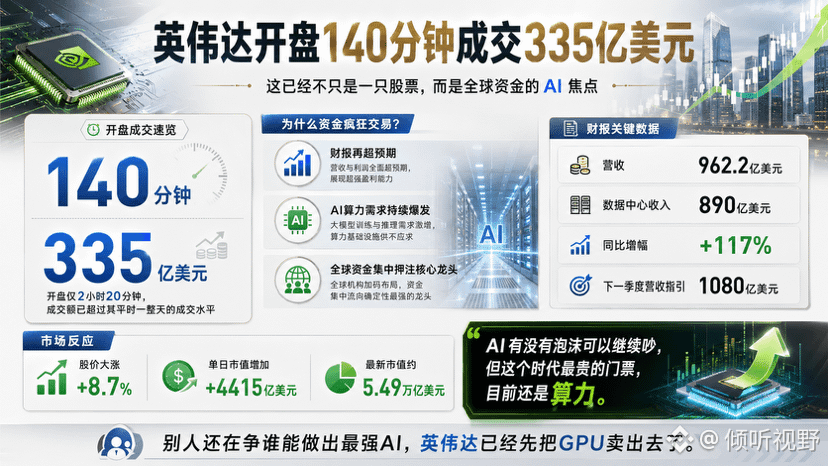
On August 27, just 2 hours and 20 minutes after the market opened—i.e., 140 minutes—Nvidia’s trading volume reached $33.5 billion, already exceeding its usual full day’s trading levels. (cls.cn)
What does $33.5 billion even mean?
In yuan terms, it’s over a few hundred billion—within 140 minutes, people were wildly switching hands around a single company.
And the fuse behind it is also very direct: the earnings report again beat expectations.
Nvidia’s Q2 revenue hit $96.22 billion, and its data center revenue surged to $89 billion, up 117% year over year. The company also forecast next-quarter revenue at around $108 billion and provided a stunning outlook: sales growth of about 70% for the next fiscal year. (reuters.com)
The result: the market voted with money.
That day, Nvidia’s stock jumped 8.7%, adding roughly $441.5 billion to its market cap, which surged to around $5.49 trillion. (marketwatch.com)
But I think the most worth discussing here isn’t whether Nvidia can still go up.
It’s that the entire U.S. stock-market AI trade is increasingly starting to answer one question:
Where does the money in AI ultimately end up?
OpenAI, Meta, Google, Amazon—they’re all burning cash to build computing power. But as long as capital expenditures keep rising, Nvidia is like the person selling shovels right at the entrance of the gold rush.
While everyone else argues about who can build the strongest AI, Nvidia first sells the GPUs.
So, in plain terms, the $33.5 billion in trading volume means the market is signaling with real money: people may doubt the AI bubble, but for now, they still don’t dare to easily leave Nvidia.
Of course, after such a big surge, I wouldn’t tell everyone to blindly chase.
The more an asset becomes watched by the whole public, the scarier the expectations get. Once a future quarter delivers only “excellent” instead of “absurd,” the valuation will still get cut without anyone being polite.
But at least for now, Nvidia has once again proven one thing:
Whether there’s a bubble in AI can keep being debated—but for this era, the most expensive entry ticket is still computing power.
#英伟达开盘140分钟成交335亿美元 #英伟达 #NVIDIA #AI $NVDA.US
This isn’t a single stock anymore—it’s the “AI casino” of global capital.
Honestly, seeing this data, my first reaction is: Wall Street’s current frenzy over Nvidia may be even more extreme than we imagined.
On August 27, just 2 hours and 20 minutes after the market opened—i.e., 140 minutes—Nvidia’s trading volume reached $33.5 billion, already exceeding its usual full day’s trading levels. (cls.cn)
What does $33.5 billion even mean?
In yuan terms, it’s over a few hundred billion—within 140 minutes, people were wildly switching hands around a single company.
And the fuse behind it is also very direct: the earnings report again beat expectations.
Nvidia’s Q2 revenue hit $96.22 billion, and its data center revenue surged to $89 billion, up 117% year over year. The company also forecast next-quarter revenue at around $108 billion and provided a stunning outlook: sales growth of about 70% for the next fiscal year. (reuters.com)
The result: the market voted with money.
That day, Nvidia’s stock jumped 8.7%, adding roughly $441.5 billion to its market cap, which surged to around $5.49 trillion. (marketwatch.com)
But I think the most worth discussing here isn’t whether Nvidia can still go up.
It’s that the entire U.S. stock-market AI trade is increasingly starting to answer one question:
Where does the money in AI ultimately end up?
OpenAI, Meta, Google, Amazon—they’re all burning cash to build computing power. But as long as capital expenditures keep rising, Nvidia is like the person selling shovels right at the entrance of the gold rush.
While everyone else argues about who can build the strongest AI, Nvidia first sells the GPUs.
So, in plain terms, the $33.5 billion in trading volume means the market is signaling with real money: people may doubt the AI bubble, but for now, they still don’t dare to easily leave Nvidia.
Of course, after such a big surge, I wouldn’t tell everyone to blindly chase.
The more an asset becomes watched by the whole public, the scarier the expectations get. Once a future quarter delivers only “excellent” instead of “absurd,” the valuation will still get cut without anyone being polite.
But at least for now, Nvidia has once again proven one thing:
Whether there’s a bubble in AI can keep being debated—but for this era, the most expensive entry ticket is still computing power.
#英伟达开盘140分钟成交335亿美元 #英伟达 #NVIDIA #AI $NVDA.US