



The US may really be reopening the doors to ICOs. On August 18, the SEC officially proposed Reg CA, the first time rules for token issuance have been specifically designed for crypto. The goal is to allow eligible projects to publicly issue tokens for financing in the United States.
After the news broke, many people called it “ICO 2.0.” But why didn’t the US allow projects to do ICOs freely in the past? And what exactly has Reg CA now opened up? To understand this new wave of ICOs, you first need to look at the US’s past restrictions on token financing.
TL;DR
1. The US may reopen ICOs: Reg CA allows eligible projects to publicly issue token financing to ordinary investors.
2. Tokens may truly have fundamentals: projects with real revenue may, going forward, more clearly link economic rights—such as revenue, buybacks, and dividends—to Tokens.
3. Focus on three categories of opportunities: regulated old Tokens, real cash flow projects, and Launchpads / on-chain fundraising platforms.
So what exactly does Reg CA change?
In the past, when U.S. projects wanted to publicly issue Tokens, they faced a dilemma:
They either register as securities, taking on full registration, disclosure, and ongoing reporting obligations; or they use an exemption, but then face limitations related to investors, fundraising methods, or liquidity. So many projects choose to issue tokens overseas, and even directly restrict U.S. users from participating.
But things will be different going forward. Reg Crypto, for the first time, designed two fundraising paths specifically for Tokens.
- Startup Exemption for early-stage projects: up to $5 million raised over 4 years
- Fundraising Exemption is aimed at larger projects: up to $20 million or $75 million in 12 months, but it requires SEC qualification, financial reporting, and Tier 2 also requires an audit.
The key is that Tokens can be publicly sold to retail investors, and in principle they don’t have the strong lock-up periods required for traditional private securities—so they can be resold immediately.
That alone is enough to excite Crypto. In the future, startups won’t need to seek VC funding—they can raise funds directly from future users. This is also what the community calls “ICO 2.0.” But it’s not a simple return to the 2017 ICO.
During fundraising, the project needs to disclose information such as the Token supply, unlock schedule, and governance rights, and clearly state what it will do with the money and what stage it has reached. After fulfilling the commitments or permanently ceasing to perform, the project can submit a Transition Report and formally terminate the covered investment contract related to the Token. The Token itself can still continue trading.
In short, 2017 was “raise money first, deal with it later.” ICO 2.0 brings fundraising, disclosure, building, and exit into the regulatory rules.
The Token’s biggest burden may be getting resolved
Reg CA solves not just “how to issue new Tokens in the future,” but also the problems left over from the past: is a Token actually a security?
In the past, many projects have been trying to prove that their Tokens are not securities, because once a Token is deemed a security, it must face stricter issuance, disclosure, and trading rules.
This also brings two questions.
First, many Token issuances may involve investment contracts, but the project has been running for many years—when will this securities-law relationship finally end? There has been no clear answer.
Second, to keep Tokens from looking more like securities, many projects also don’t dare let Tokens directly capture protocol value. In particular, designs like dividends, profit distributions, and active buybacks may strengthen their securities attributes.
That’s why Crypto has such a strange phenomenon: the protocol is clearly very profitable, yet the Token can only be used for governance, staking, and incentives, making it difficult to directly share the protocol’s revenue.
Reg CA is essentially providing new solutions to both of these problems.
1) Once the project completes the work it originally promised (or permanently stops performing it) and submits a Transition Report, it can end the investment contract relationship related to the Token—and this Safe Harbor also applies to old Tokens that were issued in the past.
2) Projects don’t necessarily need to find a way to prove that their Token “is not a security.” Instead, within the appropriate regulatory framework, they can make the Token carry more clearly defined economic rights.
According to the SEC’s own estimates, old Tokens might actually be the part with the biggest short-term impact:
The SEC expects that each year, about 130 new projects will raise funds through Reg CA, but as many as 475 existing older projects may use the new rules to resolve the Token’s previously lingering securities identity problem.
So the first wave of impacts after Reg CA takes effect may not be suddenly a flood of new ICOs. Instead, it may first help some old Tokens resolve the securities identity problems that have plagued them for years.
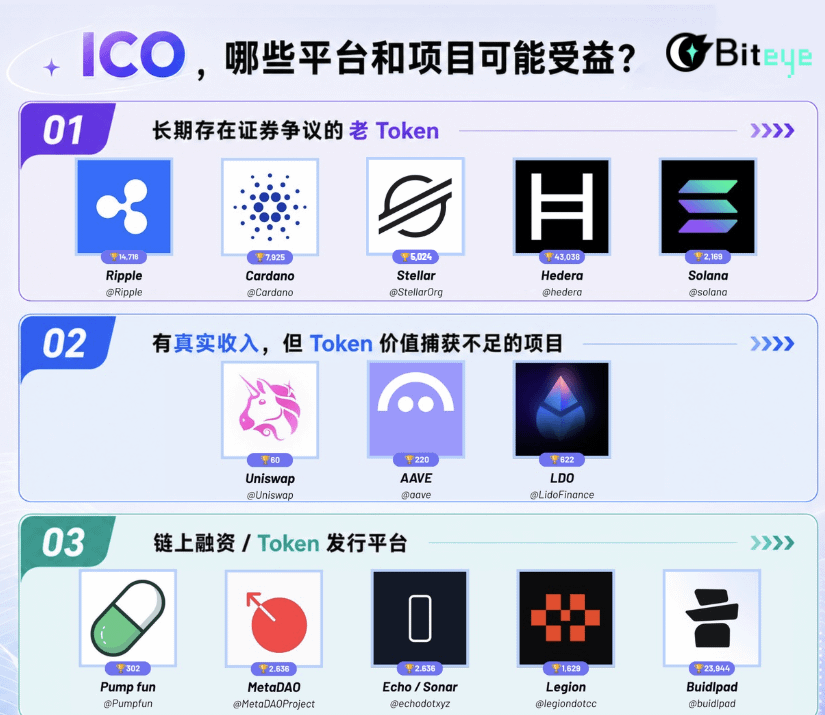
Which platforms and projects might benefit?
Along the changes mentioned above, Reg CA’s impact is actually not just “ICO returns.” Based on the current market, I think at least three types of projects are worth revisiting.
(1) Old Tokens with long-standing securities disputes
Some old projects’ core business, users, and ecosystem may not be an issue, but the price has always included a layer of hard-to-quantify “regulatory discount.”
The market will worry about SEC investigations, lawsuits, U.S. exchanges delisting the Token, institutions being unwilling to hold it, and even the project being unable to expand into the U.S. market normally.
These risks don’t show up directly in revenue and TVL, but they can weigh on the valuation the market is willing to assign for a long time.
(2) Projects with real revenue, but insufficient Token value capture
In the past, Crypto judged Tokens mostly by things like TVL, trading volume, and FDV, plus the narrative—rarely by actually calculating, the way one might for stocks, “how much profit this Token represents.”
If more and more Tokens in the future come to have clear economic rights, then the market will naturally start to distinguish between two kinds of projects:
- Tokens supported by narrative
- Tokens supported by cash flow
So we should look for all business models that are already proven and for protocols where cash flows are clear—for example, mature DeFi lending and trading fee revenue, on-chain broker transaction income, RWA platforms’ management fees and service fees, and reserve income from stablecoin issuers.
(3) On-chain fundraising / Token issuance platforms
If Token fundraising scales up again, one of the largest incremental markets might not be any single Token, but rather the new industry formed around issuance.
As early as last year, Crypto tried “ICO 2.0.” Solana’s ICM core last year was to help startups not just find VCs, but instead issue Tokens directly to finance from the community. Believe originally popularized this model, and later Pump.fun also began focusing on ICM.
Reg CA is more like a direction map of the ICM exploration from the past year, filling in a set of formal regulatory rules. If this path works,
On-chain fundraising platforms like Pump.fun, MetaDAO, Echo/Sonar, and CoinList may evolve from “token issuing platforms” into Crypto’s fundraising entry points.
When will Reg CA take effect?
In the end, it’s still worth pouring some cold water: Reg CA is currently only a proposal and has not officially taken effect.
The SEC proposed the rules on August 18, published them in the Federal Register on August 21. It is currently collecting public comments for 60 days, ending on October 20.
After that, the SEC will still need to review comments, modify the rules, and decide whether to formally approve them—there is no official timeline yet.
Because the proposal itself is relatively complex, the market generally expects it will take effect no earlier than 2027, or even later. Moreover, Reg CA is not the final answer to Crypto regulation.
It mainly addresses Token fundraising, disclosure, and the exit of investment contracts; issues like exchanges, brokers, and custodians are not covered by this set of rules. Also, with SEC leadership changing in the future, there is a possibility that the rules will be modified. So there’s no need to rush to shout “ICO is back.” Reg CA is still a ways from truly taking effect.