
The August 20 announcement established the fact: Binance launched Agent OS, its development platform for connecting AI applications to its trading, market data, wallet, and payments functions. We explained why that matters in the era of agents.
Today, we move to the only thing that gives credibility to an announcement: showing it in action. Not the theory. Real flows, real calls, real guardrails.
# The setup in one sentence
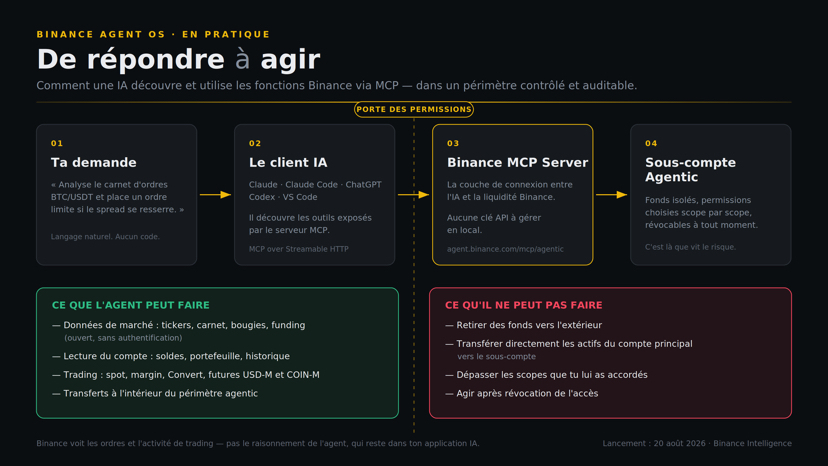
Agent OS brings together the Binance APIs, the Wallet Agentic Hub, Binance x402 (programmable payments), the Skill Hub, and support for the Model Context Protocol (MCP). The Binance MCP Server is the connection layer: it lets a compatible AI application access Binance liquidity and tools without anyone having to manage API keys locally.
Explanation: up to now, each developer was rebuilding their own plumbing. Now there is a standard plug.
# The use case, step by step
Step 1 — Connect the client.
You connect an MCP-compatible application to the Binance server through its published endpoint: `agent.binance.com/mcp/agentic`. Binance cites Claude, Claude Code, ChatGPT, Codex, and VS Code among the compatible clients. No API key to copy-paste, no environment variable to protect on your machine.
Step 2 — Create and fund an Agentic sub-account.
This is the step that 90% of people will want to skip, and it’s exactly the one that defines everything else. The agent does not operate on your main account. It operates in a funded sandbox, with the amounts you put into it. Optionally, you can grant it a read-only view of your main account.
Step 3 — Choose the scopes.
Market data, account information, spot, margin, Convert, USDⓈ-M futures, and COIN-M: you grant function by function. Public market data (tickers, order books, candles, funding rates) requires no authentication. Anything that touches the account depends explicitly on what you authorized. And you revoke whenever you want.
Step 4 — The prompt.
“Compare the depth of the BTC/USDT and ETH/USDT order books over the last 4 hours, tell me where the spread is most stable, then place a 50 USDT limit order on the most liquid pair.”
Step 5 — What actually happens.
The agent discovers the tools exposed by the MCP server, calls the market data endpoints, reasons in your AI application, and then calls the authorized trading functions—within the limits of the agentic sub-account. The order arrives in Binance’s matching engine like any other order.
Often misunderstood point: Binance can see trading activity and orders, not the agent’s reasoning. The decision-making process stays inside the AI application you chose. The responsibility split is clear-cut.
## The scope, unambiguously
What the agent can do: read the market, check balances, portfolio, and history of the designated sub-account, execute the authorized trading types, transfer within the agentic perimeter.
What it cannot do: withdraw funds to the outside, or directly transfer assets from your main account to the sub-account.
This is exactly the right architecture. The risk of an autonomous agent isn’t that it makes the wrong trade—humans make wrong trades too. The risk is that it makes those mistakes without a ceiling. The agentic sub-account is that ceiling.
#My take, no sugarcoating
The real novelty isn’t “AI can trade.” Bots have been trading for ten years. The novelty is that the trust layer has moved: it’s no longer in the model, it’s in the permissions scope. We don’t need to trust the agent—we need to control what it can reach. This is an infrastructure problem, and it has just been handled as such.
For French-speaking Africa, the reading is straightforward: the barrier is no longer code. A developer in Cotonou, Dakar, or Abidjan who knows how to write a prompt and set permissions has the same programmatic access as a quant desk. What still needs to be built is not connectors—it's judgment, strategies, and risk discipline.
Those learning today how to frame an agent are learning the job of tomorrow.
Key takeaway
- Agent OS = the platform. MCP = the standard plug. The MCP Server = the cable.
- The agentic sub-account is your seatbelt. Never remove it.
- Start with read-only access to market data before granting any trading scope.
Trading crypto-assets involves a risk of loss. An AI agent executes—it guarantees nothing. Test with amounts you can afford to lose, and revoke access you no longer need. This is not financial advice.
Sources
- Official announcement: https://www.prnewswire.com/news-releases/binance-introduces-agent-os-to-connect-ai-applications-to-financial-infrastructure-302856306.html