Hormuz Exports Resume to 70%! $CL Back to 83—How Much Longer Can the Geopolitical Premium Hold Up?
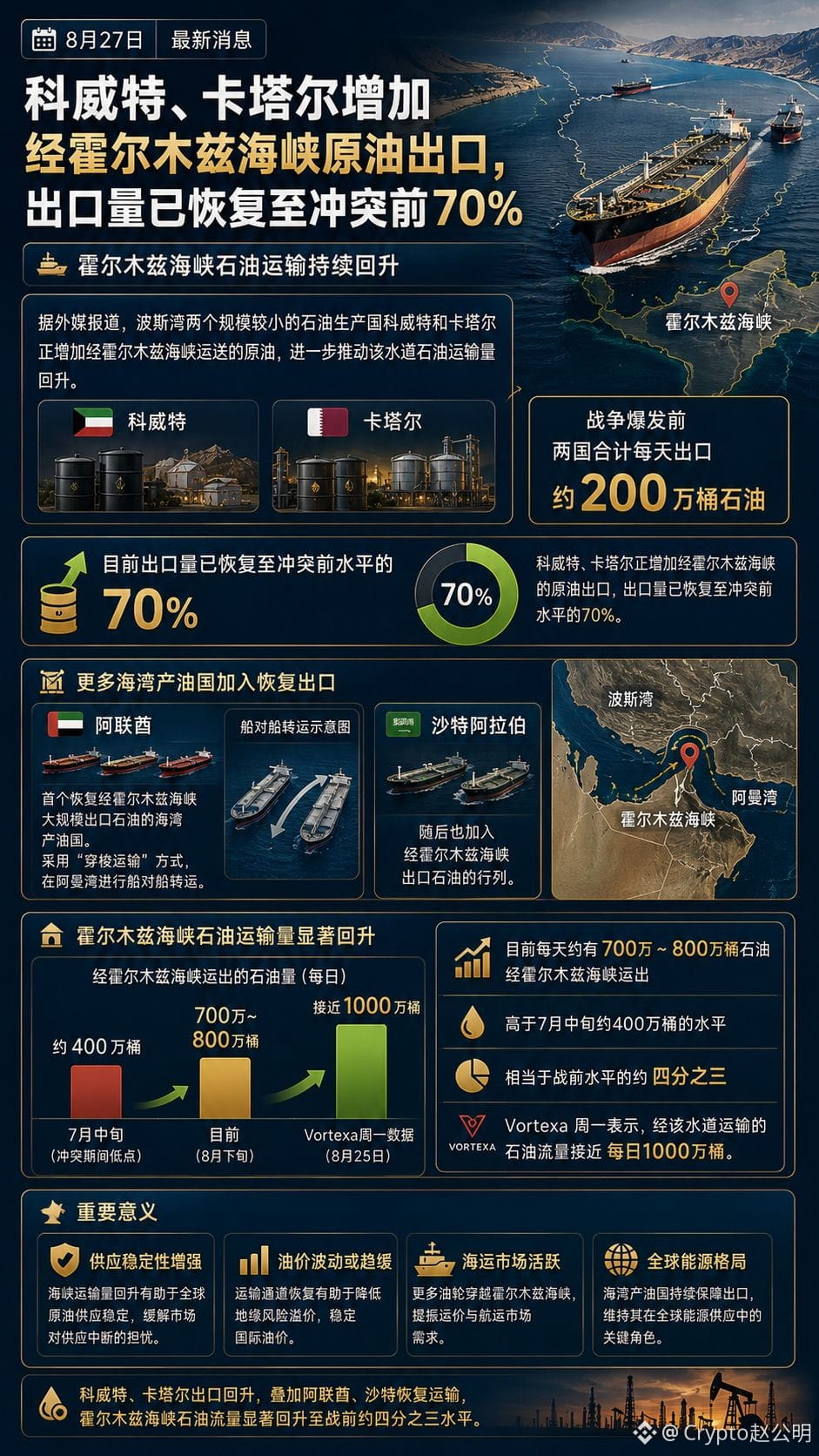
Brothers, the oil tankers in Hormuz are starting to move again—Kuwait and Qatar have restored their export volumes to 70% of pre-conflict levels. Combined with Saudi Arabia and the UAE, about 7–8 million barrels per day are being shipped through the strait, higher than the 4 million barrels in mid-July. This is the most direct loosening signal from the supply side.
News that Russia is upgrading the conflict pulled prices up briefly, but it’s the supply recovery that dominates. As the geopolitical premium fades, you can’t rely on mere talk to prop up oil prices.
Look at the price chart: 83.15 is near the Bollinger midline; MACD has a bearish crossover, and RSI has fallen back below 50. The 85–86 zone above has become a resistance area, while 80–81 below is where positions provide support. Bias is bearish in the short term, but there isn’t much room below 80.
Public perspective: Hormuz’s restoration to 70% is real supply returning. The Russia conflict can only hedge in the short term; it can’t change the direction. At the 83 level, it’s easier for prices to move down than up, but this selloff has already played out much of the way—there’s limited space toward around 80.
Trading strategy:
Short: Enter short on a rebound around 84.5–85.
Long: Enter long on a pullback around 81–81.5.
Remember, the geopolitical premium is dissipating—don’t expect it to hold up for long. Follow Zhao Gongming and let you understand the tug-of-war between geopolitics and supply/demand. #WTI原油涨1.6%至84美元
Brothers, the oil tankers in Hormuz are starting to move again—Kuwait and Qatar have restored their export volumes to 70% of pre-conflict levels. Combined with Saudi Arabia and the UAE, about 7–8 million barrels per day are being shipped through the strait, higher than the 4 million barrels in mid-July. This is the most direct loosening signal from the supply side.
News that Russia is upgrading the conflict pulled prices up briefly, but it’s the supply recovery that dominates. As the geopolitical premium fades, you can’t rely on mere talk to prop up oil prices.
Look at the price chart: 83.15 is near the Bollinger midline; MACD has a bearish crossover, and RSI has fallen back below 50. The 85–86 zone above has become a resistance area, while 80–81 below is where positions provide support. Bias is bearish in the short term, but there isn’t much room below 80.
Public perspective: Hormuz’s restoration to 70% is real supply returning. The Russia conflict can only hedge in the short term; it can’t change the direction. At the 83 level, it’s easier for prices to move down than up, but this selloff has already played out much of the way—there’s limited space toward around 80.
Trading strategy:
Short: Enter short on a rebound around 84.5–85.
Long: Enter long on a pullback around 81–81.5.
Remember, the geopolitical premium is dissipating—don’t expect it to hold up for long. Follow Zhao Gongming and let you understand the tug-of-war between geopolitics and supply/demand. #WTI原油涨1.6%至84美元