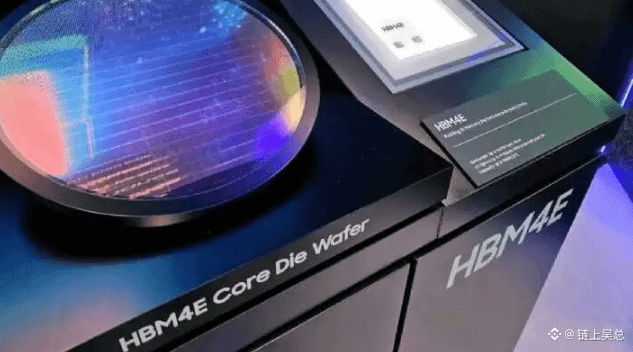
NVIDIA Sets a Challenge for Samsung Again: HBM4E Performance Requirements Raised Directly
As AI compute gets more competitive, the memory behind it is getting more competitive too.
According to a Korean media report, Samsung Electronics is developing an 8-layer HBM4E in line with NVIDIA’s requirements, targeting speeds of 17–18Gbps. Compared with the earlier sample at 14.4Gbps, this is about a 20% increase.
Why specifically emphasize 8 layers?
In plain terms, it’s to reduce stacking difficulty, improve yields, and expand supply capacity as much as possible.
This custom HBM is expected to be used in NVIDIA’s future Rubin Ultra series AI GPUs.
Even more striking is that the GPU interconnect scale for Rubin Ultra could grow from 72 chips further, to as many as 576.
What does that mean?
The stronger the AI chip, the more intense the demand for HBM.
In the future, AI competition won’t be only about GPU performance—HBM, advanced packaging, and supply capacity will all become key battlegrounds.
Samsung is now accelerating its catch-up, and behind it is essentially a signal:
The AI compute battle isn’t over yet—the storage battle is only just starting.$NVDA $SKHY $SNDK
As AI compute gets more competitive, the memory behind it is getting more competitive too.
According to a Korean media report, Samsung Electronics is developing an 8-layer HBM4E in line with NVIDIA’s requirements, targeting speeds of 17–18Gbps. Compared with the earlier sample at 14.4Gbps, this is about a 20% increase.
Why specifically emphasize 8 layers?
In plain terms, it’s to reduce stacking difficulty, improve yields, and expand supply capacity as much as possible.
This custom HBM is expected to be used in NVIDIA’s future Rubin Ultra series AI GPUs.
Even more striking is that the GPU interconnect scale for Rubin Ultra could grow from 72 chips further, to as many as 576.
What does that mean?
The stronger the AI chip, the more intense the demand for HBM.
In the future, AI competition won’t be only about GPU performance—HBM, advanced packaging, and supply capacity will all become key battlegrounds.
Samsung is now accelerating its catch-up, and behind it is essentially a signal:
The AI compute battle isn’t over yet—the storage battle is only just starting.$NVDA $SKHY $SNDK