Little by little, we have it—something impossible at the start, a reminder: we are no longer fools, but realists.
Banks are moving into crypto payments
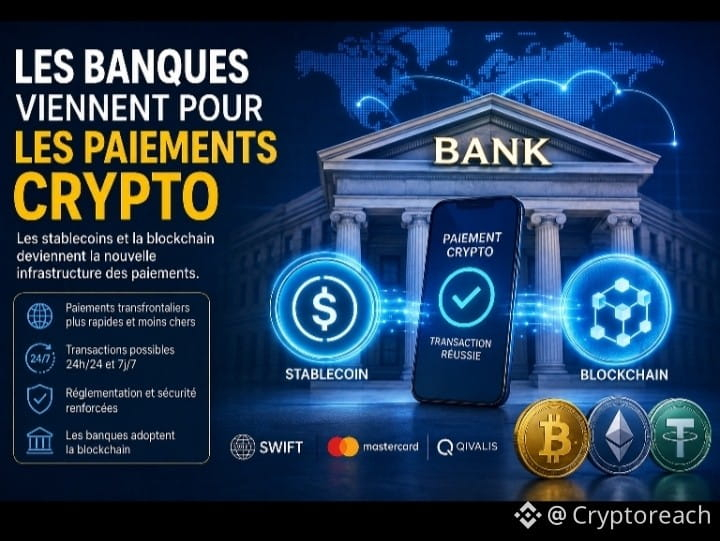
Change is accelerating: banks are no longer just trying to fight cryptocurrencies. They now want to use their infrastructure to move money on the blockchain.
In 2026, several signals are very strong:
* 37 European banks are working together within Qivalis to develop a euro stablecoin intended for payments and on-chain settlements.
* 17 banks from six continents are preparing cross-border transactions using tokenized deposits via SWIFT’s blockchain infrastructure.
* American banks are now exploring their own stablecoins, particularly for commercial payments.
* Mastercard is also developing settlement of transactions with regulated stablecoins, including 24/7 and on weekends.
* The UK even wants to set a specific objective for the Bank of England to promote innovation in digital payments and stablecoins.
- What this means
The real battle might no longer be:
Banks vs Crypto
but rather:
Banks + Blockchain + Stablecoins = a new payments infrastructure.
Bitcoin remains mainly a digital asset. But for everyday and international payments, stablecoins and tokenized deposits could become the bridge between the traditional banking system and the blockchain.
And for Africa, the stakes are huge: cheaper international transfers, 24/7 payments, and better interoperability could profoundly change cross-border payments.
Question: will banks ultimately become the biggest users of blockchain?
$AMZNB $MSFTB $AAPLB
#Crypto #Blockchain #Stablecoins #Bitcoin #Web3 #DeFi #Payments #Banking #Tokenisation #Fintech #Africa #CryptoAfrica
Banks are moving into crypto payments
Change is accelerating: banks are no longer just trying to fight cryptocurrencies. They now want to use their infrastructure to move money on the blockchain.
In 2026, several signals are very strong:
* 37 European banks are working together within Qivalis to develop a euro stablecoin intended for payments and on-chain settlements.
* 17 banks from six continents are preparing cross-border transactions using tokenized deposits via SWIFT’s blockchain infrastructure.
* American banks are now exploring their own stablecoins, particularly for commercial payments.
* Mastercard is also developing settlement of transactions with regulated stablecoins, including 24/7 and on weekends.
* The UK even wants to set a specific objective for the Bank of England to promote innovation in digital payments and stablecoins.
- What this means
The real battle might no longer be:
Banks vs Crypto
but rather:
Banks + Blockchain + Stablecoins = a new payments infrastructure.
Bitcoin remains mainly a digital asset. But for everyday and international payments, stablecoins and tokenized deposits could become the bridge between the traditional banking system and the blockchain.
And for Africa, the stakes are huge: cheaper international transfers, 24/7 payments, and better interoperability could profoundly change cross-border payments.
Question: will banks ultimately become the biggest users of blockchain?
$AMZNB $MSFTB $AAPLB
#Crypto #Blockchain #Stablecoins #Bitcoin #Web3 #DeFi #Payments #Banking #Tokenisation #Fintech #Africa #CryptoAfrica