

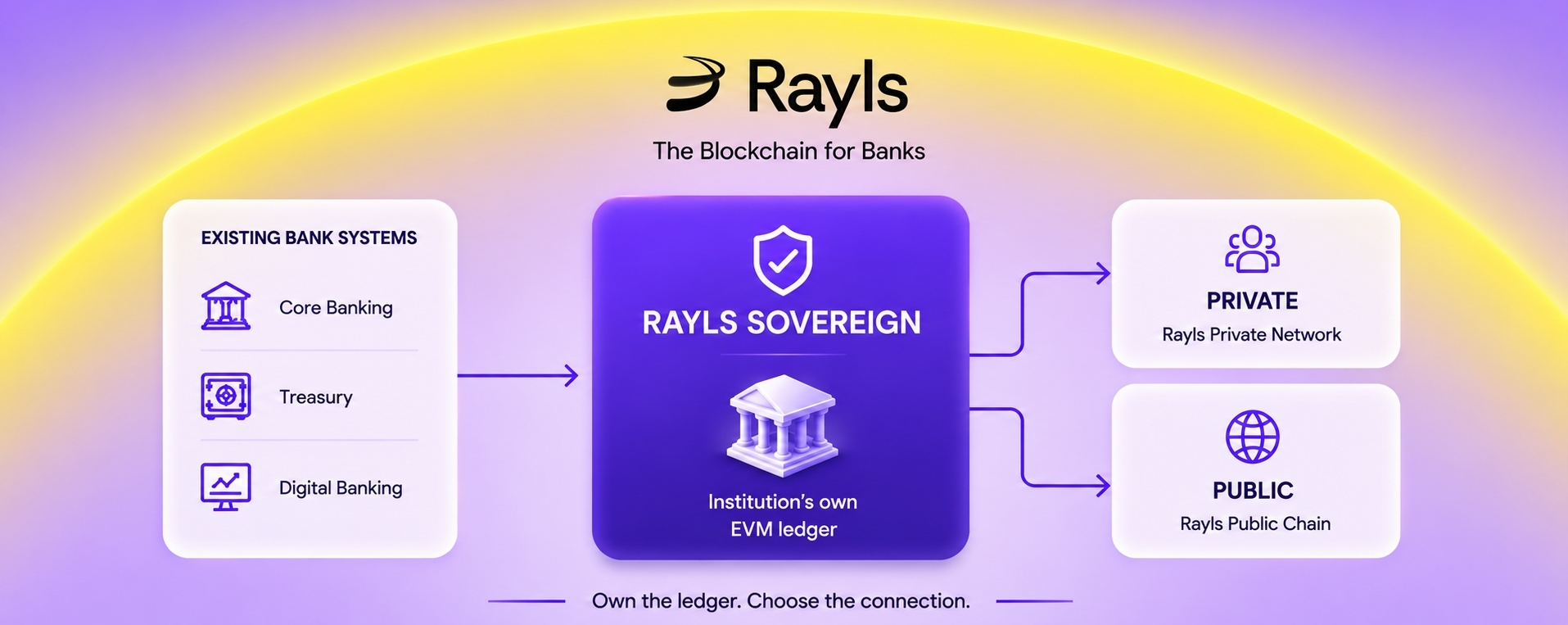

A bank can prove tokenisation works with a prototype.
The harder question is what happens when that prototype has to talk to the systems the bank already depends on.
Core banking. Treasury. Digital banking. Identity and KYC systems.
If the blockchain becomes another isolated system, the bank has created another integration problem instead of solving one.
That is the part of Rayls Sovereign I find most interesting.
The mechanism: Sovereign exposes the ledger through familiar interfaces
Rayls Sovereign is a private EVM compatible blockchain that the institution installs and operates inside its own environment.
The ledger handles the institution's onchain activity, while applications can connect to it through standard interfaces.
The most direct option is Ethereum JSON-RPC.
That means existing Ethereum tooling such as ethers.js, web3.js, viem, Hardhat and Foundry can communicate with the Sovereign ledger without a bespoke blockchain client.
There are also other integration paths.
The Rayls Backend can expose a REST API for transaction construction and custody integration, while WebSocket connections can provide real-time events from the ledger.
So the integration doesn't have to look like:
Bank systems → completely new blockchain stack
It can look more like:
Bank systems → existing integration layer → Sovereign ledger
That distinction matters.
Rayls' documentation specifically describes Sovereign as being able to integrate with core banking platforms, ERP systems, price feeds, identity and KYC stores.
Then the ledger can connect outward
Once an asset or transaction is on the institution's Sovereign ledger, the institution can choose where it needs to go.
For a private institutional transaction:
Sovereign → Private Network Hub → another Sovereign ledger
For public-chain activity:
Sovereign → Rayls Public Chain
Those are not the same route.
The Public Chain connection is a direct one to one path and uses its own contracts and relayer process. It does not go through the Private Network Hub.
That separation is useful because the institution doesn't need to expose its entire internal ledger just because one tokenised asset needs to interact with an external network.
A practical example
Imagine a bank tokenises a deposit.
The bank can issue and manage that asset on its own Sovereign ledger while keeping the ledger inside its own environment.
Its existing systems can interact with the ledger through the available interfaces.
If the deposit later needs to interact with another institution, it can use the Private Network route.
If it needs to reach an application or liquidity on the Public Chain, it has a separate route for that.
The important part is that the bank's internal ledger remains the institution's own ledger.
What changes is its ability to connect that ledger to other environments when there is a business reason to do so.
Why this matters for production
This is where I think the distinction between a blockchain prototype and institutional infrastructure becomes clearer.
A prototype asks:
“Can we put this asset onchain?”
Production asks:
“Can our existing systems operate with that asset without rebuilding the bank around a new stack?”
Sovereign is designed around the second question.
It gives the institution its own EVM ledger, familiar integration interfaces and controlled routes to Rayls Private Networks and the Public Chain.
The underlying platform has also been in production since June 2024, with Rayls stating that Sovereign has been installed and used by 30+ financial institutions.
My takeaway
For institutional blockchain, integration is part of the product.
The interesting thing about Sovereign isn't simply that a bank gets its own blockchain.
It's that the blockchain is designed to sit inside the bank's existing environment while still having defined paths to private and public onchain networks.
CTA: If you're evaluating blockchain infrastructure for an institution, the @Rayls Sovereign architecture is worth examining from the integration layer first.