

As a KOL’s account, quotes, and contact information become increasingly transparent, the KOL resource itself is being commoditized. What’s truly scarce has shifted from “knowing who” to “how to ensure different people play the right roles in the process where expectations form.”
⸻
This article will answer the following questions:
01|As a KOL’s account, quotes, and contact information become increasingly transparent, why do project owners still need a third-party system?
02|Why getting the same KOL doesn’t mean achieving the same market outcome?
03|Why a KOL’s real effectiveness depends on Signal, Role, Timing, and Context?
04 | Why is it that sometimes dozens of KOLs posting at the same time are less effective than a group of nodes in an orderly manner?
05 | How can KOLs transform from "traffic channels" into "market expectation formation nodes"?
06|Market Expectation Systems: What are they really managing – KOLs or the process of market expectation formation?
⸻
Before we get to the main content, let me answer a question that project teams often ask me:
“Now that KOLs’ accounts, prices, and even contact information are becoming more and more transparent, we can directly contact KOLs ourselves, so why do we need you?”
This question is actually entirely valid. If our value is only:
Find KOLs for the project.
As the market becomes more transparent, this value will inevitably decrease. Project teams can certainly build their own KOL database.
You can inquire about the price yourself.
He negotiated the cooperation himself.
AI can even be used to automatically filter accounts, generate briefs, and monitor postings. Therefore, I don't believe that:
"Having a KOL List"
This will be the real barrier in the future. The real issue worth discussing is:
Why do the same KOLs generate completely different market efficiencies in different systems?
⸻
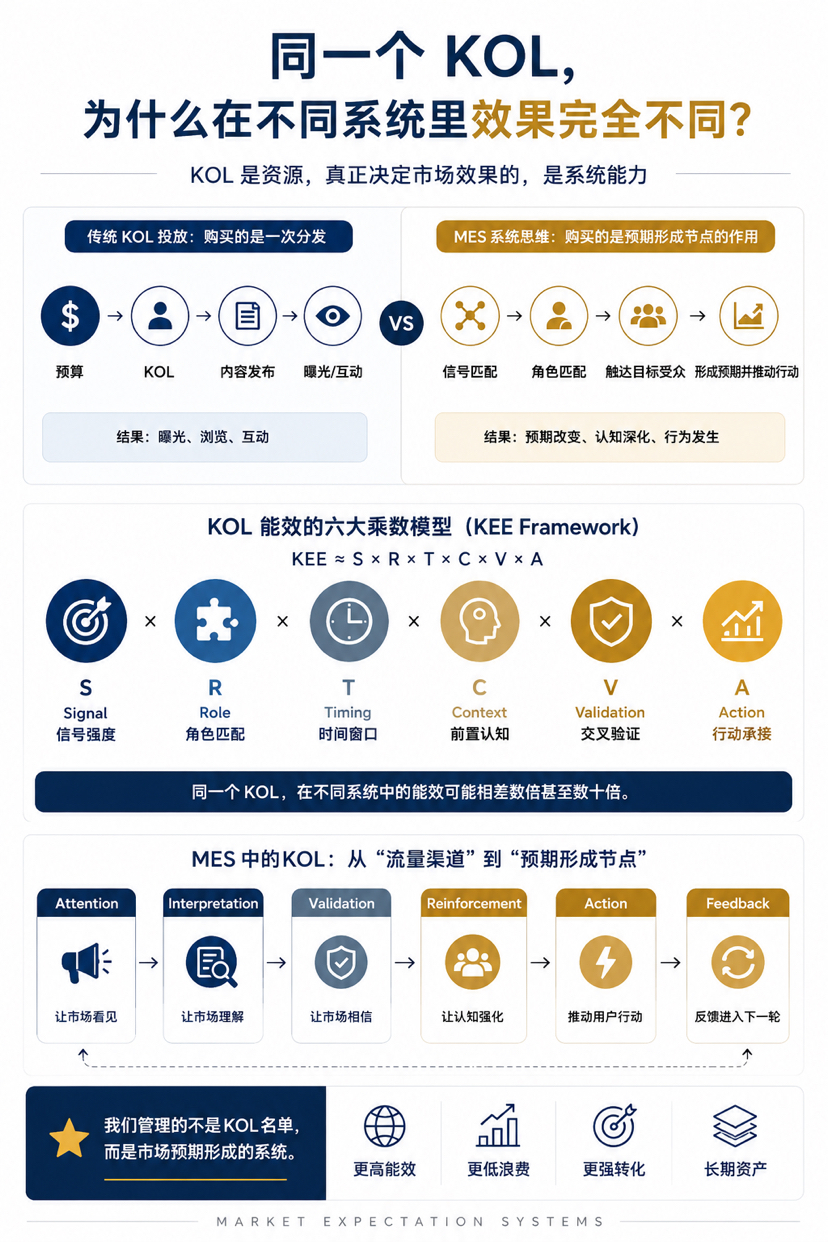
01|Project teams can buy KOLs, but what they usually buy is a one-time distribution.
The simplest KOL collaboration model is:
Budget
↓
AS LONG AS
↓
Content
↓
Exposure
The project team pays. KOLs post the content and receive views, likes, comments, and shares.
In this model, a KOL is essentially a:
Distribution Channel | Information distribution channel.
If the goal is simply to gain exposure, then the project team can certainly accomplish that on their own.
However, Market Expectation Systems has a different understanding of KOLs. We view KOLs as:
Expectation Formation Node
Therefore, we are concerned with more than just:
How many followers does this KOL have?
How much?
What is the average page view count?
Instead:
What is the current state of market perception?
What signals are worth amplifying?
What cognitive tasks should this person undertake?
What do the target users already know before they see him?
What judgment should be formed after seeing this?
What behavior is ultimately desired to occur?
This is no longer a simple KOL promotion. Rather:
Expectation Formation Design。
⸻
02 | The first variable: Signal
Not every message deserves to utilize the same KOL resources.
The difference doesn't necessarily come from KOLs.
And from:
Signal Strength
Therefore, before calling a KOL, we first need to determine the signal strength.
Does this message contain any new information?
Is the market currently concerned about this variable?
……
so:
KOLs cannot create all value.
It first needs a signal worth spreading.
⸻
03 | The Second Variable: Role
The same KOL should not bear all the tasks.
In the previous article, I discussed:
KOLs should not be categorized solely based on the number of followers.
From the perspective of market expectation formation, we pay more attention to its function.
Some people are good at:
Attention
Some people are good at:
Interpretation
Others are skilled at:
Community Reinforcement
Engage in ongoing discussions, answer questions, and reinforce understanding within real-world communities.
Therefore, when selecting a KOL, we don't simply make a judgment:
Is this account any good?
Instead:
"What task should this person accomplish in the formation of market expectations in this round?"
The same account, placed in the wrong location, could result in just one expensive exposure.
If placed in the right position, it can become a crucial part of the process of forming expectations.
⸻
04 | The third variable: Timing
The same person appearing today and five days later may have completely different effects.
Suppose a project has just released a major mechanism upgrade.
On the first day, the market didn't even realize the importance of this.
What might be needed at this time is:
Attention。
Two days later, what was needed had changed to:
Interpretation。
A few days later, the real data began to appear.
Validation。
After that, users generally understood, but took no further action. The problem then became:
Conversion。
so:
The same KOL, appearing at the wrong time, may accomplish the wrong task.
What we are really designing is:
Sequence。
Instead of:
Everyone posts at the same time。
⸻
05 | The fourth variable: Context
This is the layer that I think is most easily underestimated.
Users never see KOL content in a vacuum.
Before seeing this content,
He may have already seen:
Project announcement.
The founder explained.
Another researcher's analysis.
……
A preliminary judgment has even been formed.
Therefore, the same sentence can have completely different meanings in different contexts.
For example:
“Protocol Revenue increased significantly.”
If the market is hearing about this project for the first time, it might just be a data point. But if the market already understands it:
New mechanism
↓
Changes in user behavior
↓
Growth in transaction activity
So when the Revenue data appears, it's no longer just a number. It becomes:
Validation。
It is telling the market:
The previous judgment may be being validated by reality.
Therefore, MES is not just about design:
Who said what?
Also need to design:
How will the market interpret this statement?
⸻
06 | The fifth variable: Validation
Ten KOLs repeating the same statement does not equate to ten pieces of evidence.
This is a problem that is very common in traditional campaigns.
if:
20 accounts
Within two days, they used very similar expressions to tell the market:
“Project X is undervalued.”
The market is easy to identify:
This is a campaign that can generate attention, but not necessarily increase belief.
because:
Repetition ≠ Validation
The real verification should come from different roles.
The official facts are provided.
↓
The founder explained his intentions.
↓
Researchers explain the mechanism.
↓
Partners validate the application's value through practical collaboration.
↓
Users generate real usage behavior.
↓
Further verification was conducted using on-chain data.
This information is not a simple repetition. It is a completion:
Cross-validation.
⸻
07 | The Sixth Variable: Action
KOL launch is not the end.
Traditional campaigns easily stop at:
Views。
Likes。
Comments。
Retweets。
But if we are doing market expectation management...
We must continue asking:
Then what?
After the user read it:
Did you search for the project?
Have you entered the community yet?
Have you tried out the product?
Have the developers started reading the documentation?
Have new partners started contacting you about the project?
Did the user take any on-chain actions?
Has the structure of community discussions changed?
Therefore, before each use of a KOL, there should be one question:
What judgments do we hope his target users will form, and what next steps will they take?
If this question has no answer, then this content may never have been prepared for publication.
because:
KOLs are not the end goal.
Behavior is what matters.
⸻
08 | Therefore, the energy efficiency of the same KOL is actually a result of a system.
We can temporarily abstract this relationship as:
KOL Expectation Effectiveness
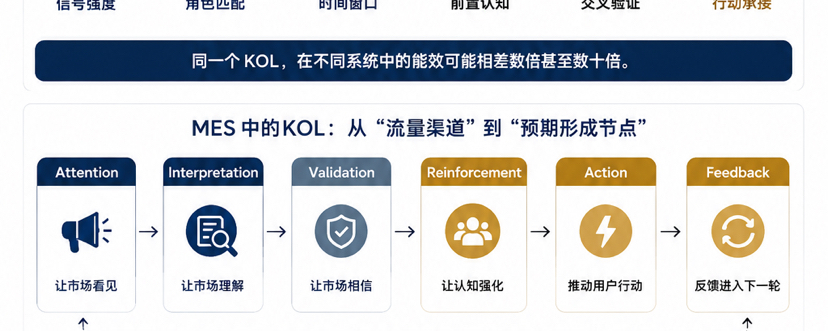
KEE ≈ S × R × T × C × V × A
in:
S|Signal Strength
R|Role Fit
T | Timing Fit Time Window
C | Context Fit: Prior Knowledge
V | Validation Strength Cross-validation
A|Action Path
This is not a mathematical formula for calculating precise results.
Rather, it's a framework for understanding KOL energy efficiency. It explains why:
The same KOL.
Same price.
Even with the same number of views.
The resulting market value may be completely different.
⸻
09 | The project team purchased 10 Posts, but we want to organize 10 Nodes.
This is probably the most fundamental difference between the two models.
The traditional model might be:
10 TODAY
↓
10 Posts
↓
1M Views
↓
Campaign End
Market Expectation Systems aims to create:
Signal
↓
Attention Node
↓
Interpretation Node
↓
Community Node
↓
External Validation
↓
Behavior
↓
Data
↓
Expectation Update
At this point, KOLs are no longer just a group of independent accounts. They have become:
Expectation Network
Different nodes in the process.
⸻
10 | This is also why "KOL price transparency" does not eliminate system value.
On the contrary, I believe the future will be:
The list of KOLs will become increasingly transparent.
Prices will become increasingly transparent.
Data will become increasingly transparent.
AI can even help projects automatically find and connect with a large number of KOLs.
therefore:
The value of Access itself will inevitably decrease.
But another ability will become increasingly important:
Orchestration | System orchestration capability.
When will the spread stop?
When should we let the data speak for itself?
Once the user has formed a judgment, how should the action be carried out?
This is the problem that the system truly solves.
⸻
11 | Therefore, we do not believe that "KOL resources" themselves are the ultimate barrier.
We have our own KOL network, which is certainly an execution advantage.
But if the barriers to entry for Market Expectation Systems are ultimately just:
"We've met more KOLs."
Then this barrier is not enough.
What we should truly accumulate continuously is another type of asset:
Signal Type
×
Market State
×
KOL Function
×
Timing
×
Content
×
Audience Response
×
Behavioral Response
After long-term recording, what we truly hope to achieve is:
Expectation Response Database
That is to say:
What type of signal, in what market condition, through what type of people, and at what time sequence, is more likely to change the judgments and behaviors of which type of users?
This is a more important long-term asset than a KOL list.
⸻
12 | Ultimately, what we're really selling isn't KOLs.
If a project only requires 20 accounts to post content, the project team can do it themselves. In fact, AI will likely make this even cheaper in the future.
Market Expectation Systems is actually trying to solve a different problem:
How can we, within a limited time window, organize the real changes that are happening in a project into a set of new expectations that can be seen, understood, believed, verified by the market, and ultimately translated into action?
KOLs are just one type of resource.
Like official accounts, founders, media, researchers, community partners, on-chain data, and product data, they collectively constitute a system.
So the real difference is not:
"Can we find this KOL?"
Instead:
“We know why we need him right now, and what the next step should be after he appears.”
⸻
This is also my final answer to this question.
The outcome is never solely determined by the KOL themselves.
Instead:
Signal × Role × Timing × Context × Validation × Action。
so:
KOLs are resources.
Expectation formation is the system.
KOLs are resources.
The true capability lies in how to leverage diverse resources to drive new market judgments and actions.
This is the barrier that Market Expectation Systems truly hopes to build.
This is not investment advice, but only a study of Web3 market expectations, growth mechanisms, and influence networks.
#Web3#KOL#MarketExpectation#NarrativeStrategy#Growth#Community#BinanceSquare#ETH #bnb #uniswap
⸻