
Gie Alzam
3.8k Posts

Gie Alzam
content creator, learn n learn
High-Frequency Trader
1.2 Years
3.6K+ Following
26.4K+ Followers
6.6K+ Liked
Posts
All
Quotes
Live
PINNED
Big waves don’t always come with loud noise.
Sometimes they appear slowly, and then when everyone realizes it… everything has already moved.
LUCIC is not just a name that passes by on a timeline.
Behind it, there’s a community that keeps coming together, sharing, and pushing this story forward.
Today it may still look small.
But every great journey always starts from a single point.
One community.
One belief.
One step forward.
Don’t be too busy guessing the peak.
Look at who’s still walking when the hype starts to fade.
LUCIC, the journey has only begun.
#LUCiC透明契约
Sometimes they appear slowly, and then when everyone realizes it… everything has already moved.
LUCIC is not just a name that passes by on a timeline.
Behind it, there’s a community that keeps coming together, sharing, and pushing this story forward.
Today it may still look small.
But every great journey always starts from a single point.
One community.
One belief.
One step forward.
Don’t be too busy guessing the peak.
Look at who’s still walking when the hype starts to fade.
LUCIC, the journey has only begun.
#LUCiC透明契约
LUCIC Light Gathering
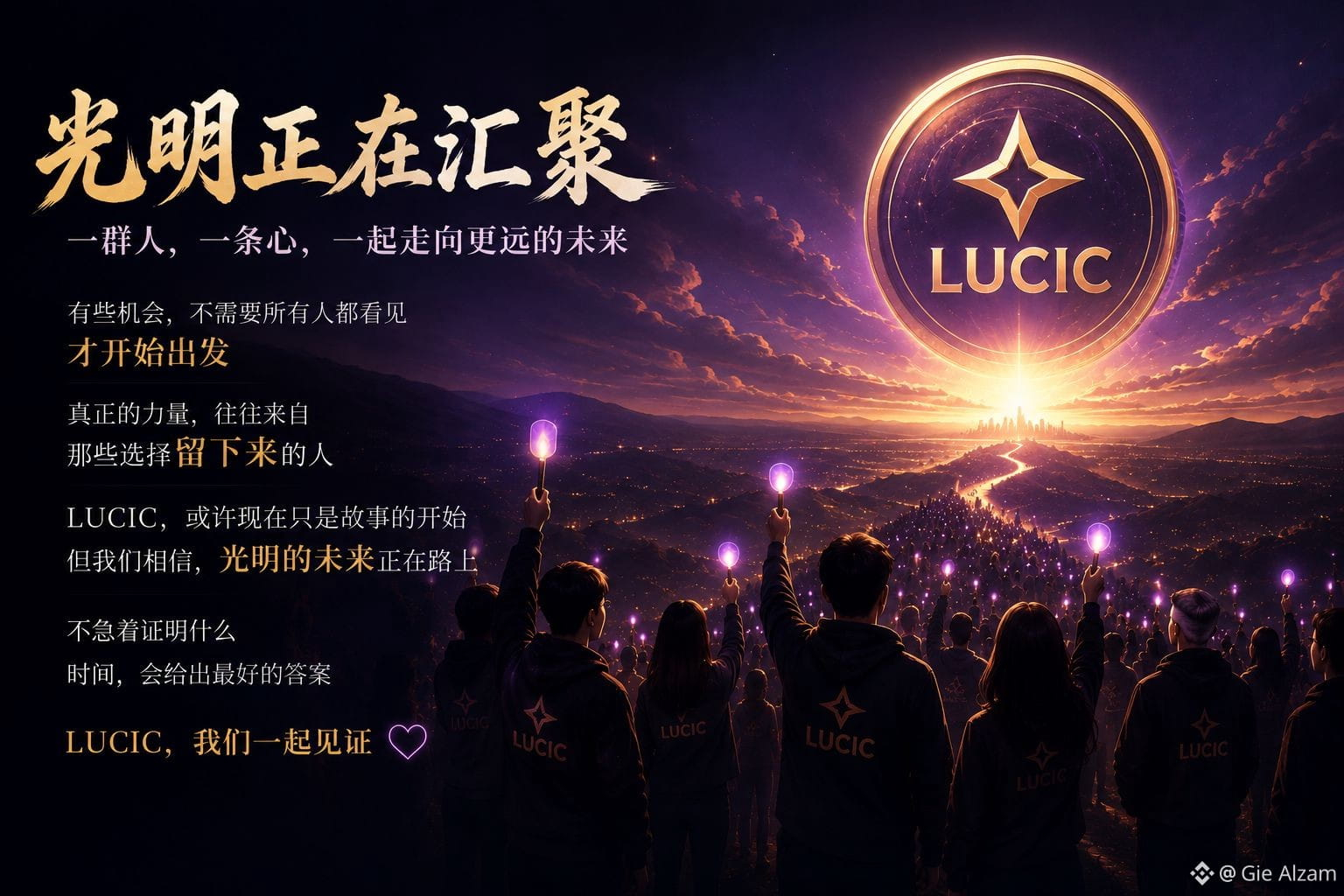
There are opportunities that don't need everyone to notice them before they start moving.
True strength often comes from people who choose to stay.
LUCIC—maybe this is only the beginning of a story.
But slowly, more and more people gather.
More voices are heard.
More choose to walk together.
One person might be able to walk faster.
But a group of people can go farther.
The community keeps moving.
No need to rush to prove anything.
Let time provide the answers.
LUCIC, let's see together where this journey takes us. ✨
@光明社区-亮总 @一休哥168 @静姐6888
There are opportunities that don't need everyone to notice them before they start moving.
True strength often comes from people who choose to stay.
LUCIC—maybe this is only the beginning of a story.
But slowly, more and more people gather.
More voices are heard.
More choose to walk together.
One person might be able to walk faster.
But a group of people can go farther.
The community keeps moving.
No need to rush to prove anything.
Let time provide the answers.
LUCIC, let's see together where this journey takes us. ✨
@光明社区-亮总 @一休哥168 @静姐6888
Good morning, everyone 💪💪
There’s one thing I think needs to be evaluated from the Dusk Livestream campaign, especially the reward system based on trading volume.
If the campaign’s goal is truly to increase DUSK trading activity, why should what gets counted be restricted by certain eligibility criteria—so that trading with smaller capital ultimately doesn’t count?
In the live session, the reality is that not all viewers are traders with large capital. Many have small capital, but they still want to learn, follow the live, and try trading DUSK after getting the education.
I personally have invited the audience to trade DUSK while also explaining the project and its technology. But when their transactions don’t meet the eligibility criteria, their activity practically doesn’t contribute to the reward calculation.
In my opinion, this creates a fairness issue.
If the reward depends too much on large volumes, the campaign could end up turning into a “competition of capital”, not a competition of engagement. Those with large capital have a much bigger advantage in generating volume.
Meanwhile, the purpose of the livestream shouldn’t be only to find a few big traders, but to bring more people to know Dusk and interact with it.
Maybe it could be considered to have a system that still counts the activity of small-cap traders—for example, through weighted points based on trading activity, not just the nominal volume or the eligibility threshold.
Because 10 active small traders are also engagement, not just numbers that can be ignored.
If Binance Square and Dusk want to build a wider community, in my view the rewards shouldn’t only benefit those with large capital, but also creators who successfully bring and educate smaller communities.
Volume is important. But if the way to get it only benefits large capital, the part that grows may not actually be the community—it could just be the volume.
@Dusk $DUSK #dusk
@Binance Square Official
@三月 - M A R C H @POXY_ @大丽7613 @Ajibata SAMOSIR
There’s one thing I think needs to be evaluated from the Dusk Livestream campaign, especially the reward system based on trading volume.
If the campaign’s goal is truly to increase DUSK trading activity, why should what gets counted be restricted by certain eligibility criteria—so that trading with smaller capital ultimately doesn’t count?
In the live session, the reality is that not all viewers are traders with large capital. Many have small capital, but they still want to learn, follow the live, and try trading DUSK after getting the education.
I personally have invited the audience to trade DUSK while also explaining the project and its technology. But when their transactions don’t meet the eligibility criteria, their activity practically doesn’t contribute to the reward calculation.
In my opinion, this creates a fairness issue.
If the reward depends too much on large volumes, the campaign could end up turning into a “competition of capital”, not a competition of engagement. Those with large capital have a much bigger advantage in generating volume.
Meanwhile, the purpose of the livestream shouldn’t be only to find a few big traders, but to bring more people to know Dusk and interact with it.
Maybe it could be considered to have a system that still counts the activity of small-cap traders—for example, through weighted points based on trading activity, not just the nominal volume or the eligibility threshold.
Because 10 active small traders are also engagement, not just numbers that can be ignored.
If Binance Square and Dusk want to build a wider community, in my view the rewards shouldn’t only benefit those with large capital, but also creators who successfully bring and educate smaller communities.
Volume is important. But if the way to get it only benefits large capital, the part that grows may not actually be the community—it could just be the volume.
@Dusk $DUSK #dusk
@Binance Square Official
@三月 - M A R C H @POXY_ @大丽7613 @Ajibata SAMOSIR
Market never waits for everyone.
When the crowd starts talking,
the early ones are already watching the next move.
LUCIC.
No noise.
No endless explanations.
Just a community that keeps showing up.
Small today.
But small doesn't mean weak.
Every big move starts before the crowd notices.
So don't ask why people are watching LUCIC.
Ask yourself:
What if you're watching too late?
$LUCIC
#LUCIC @光明社区-亮总
When the crowd starts talking,
the early ones are already watching the next move.
LUCIC.
No noise.
No endless explanations.
Just a community that keeps showing up.
Small today.
But small doesn't mean weak.
Every big move starts before the crowd notices.
So don't ask why people are watching LUCIC.
Ask yourself:
What if you're watching too late?
$LUCIC
#LUCIC @光明社区-亮总
Why Did Dusk Enter Binance CreatorPad Twice?
If Dusk only entered CreatorPad once, it might just be considered regular marketing activity.
But Dusk has entered Binance CreatorPad twice in 2026. And compared to the first time, the approach is quite interesting.
The first campaign ran from 8 January to 9 February 2026, with a reward pool of 3,059,210 DUSK. Participants weren’t only asked to create content, but also to follow the account, post on X, and trade DUSK.
That means the first campaign already combined content, social engagement, and trading activity.
Then Dusk returned to CreatorPad from 13–26 August 2026, with a reward of 480,000 DUSK plus a Square Live track with rewards up to 40,000 USDC.
In my opinion, this shows a shift from awareness → engagement.
But don’t immediately assume that entering CreatorPad twice automatically means Dusk will definitely succeed.
More content ≠ more users. Trading volume ≠ adoption. And rewards ≠ loyalty.
The real test starts after the campaign is over.
Will creators still talk about Dusk without incentives? Will traders keep using DUSK? Will developers and the ecosystem continue to grow?
Because CreatorPad can help introduce people to Dusk.
But what keeps them around is the product, the technology, and the ecosystem.
So for me, two times of CreatorPad isn’t proof that Dusk has already won.
It’s actually an opportunity to see whether the awareness built can turn into real adoption.
#dusk $DUSK @Dusk
If Dusk only entered CreatorPad once, it might just be considered regular marketing activity.
But Dusk has entered Binance CreatorPad twice in 2026. And compared to the first time, the approach is quite interesting.
The first campaign ran from 8 January to 9 February 2026, with a reward pool of 3,059,210 DUSK. Participants weren’t only asked to create content, but also to follow the account, post on X, and trade DUSK.
That means the first campaign already combined content, social engagement, and trading activity.
Then Dusk returned to CreatorPad from 13–26 August 2026, with a reward of 480,000 DUSK plus a Square Live track with rewards up to 40,000 USDC.
In my opinion, this shows a shift from awareness → engagement.
But don’t immediately assume that entering CreatorPad twice automatically means Dusk will definitely succeed.
More content ≠ more users. Trading volume ≠ adoption. And rewards ≠ loyalty.
The real test starts after the campaign is over.
Will creators still talk about Dusk without incentives? Will traders keep using DUSK? Will developers and the ecosystem continue to grow?
Because CreatorPad can help introduce people to Dusk.
But what keeps them around is the product, the technology, and the ecosystem.
So for me, two times of CreatorPad isn’t proof that Dusk has already won.
It’s actually an opportunity to see whether the awareness built can turn into real adoption.
#dusk $DUSK @Dusk
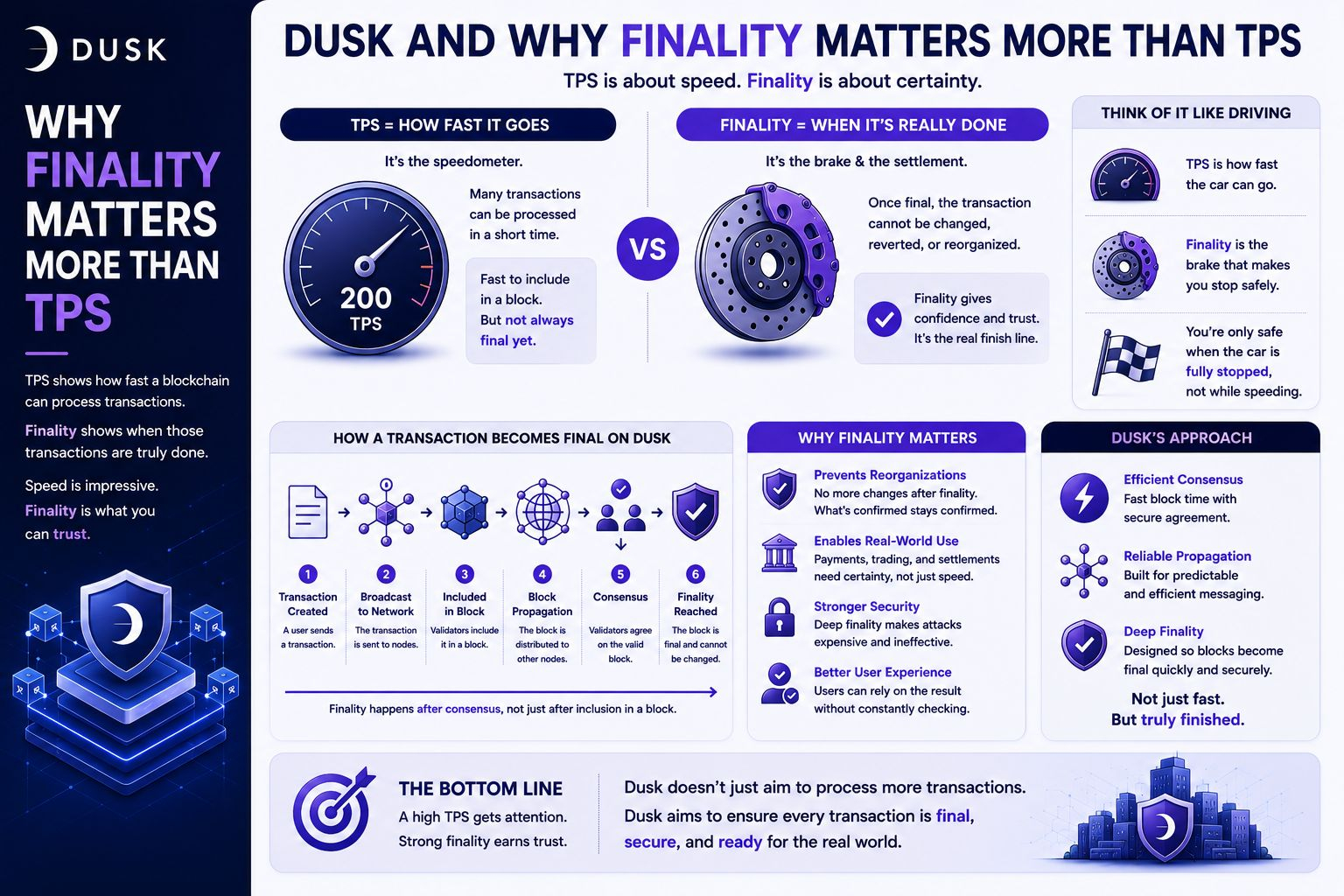
Dusk and Why Finality Matters More Than TPS
In crypto, we often see blockchains showcased through TPS numbers.
“Can handle thousands of transactions per second!”
Cool, sure. But in my opinion, there’s an equally important question:
Are the transactions truly final? 😅
Think of it like a motorbike: TPS is like talking about how fast the bike can go. But if the brakes aren’t clear and we still have to wait until it fully stops, speed alone isn’t enough.
It’s the same with a blockchain.
TPS tells you how many transactions can be processed within a given time period. But finality is about when that transaction is considered fully final—no longer something you need to worry about changing due to the consensus process.
This matters because fast inclusion into a block doesn’t necessarily mean settlement is already complete.
That’s where consensus, validators, block propagation, latency, and finality are all connected.
Dusk doesn’t just need to process transactions quickly, but also ensure the network has a consensus mechanism that lets all nodes reach a shared decision safely.
So when looking at blockchain performance, don’t just focus on TPS figures.
Because a good blockchain isn’t only the one that can say:
“I can process lots of transactions.”
But also the one that can answer:
“I know when a transaction is truly finished.”
And in my opinion, that’s where finality becomes much more interesting than just a big TPS number.
#dusk $DUSK @Dusk
In crypto, we often see blockchains showcased through TPS numbers.
“Can handle thousands of transactions per second!”
Cool, sure. But in my opinion, there’s an equally important question:
Are the transactions truly final? 😅
Think of it like a motorbike: TPS is like talking about how fast the bike can go. But if the brakes aren’t clear and we still have to wait until it fully stops, speed alone isn’t enough.
It’s the same with a blockchain.
TPS tells you how many transactions can be processed within a given time period. But finality is about when that transaction is considered fully final—no longer something you need to worry about changing due to the consensus process.
This matters because fast inclusion into a block doesn’t necessarily mean settlement is already complete.
That’s where consensus, validators, block propagation, latency, and finality are all connected.
Dusk doesn’t just need to process transactions quickly, but also ensure the network has a consensus mechanism that lets all nodes reach a shared decision safely.
So when looking at blockchain performance, don’t just focus on TPS figures.
Because a good blockchain isn’t only the one that can say:
“I can process lots of transactions.”
But also the one that can answer:
“I know when a transaction is truly finished.”
And in my opinion, that’s where finality becomes much more interesting than just a big TPS number.
#dusk $DUSK @Dusk
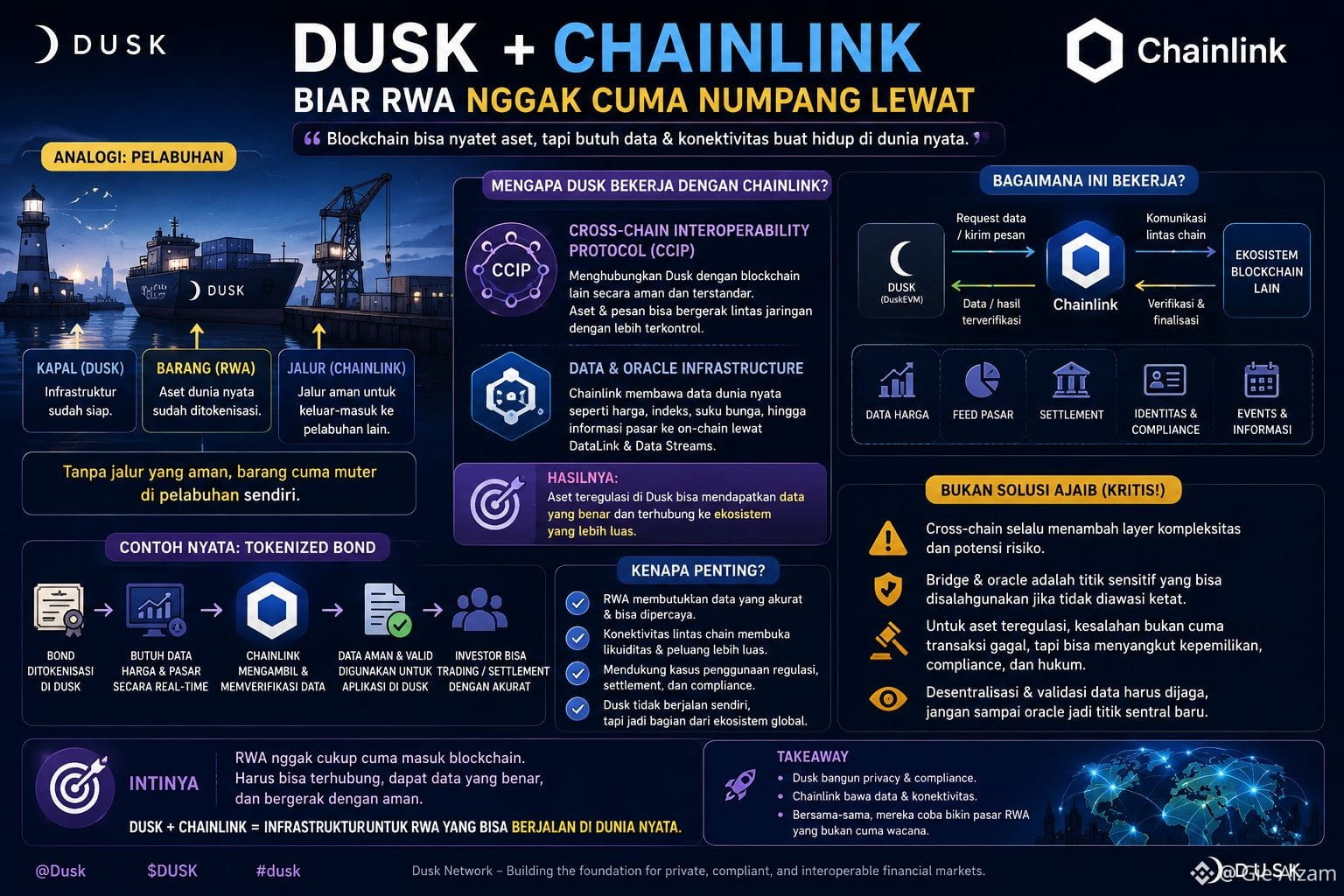
When talking about RWA, people usually get busy discussing, “Has the asset already been tokenized?” Meanwhile, there’s another issue: the token must be able to communicate with the outside world.
Imagine Dusk as a port. The ships are ready, the goods are packed, but if there isn’t a safe route to other ports, the goods just keep circling around there.
That’s where Chainlink becomes interesting. Dusk works with Chainlink for cross-chain connectivity via CCIP and access to on-chain market data. So the asset running on Dusk has the opportunity to connect with a broader blockchain ecosystem.
For example, a tokenized bond. A blockchain can record ownership, but it still needs price data, market information, and even communication with other networks.
But I also don’t want to say that “Dusk + Chainlink = RWA is automatically done.” Cross-chain still has its own complexity and risks. Especially if the transferred assets are regulated—one wrong step, and it’s not just a failed transaction; it can also touch compliance and ownership.
So what’s compelling isn’t merely the partnership, but whether data, interoperability, privacy, and compliance can truly produce an RWA market that’s actually used in the real world.
Because RWA isn’t enough to just be on a blockchain. It has to be able to move, too.
#dusk $DUSK @Dusk
Imagine Dusk as a port. The ships are ready, the goods are packed, but if there isn’t a safe route to other ports, the goods just keep circling around there.
That’s where Chainlink becomes interesting. Dusk works with Chainlink for cross-chain connectivity via CCIP and access to on-chain market data. So the asset running on Dusk has the opportunity to connect with a broader blockchain ecosystem.
For example, a tokenized bond. A blockchain can record ownership, but it still needs price data, market information, and even communication with other networks.
But I also don’t want to say that “Dusk + Chainlink = RWA is automatically done.” Cross-chain still has its own complexity and risks. Especially if the transferred assets are regulated—one wrong step, and it’s not just a failed transaction; it can also touch compliance and ownership.
So what’s compelling isn’t merely the partnership, but whether data, interoperability, privacy, and compliance can truly produce an RWA market that’s actually used in the real world.
Because RWA isn’t enough to just be on a blockchain. It has to be able to move, too.
#dusk $DUSK @Dusk
When talking about privacy on the blockchain, discussions are sometimes too black-and-white: transparent or private.
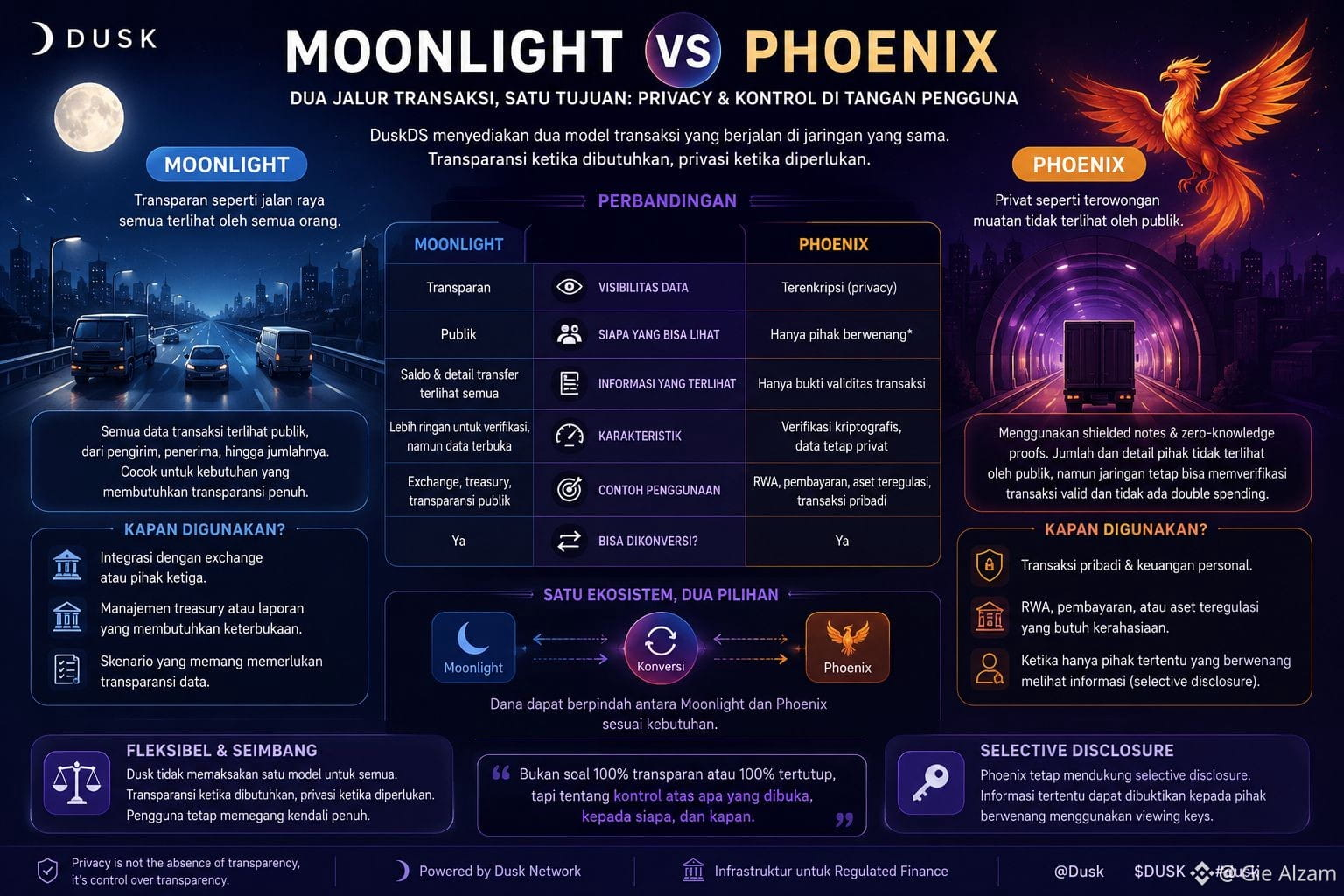
Dusk, however, takes a more flexible approach. At the DuskDS level, there are two transaction models: Moonlight and Phoenix. Both run on the same network, but they have different functions.
Imagine you have two lanes on the same road.
The first lane is Moonlight. Everyone can see the vehicles passing by: where they come from, where they’re going, and how much cargo they’re carrying. In this model, balances and transfer details are indeed public. This fits needs that require transparency, such as some treasury activities or exchange integrations.
The second lane is Phoenix. The vehicles still travel, but their cargo isn’t displayed along the roadside. Phoenix uses shielded notes and zero-knowledge proofs so the transferred amount and information about certain parties aren’t visible to the public, while the network can still verify that transactions are valid and prevent double spending.
What I find interesting is that Dusk doesn’t force all transactions into a single model.
Need transparency? Use Moonlight.
Need confidentiality? There’s Phoenix.
Even both can be used within one ecosystem, and funds can be converted between the Moonlight and Phoenix models.
But don’t misunderstand it either. Phoenix doesn’t mean “everything disappears and can’t be audited.” Dusk supports selective disclosure through viewing keys when specific information needs to be proven to authorized parties.
In my opinion, that’s exactly where the Dusk concept becomes interesting.
Because the financial world doesn’t always need 100% transparency, but it also can’t always accept 100% closure.
What’s often needed is control over what’s disclosed, to whom, and when.
And Moonlight + Phoenix is Dusk’s way of trying to provide that flexibility at the transaction level.
#dusk $DUSK @Dusk
Dusk, however, takes a more flexible approach. At the DuskDS level, there are two transaction models: Moonlight and Phoenix. Both run on the same network, but they have different functions.
Imagine you have two lanes on the same road.
The first lane is Moonlight. Everyone can see the vehicles passing by: where they come from, where they’re going, and how much cargo they’re carrying. In this model, balances and transfer details are indeed public. This fits needs that require transparency, such as some treasury activities or exchange integrations.
The second lane is Phoenix. The vehicles still travel, but their cargo isn’t displayed along the roadside. Phoenix uses shielded notes and zero-knowledge proofs so the transferred amount and information about certain parties aren’t visible to the public, while the network can still verify that transactions are valid and prevent double spending.
What I find interesting is that Dusk doesn’t force all transactions into a single model.
Need transparency? Use Moonlight.
Need confidentiality? There’s Phoenix.
Even both can be used within one ecosystem, and funds can be converted between the Moonlight and Phoenix models.
But don’t misunderstand it either. Phoenix doesn’t mean “everything disappears and can’t be audited.” Dusk supports selective disclosure through viewing keys when specific information needs to be proven to authorized parties.
In my opinion, that’s exactly where the Dusk concept becomes interesting.
Because the financial world doesn’t always need 100% transparency, but it also can’t always accept 100% closure.
What’s often needed is control over what’s disclosed, to whom, and when.
And Moonlight + Phoenix is Dusk’s way of trying to provide that flexibility at the transaction level.
#dusk $DUSK @Dusk
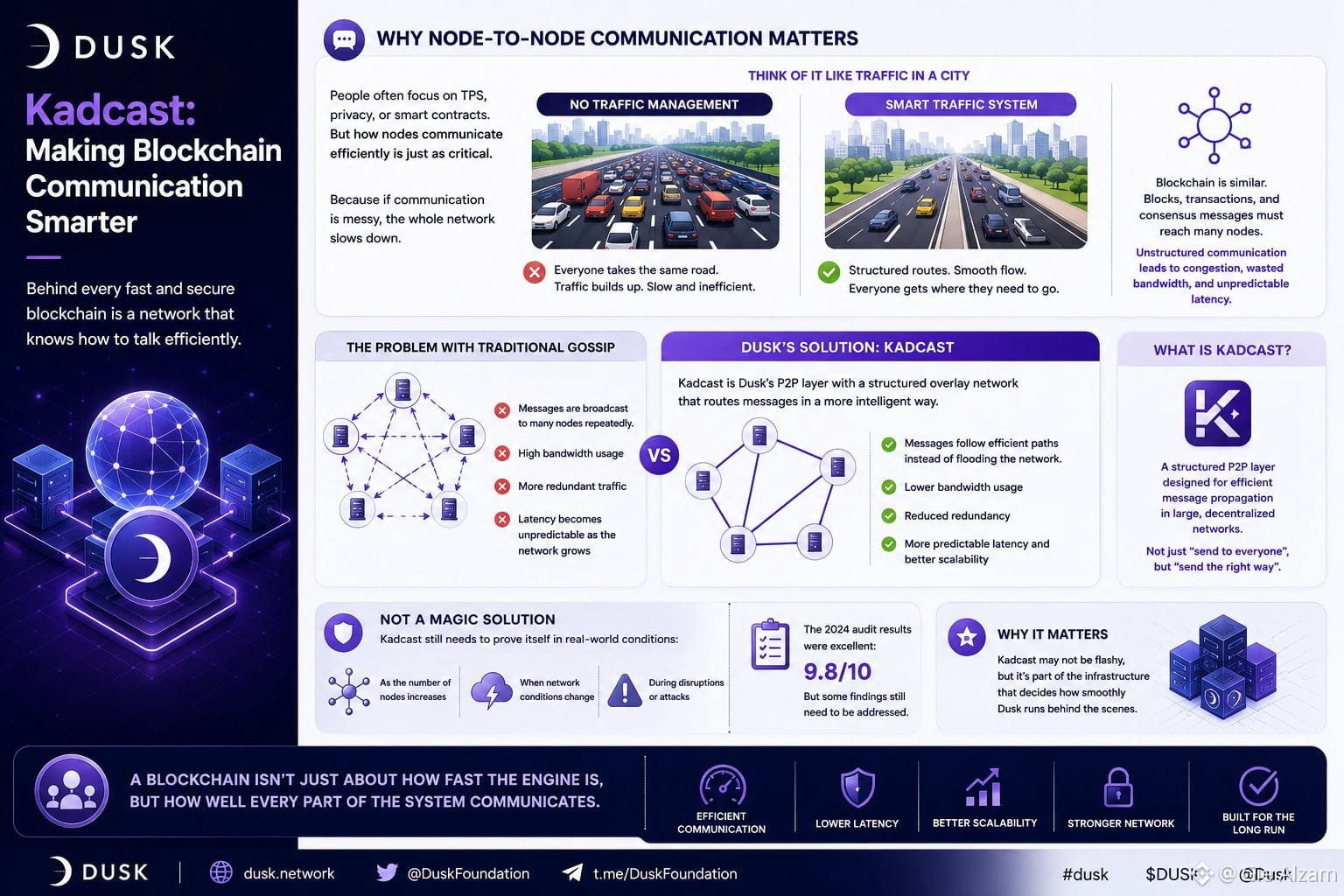
When talking about blockchain, people usually focus on TPS, privacy, or smart contracts. But there’s something just as important: how can all nodes communicate with each other without turning the network into a mess?
Imagine a city’s road system. If every vehicle is free to choose its own lane and everything ends up on the same road, eventually there will be traffic buildup. Not because the vehicles are slow, but because the distribution system isn’t efficient.
Blockchain has a similar problem. Blocks, transactions, and consensus messages must be broadcast to many nodes. The gossip model is simple, but as the network grows, repeated communication can waste bandwidth and make latency less predictable.
Dusk uses Kadcast, a P2P layer with a structured overlay that makes message dissemination more targeted. So it’s not just “send it to anyone,” but a structure that helps messages find more efficient distribution paths.
But in my opinion, Kadcast also shouldn’t be taken as an instant magical solution. Systems like this still need to be tested as the number of nodes increases, network conditions change, or disruptions occur. The 2024 audit delivered very positive results with a score of 9.8/10, but some findings still need improvement.
That’s what’s interesting. Kadcast isn’t a flashy feature you can easily notice from the outside—it’s part of the infrastructure that determines how neatly Dusk operates behind the scenes.
Because blockchain isn’t only about how fast the machines are, but also how smoothly all the components inside it communicate.
#dusk $DUSK @Dusk
Imagine a city’s road system. If every vehicle is free to choose its own lane and everything ends up on the same road, eventually there will be traffic buildup. Not because the vehicles are slow, but because the distribution system isn’t efficient.
Blockchain has a similar problem. Blocks, transactions, and consensus messages must be broadcast to many nodes. The gossip model is simple, but as the network grows, repeated communication can waste bandwidth and make latency less predictable.
Dusk uses Kadcast, a P2P layer with a structured overlay that makes message dissemination more targeted. So it’s not just “send it to anyone,” but a structure that helps messages find more efficient distribution paths.
But in my opinion, Kadcast also shouldn’t be taken as an instant magical solution. Systems like this still need to be tested as the number of nodes increases, network conditions change, or disruptions occur. The 2024 audit delivered very positive results with a score of 9.8/10, but some findings still need improvement.
That’s what’s interesting. Kadcast isn’t a flashy feature you can easily notice from the outside—it’s part of the infrastructure that determines how neatly Dusk operates behind the scenes.
Because blockchain isn’t only about how fast the machines are, but also how smoothly all the components inside it communicate.
#dusk $DUSK @Dusk
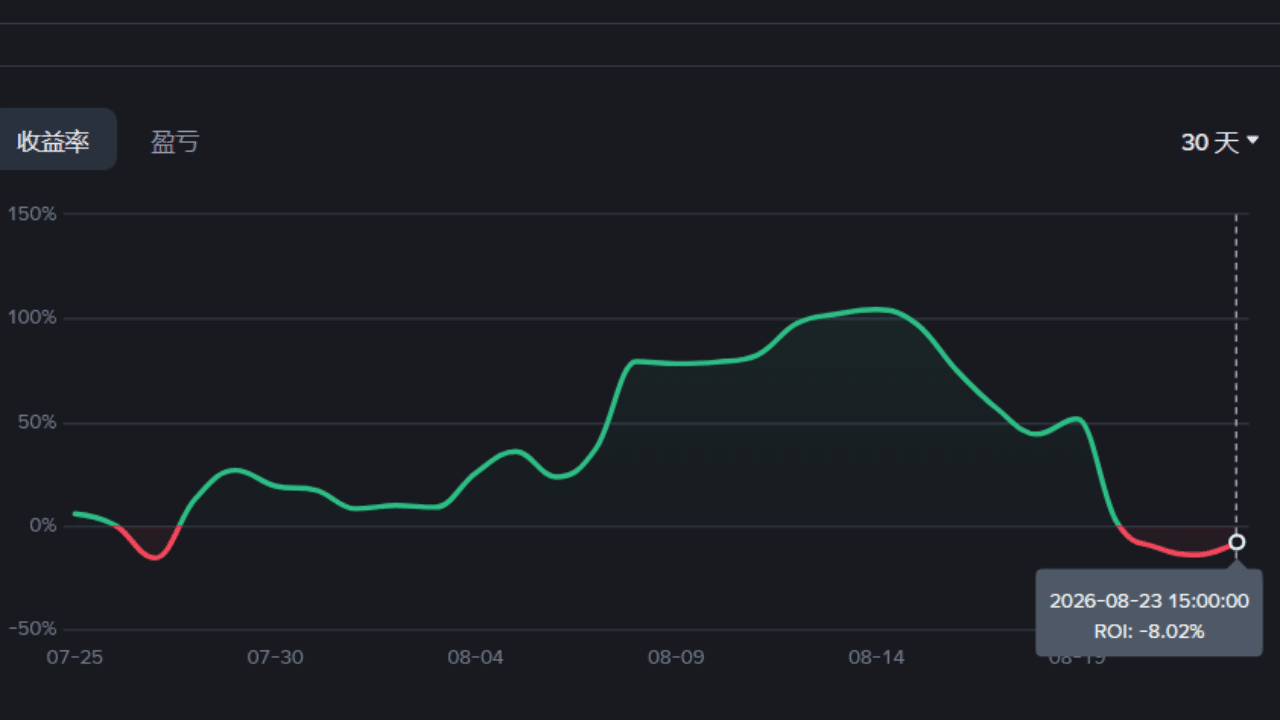
30D trade $DUSK 153.5 USDT
Zedger: RWA Is Not Just About Making Tokens
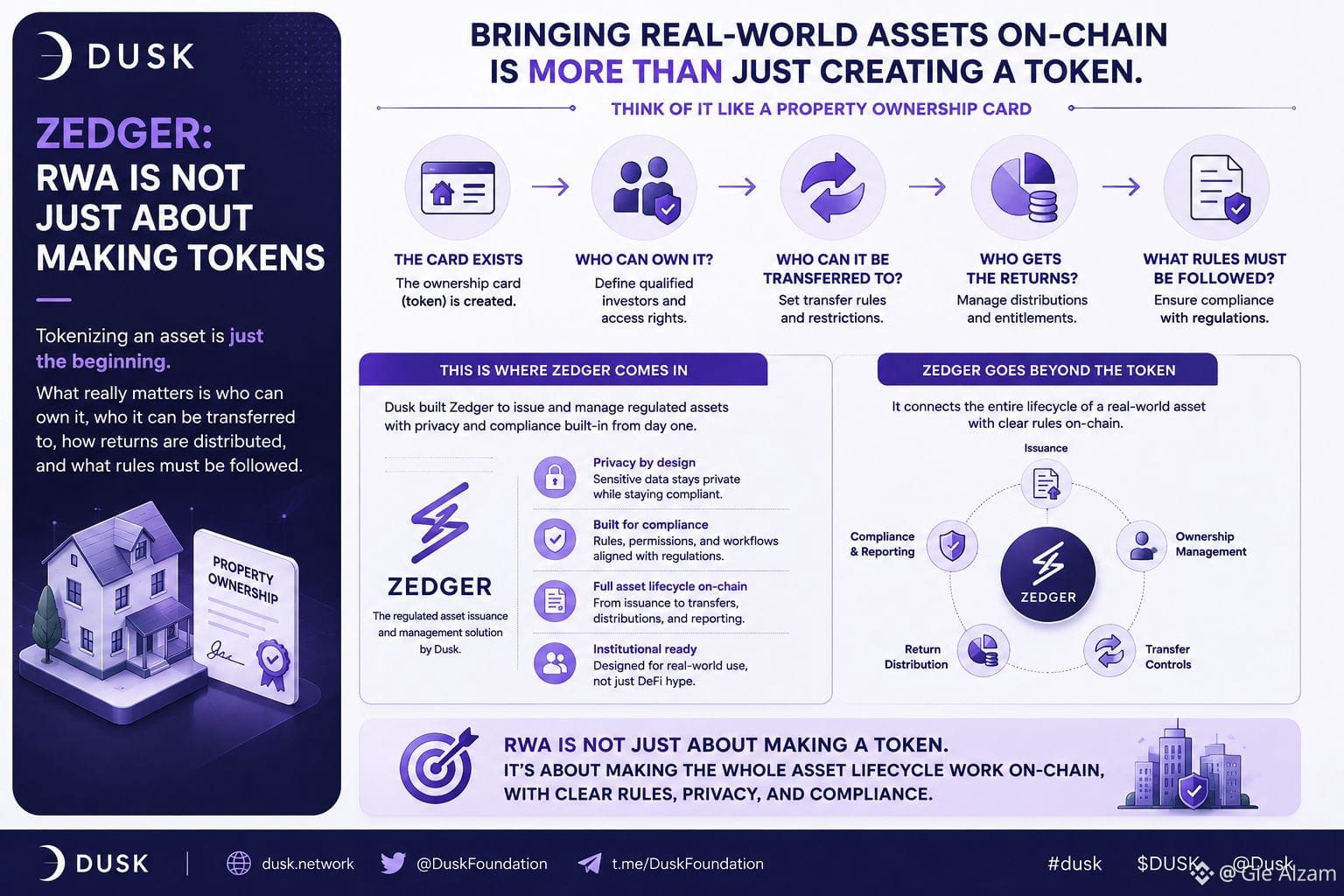
When talking about RWA, we often focus on one thing: the asset has been tokenized. But making tokens is only the beginning.
It’s like making a house ownership card. What matters isn’t just that the card exists, but who is allowed to own it, who it can be transferred to, how the returns are divided, and what rules must be followed.
This is where Zedger gets interesting. Dusk designed Zedger to handle the issuance and management of regulated assets with privacy and compliance that have been considered from the very start.
So it’s not just:
“Here’s your token.”
But also:
“Who’s allowed to own it?”
“Who can it be transferred to?”
“Who is entitled to receive the returns?”
In my opinion, these are exactly the parts that are often overlooked in RWA narratives.
Because bringing an asset onto the blockchain isn’t only about creating a token, but about how the asset’s entire lifecycle can run with clear rules on-chain.
And Zedger is trying to build the foundation for that.
#dusk $DUSK @Dusk
When talking about RWA, we often focus on one thing: the asset has been tokenized. But making tokens is only the beginning.
It’s like making a house ownership card. What matters isn’t just that the card exists, but who is allowed to own it, who it can be transferred to, how the returns are divided, and what rules must be followed.
This is where Zedger gets interesting. Dusk designed Zedger to handle the issuance and management of regulated assets with privacy and compliance that have been considered from the very start.
So it’s not just:
“Here’s your token.”
But also:
“Who’s allowed to own it?”
“Who can it be transferred to?”
“Who is entitled to receive the returns?”
In my opinion, these are exactly the parts that are often overlooked in RWA narratives.
Because bringing an asset onto the blockchain isn’t only about creating a token, but about how the asset’s entire lifecycle can run with clear rules on-chain.
And Zedger is trying to build the foundation for that.
#dusk $DUSK @Dusk
Dusk and How to Avoid Over-Engineering
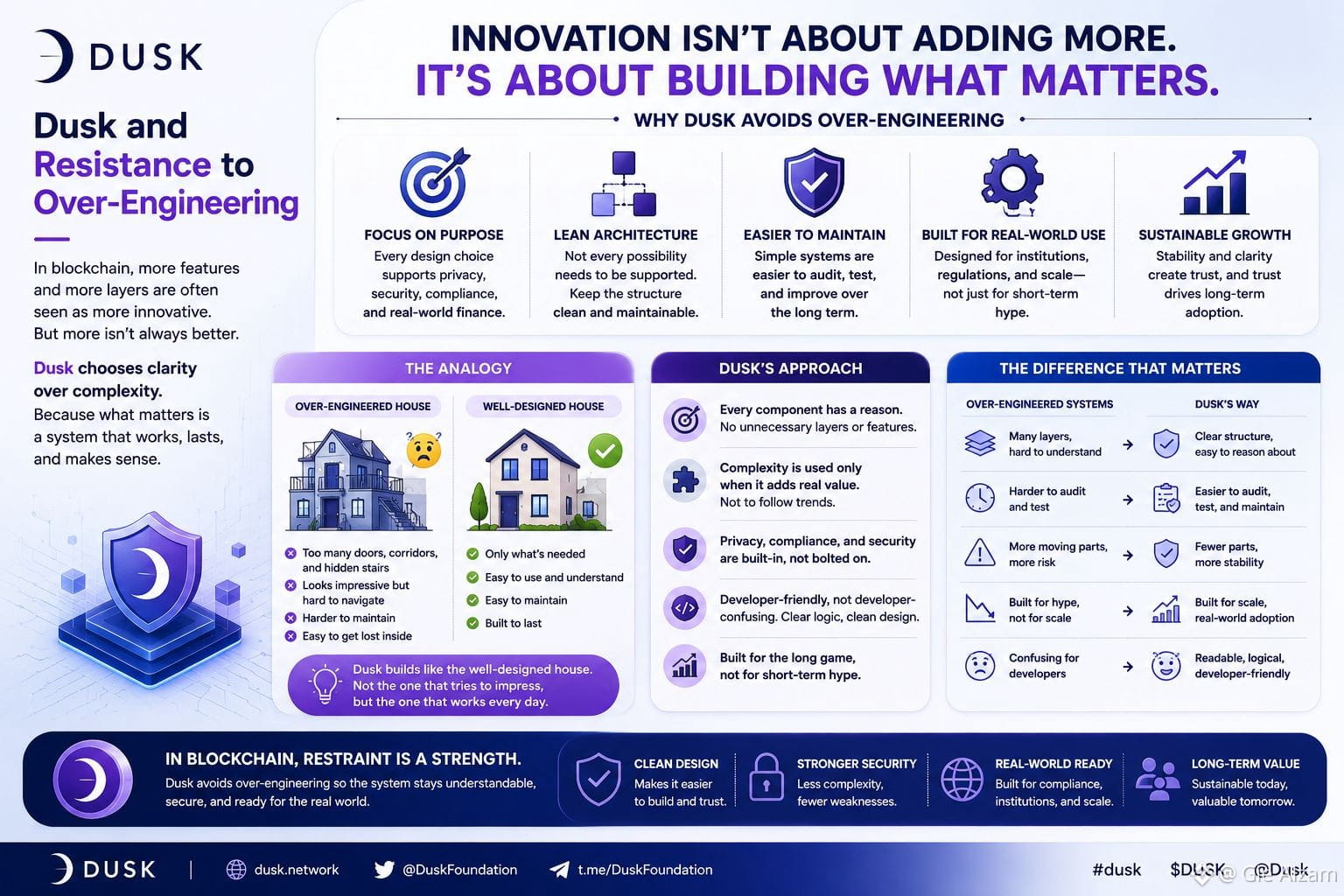
In the blockchain world, we sometimes develop a habit: if something can be made complicated, why should it be simple? 😂
Features are added, layers are stacked, and in the end, developers themselves get confused trying to understand the system.
It’s like a house: we only need one entrance, but we end up installing five doors, three hallways, and a secret staircase. It looks sophisticated, but even just getting in becomes confusing.
Now, I find Dusk interesting because it doesn’t have to chase complexity just to look innovative.
Its design and infrastructure are still directed toward needs such as privacy, security, compliance, and financial use cases. So the complexity that exists has a reason—not just extra features.
This is important because blockchain isn’t only about “whether it can run.”
If we later have to deal with institutions, regulations, audits, and large-scale operations, the system also needs to remain sensible to maintain and develop.
In my view, innovation isn’t about who has the most features.
Sometimes it’s about knowing when to say: “That’s enough—the important thing is that the system works correctly.”
And that’s where Dusk’s approach is really interesting.
#dusk $DUSK @Dusk
In the blockchain world, we sometimes develop a habit: if something can be made complicated, why should it be simple? 😂
Features are added, layers are stacked, and in the end, developers themselves get confused trying to understand the system.
It’s like a house: we only need one entrance, but we end up installing five doors, three hallways, and a secret staircase. It looks sophisticated, but even just getting in becomes confusing.
Now, I find Dusk interesting because it doesn’t have to chase complexity just to look innovative.
Its design and infrastructure are still directed toward needs such as privacy, security, compliance, and financial use cases. So the complexity that exists has a reason—not just extra features.
This is important because blockchain isn’t only about “whether it can run.”
If we later have to deal with institutions, regulations, audits, and large-scale operations, the system also needs to remain sensible to maintain and develop.
In my view, innovation isn’t about who has the most features.
Sometimes it’s about knowing when to say: “That’s enough—the important thing is that the system works correctly.”
And that’s where Dusk’s approach is really interesting.
#dusk $DUSK @Dusk
Verified
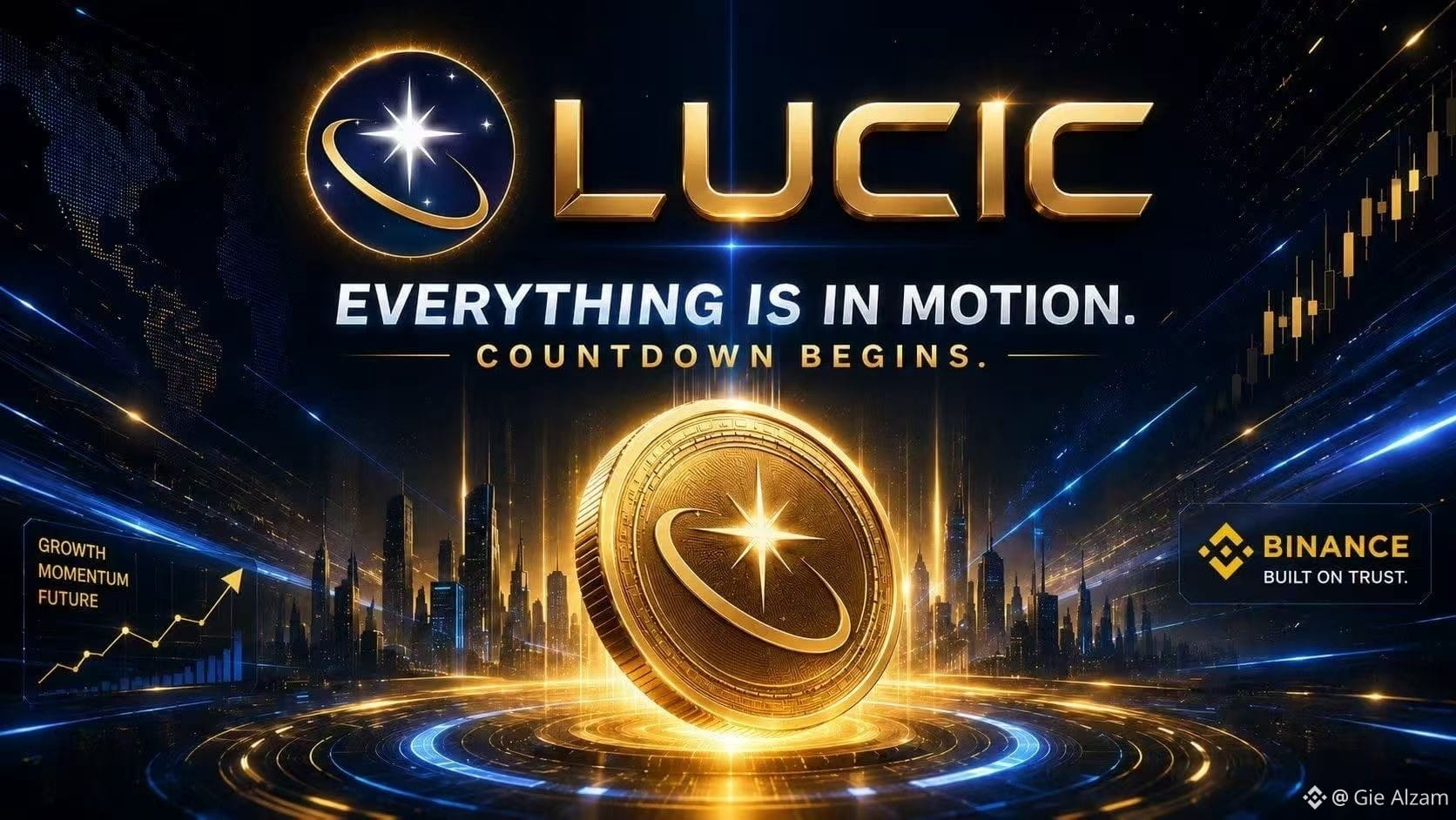
First, get to know LUCIC 👀
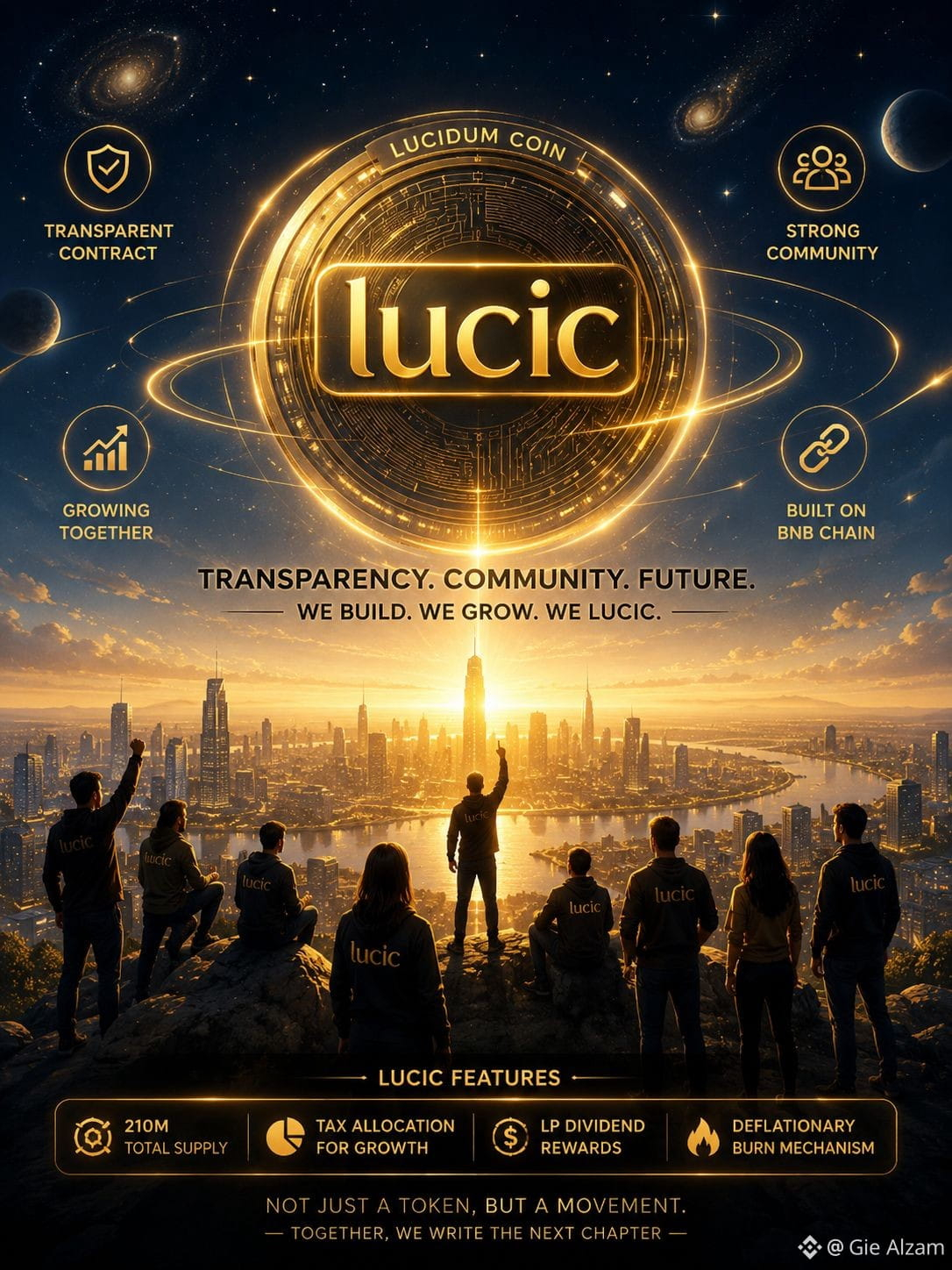
For those who are hearing about it for the first time, LUCIC or Lucidum Coin is a BEP-20 meme coin on the BNB Chain.
Its signature feature is the concept of transparency. LUCIC wants to make the project’s progress, milestones, and fund flows easier to track—not just rely on hype.
Its total supply is 210 million LUCIC, with a transaction tax mechanism allocated for LP Dividend, marketing, and burn.
But there’s one thing that I find quite interesting: the community.
In the whitepaper, LUCIC discusses participation, cohesion, and building a mutually supportive community quite extensively. So the community isn’t just an accessory—it’s part of the project’s vision.
Now, LUCIC also already has around 12.8K holders according to CoinMarketCap data.
So if you’re seeing LUCIC for the first time, you might not need to immediately think about “how much it will go up.”
Get to know the project first, look at the community, and monitor how the roadmap is progressing.
LUCIC — Lucidum Coin.
Has anyone been part of its community for a while now? 👀
For those who are hearing about it for the first time, LUCIC or Lucidum Coin is a BEP-20 meme coin on the BNB Chain.
Its signature feature is the concept of transparency. LUCIC wants to make the project’s progress, milestones, and fund flows easier to track—not just rely on hype.
Its total supply is 210 million LUCIC, with a transaction tax mechanism allocated for LP Dividend, marketing, and burn.
But there’s one thing that I find quite interesting: the community.
In the whitepaper, LUCIC discusses participation, cohesion, and building a mutually supportive community quite extensively. So the community isn’t just an accessory—it’s part of the project’s vision.
Now, LUCIC also already has around 12.8K holders according to CoinMarketCap data.
So if you’re seeing LUCIC for the first time, you might not need to immediately think about “how much it will go up.”
Get to know the project first, look at the community, and monitor how the roadmap is progressing.
LUCIC — Lucidum Coin.
Has anyone been part of its community for a while now? 👀
Log in to explore more content