


Compiled & Edited by: ShenChao TechFlow

Program Title: 21 YouTubers Agree on 5 Stocks. My Entry Points(BWB - Business With Brian,Single Episode)
Host: Brian (Brian Ferraro, host of the independent investor channel, 429k subscribers)
Duration: 25:19 (Released on 2026/8/25, 127k views per episode)
Underlying Assets Involved: Alphabet (Google) / Nvidia / Micron / CoreWeave / Uber
Financial Disclosure: Brian himself holds Nvidia (over 12% of the portfolio, reached his limit), Google, and Micron (currently planning to buy); also holds Uber. He does not hold CoreWeave. His views are directly tied to his own wallet. This episode also has a paid sponsorship (Galaxy Premium Yield, a cash management tool provider). The prices below are outputs from his personal model, not investment advice.
One: after finishing 141 videos, only 5 stocks are repeatedly singled out
One commentator did a brutal piece of work: in 11 days, he watched all 141 stock videos across 21 YouTube investment channels—only the stock-related segments in each episode—and recorded them one by one into a spreadsheet.
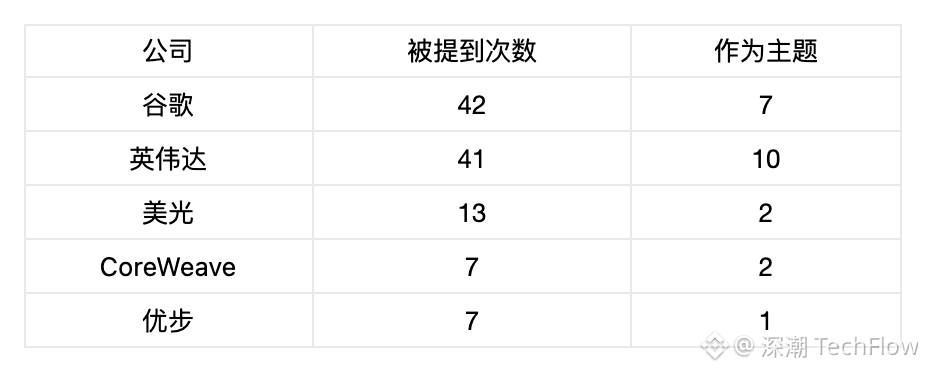
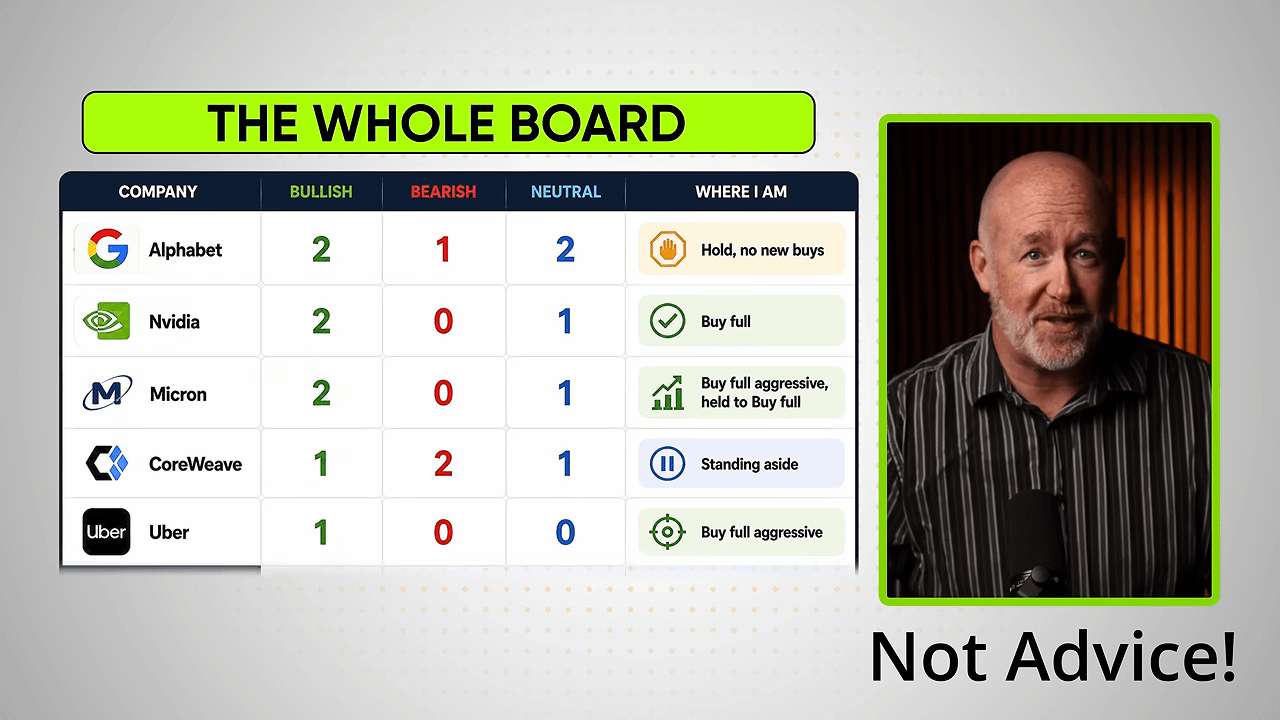
As a result, after filtering the entire table down, only five companies remain repeatedly mentioned: Google, Nvidia, Micron, CoreWeave, and Uber. For the other 100-plus companies, they basically disappear after being mentioned once—they’re not discussed further.
But don’t rush to copy homework. The protagonist prototype of (The Big Short), Eisman, also watched these podcasts—but his reaction was to sell Google outright, with a one-sentence reason: these AI stocks are really one and the same trade—either they all win or they all lose.
And in this episode of the comprehensive podcast, the investment commentator Brian broke down and tallied the themes of these 141 videos: 76 are about chips, cloud, and AI models—just over half. So among these five stocks that are “repeatedly praised,” four (Google, Nvidia, Micron, CoreWeave) are essentially the same AI bet, just wearing different names. Only Uber is truly independent.
Below, stock by stock, here’s why everyone is bullish on it, what everyone is afraid of, and Brian’s positions and entry points.
Two: Google—Buffett is adding, current price $362, but he only opened half a position
Why is it being looked at favorably
Based on profits already earned, Google currently sits in the cheapest tier of the last decade. At $362, it’s down about 14% from its historical high in May. Commentators who make valuation videos typically put the reasonable price somewhere between $350 and $450.
Another headline: Berkshire just materially increased its stake in Google, bringing it to near double. Google is already in Berkshire’s top three holdings.
What is everyone afraid of
Swap in another ruler and the answer flips: by sales, Google is in the priciest 3% in the last decade. The same company, on the same day, can yield two opposite conclusions—the difference is only which line of the financial report you look at.
One commentator did a memorable live-stream experiment. He first asked the audience, “At what price are you planning to sell Google?” Everyone wrote down their numbers. Then he announced the news that Buffett had added to his position and asked again, “Are you changing it?” Everyone changed. One piece of news can make you throw away the rules you set yourself—that’s the most real weakness of retail investors.
Brian’s moves
At the current price of $362: only open half a position (half his normal allocation), and only do monthly DCA instead of adding a heavy position. The reason goes back to the dual rulers above: being “cheap” and “expensive” can both be true—so buy less and buy gradually.
Three: Nvidia—current price $221. Valuation suggests it’s one-third cheap, but someone is betting on it going wrong
Why is it being looked at favorably
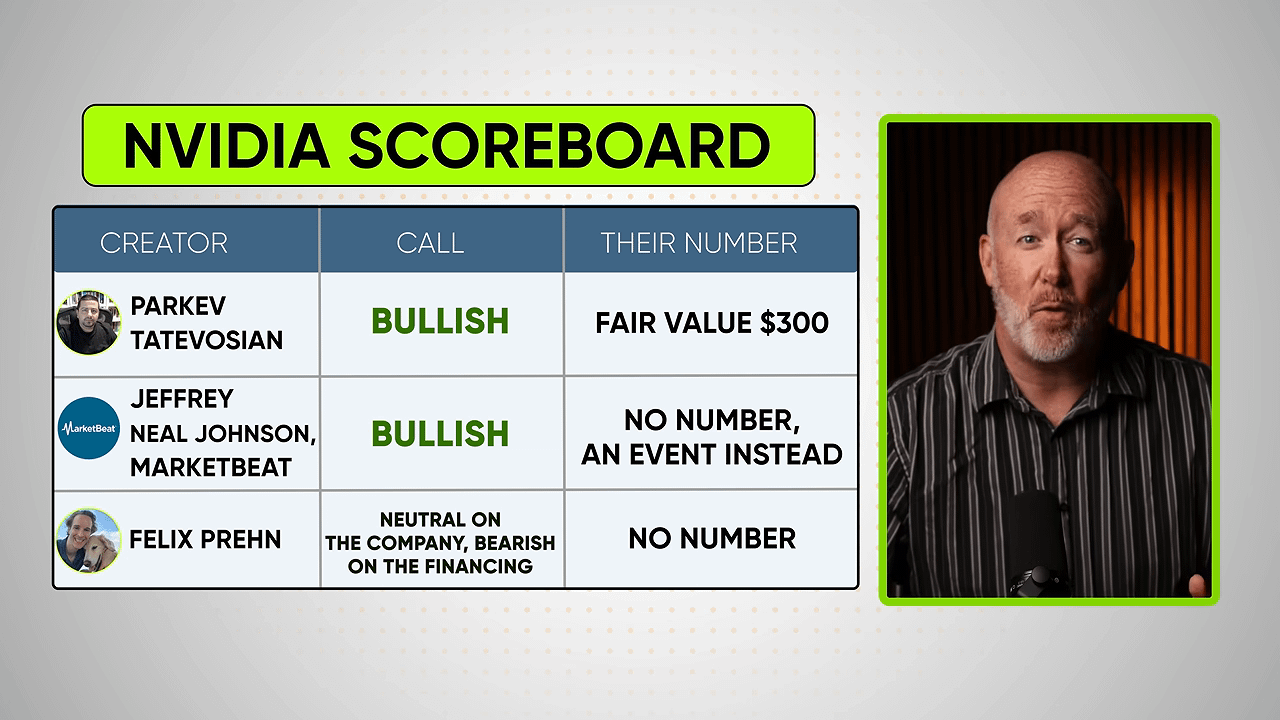
One commentator put Nvidia’s assets, liabilities, and equity into an Excel sheet and calculated intrinsic value per share of about $300. At the current price of $221, that means it’s about a quarter to a third cheaper than the model. Brian’s own model is $290, while the typical sell-side analysts’ expectation is $330—multiple numbers point in the same direction: cheap.
What is everyone afraid of
The truly scary numbers are outside the financial statements: Nvidia’s customers have borrowed about $500 billion to buy chips. That number is close to twice Nvidia’s annual revenue, the repayment period can be as long as 5 years, and the debt ultimately gets rolled back into pension accounts on the books. The cost of insuring Nvidia’s debt against default has already doubled since the end of May. The market talks bullish, but the insurance market is voting with money saying, “We’re not confident.”
Brian’s moves
He calculates a reasonable price of $290 himself, but his Nvidia position is already at 12% (his own cap), so he doesn’t add. Under $148, he refuses to buy: if the chain of borrowing to buy chips really goes wrong, falling to $148 isn’t “cheap”—it’s catching knives. The company story is already broken.
Four: Micron—reasonable value $1,450, but the current price has already fallen below a key moving average. He continues buying according to plan
Why is it being looked at favorably
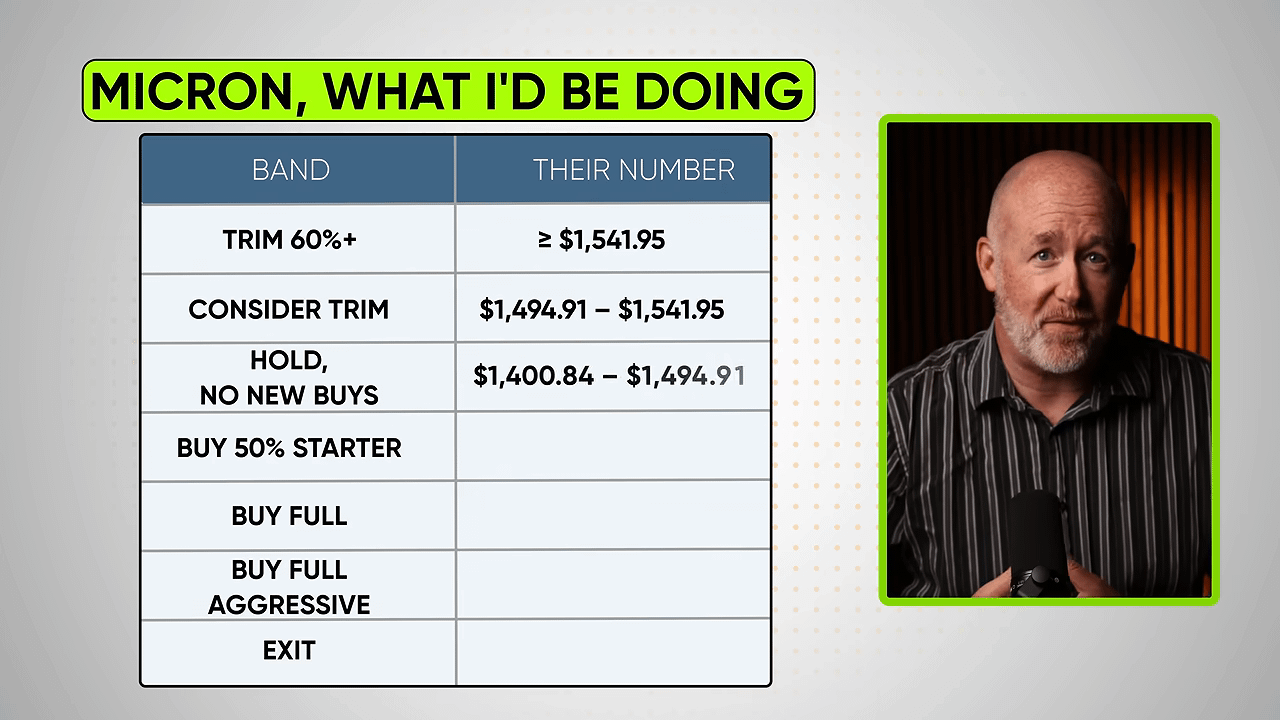
Brian’s model values Micron around $1,450—the largest “space” in the whole table. And Micron’s production capacity is already locked by orders through 2027, so there’s no need to worry about selling.
What is everyone afraid of
Look at the two numbers together: based on realized profits, Micron is currently trading at a P/E of 22x—not cheap. The “cheap” people usually quote is based on next year’s expected profits at 6x. These two numbers can both be true, and there’s only one condition: the market assumes Micron’s future profits will triple. When you buy Micron, fundamentally you’re buying whether that “tripling” can be delivered.
And Micron is a cyclical stock—stocks at the peak of the cycle often look cheap. Historically, there are countless examples of memory companies dropping 70% from their highs.
Brian’s moves (the most specific segment of this episode)
His model was contradicting itself: it said Micron is cheap, but when looking at Micron’s own historical data it said Micron is expensive. He chose to trust the “bad” version and kept the position smaller.
Specific discipline:
The 50-day moving average at $961 is the master switch. The stock has already fallen below it, so he continues buying according to the original plan (not adding a single extra dollar).
Only when the stock price climbs back above $961 will he add again
$434 is the signal line for “the company is broken.” If it falls there, it means the whole story has changed, and the earlier analysis is void.
And here’s a contrast group: another commentator’s approach is to buy at $135, add at $275, and add again at $500—each rung is chasing after a new all-time high. That’s a breakout-chasing trading mindset, completely opposite Brian’s idea of buying only after prices drop. Same company—both approaches work. It depends on who you are.
Five: CoreWeave—old story from 1999 repeating itself? He didn’t buy a single share, just stood and watched
Why is it being looked at favorably
With contract orders totaling $130 billion, one commentator’s reasonable value estimate is $113; the current price is $104.
What is everyone afraid of
In 1999, there was a star stock in the US called Lucent. It lent money to customers, and customers used that money to buy Lucent’s equipment; Lucent recognized that as its own revenue. The numbers looked great—until one customer went back for another $90 million loan and was rejected. A few weeks later, Lucent went bankrupt. That’s when everyone realized the demand was manufactured by the seller all along.
Now Nvidia has agreed in its SEC filing: to lease back all compute capacity of CoreWeave that can’t be leased out by 2032. Translate it: part of the demand on CoreWeave’s reports may be the seller stepping in to cover its own customers. It’s exactly the same structure as what Lucent did back then.
Brian’s moves
Zero position—stand and watch. CoreWeave has only been public for 17 months, and there isn’t enough historical data for him to draw an entry ladder. He emphasizes: standing by and holding are two different things—don’t treat “not buying” as “quietly buying after being bearish.”

Six: Uber—the only one that isn’t an AI bet. Two people’s independent valuation estimates differ by only $10
Why is it being looked at favorably
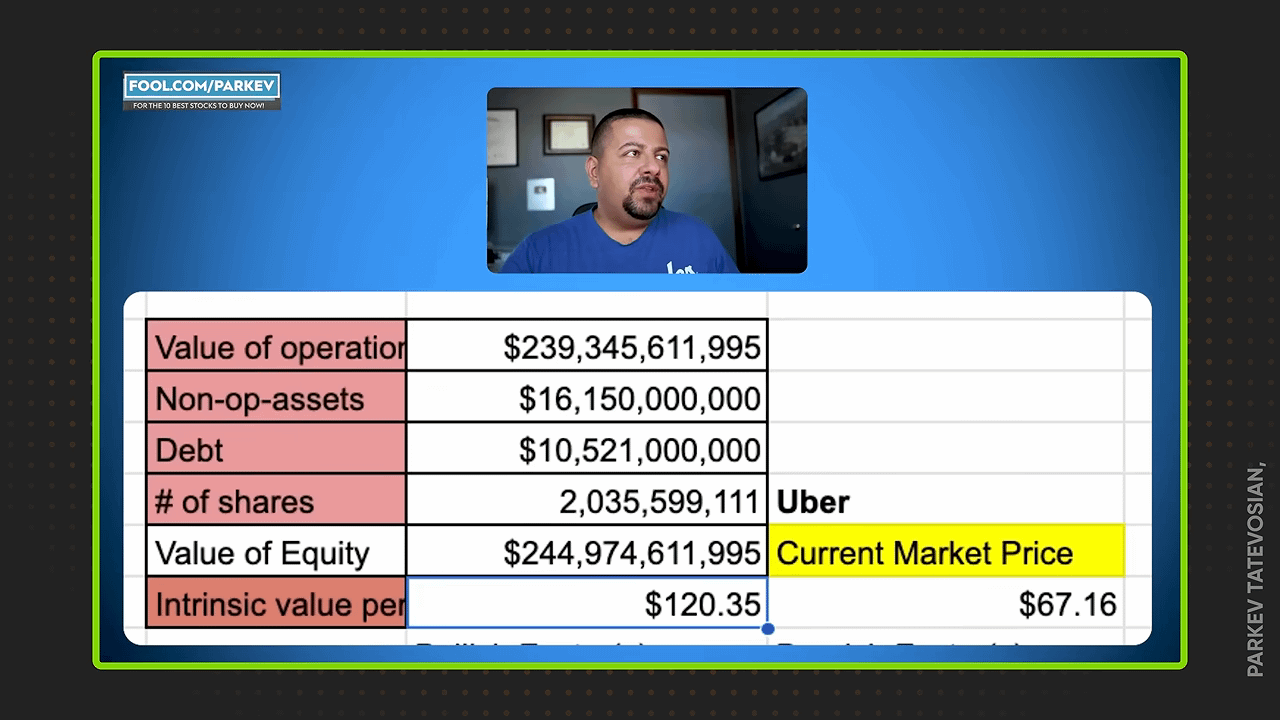
Uber lives on cash flow: about $10 billion in free cash flow per year. Market cap is $150 billion, placing it in the cheapest one-third range over the last decade. In 141 videos, it’s the only stock mentioned by only one commentator—yet it’s also the one Brian gives the deepest buy tranche in his whole table.
There’s a detail that shows how solidly “cheap” it is: that commentator independently calculates Uber’s reasonable value at $120, while Brian calculates $109. They never reviewed each other’s work—yet the difference is only $10, about 5%. Current price is $67 (down just 7% on the day it was recorded).
What is everyone afraid of
Self-driving. Either Waymo takes Uber’s passengers, or Uber is forced to operate its own fleet—turning it into a completely different heavy-asset company. That’s the “cap” over the valuation.
Brian’s moves
Deepest buy tranche—go all in. His reasoning is based on cash flow, not accounting profits (accounting profit includes one-off items; cash flow is cleaner). The market prices Uber based on “profit decline in the future.” He prices it based on the continuity of cash flow. The gap is his opportunity.
Seven: take this method home—4 questions to ask before buying any stock
Brian’s entry ladder isn’t mysticism—just four questions:
Compared to its own history, is it expensive now or cheap? (Don’t compare with other companies—compare with itself.)
What has the current price already priced in? (Micron example: current price assumes profits triple—do you believe it?)
Have you mixed up a good company with a good price? (a bad company at a bargain price, or a bad business)
What would make you change your mind? (This question doesn’t cost anything, but it can save your life.)
He added a practical warning: writing down your exit price before buying, and looking up an exit price when you’re losing money, are completely different mental states. The first is discipline; the second is stop-loss.
Eight: looking back—what you think is holding five companies is actually holding one bet
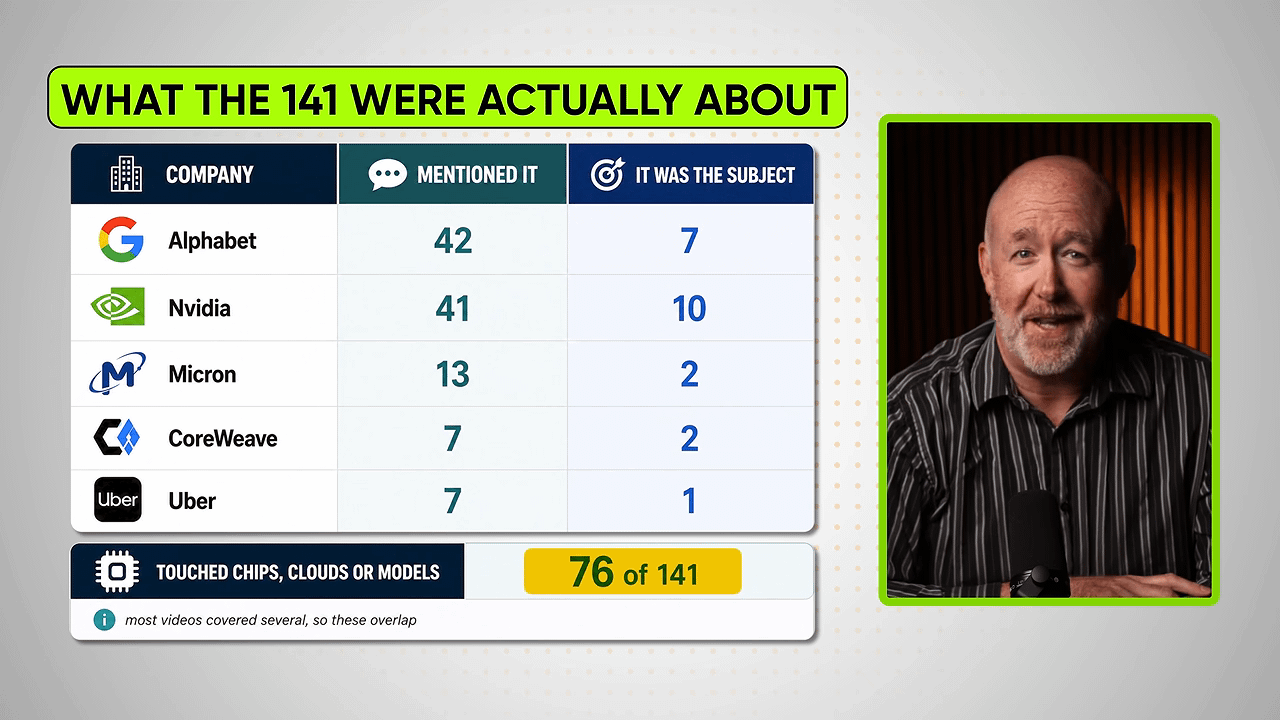
Brian finally counted the theme distribution across the 141 videos:
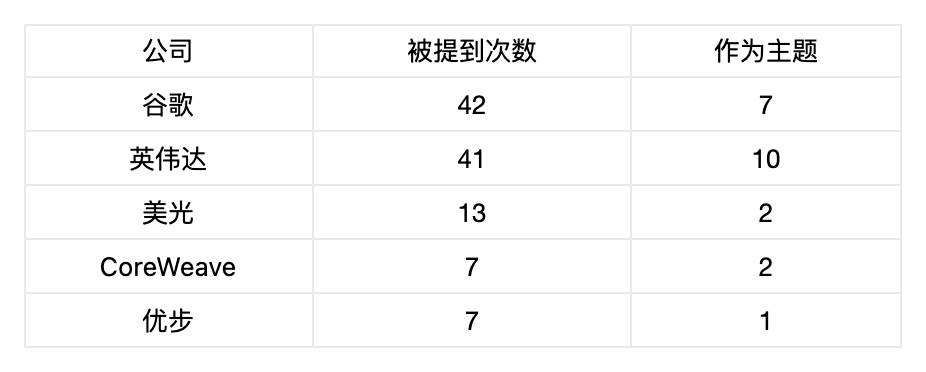
More than half the videos (76/141) are about the same thing: chips, cloud, and AI models. Even Uber, the one “independent” stock—its risk (self-driving) also runs on Nvidia’s chips.
That’s why Eisman’s line is worth putting up front: if your watchlist was built from videos like these, you think you’re diversified—you hold five companies—but you’re really holding the same AI bet under five different names. Brian even admits it, guilty: “My own list has been built that way, too.”