

Written by: Rita
AI heavyweights say that most diseases can be cured within 5 to 10 years; Bernstein says, hold on. On August 26, Bernstein released a report on the U.S. biopharmaceutical industry, systematically outlining the real progress of AI in drug R&D: about 70 AI-sourced projects have entered the clinical pipeline, and the vast majority are still in early stages—the real test will come in the next 3 to 5 years.
DeepMind CEO Demis Hassabis said, “Perhaps within 10 years, AI can cure all diseases,” while Anthropic CEO Dario Amodei was even more aggressive: “Cure most human diseases within 5 to 10 years.” Bernstein believes these claims are more like a defense of AI’s social value, not grounded in the realities of drug development. From target discovery to clinical trials, and then to how well healthcare systems can absorb the results, each layer is a bottleneck. AI may speed up certain steps, but biology ultimately must be validated in human bodies—and this timeline cannot be compressed by algorithms.
Increasing the success rate is more valuable than speeding things up
Bernstein estimates that a 20% improvement in success rate creates far greater R&D returns than saving time and costs at the same magnitude. The cost of failure concentrates in the later stages; avoiding failure is worth more than accelerating the process.
AI’s impact on success rates depends on what problem it solves. If AI is mainly used for molecular optimization on known targets, success rates may be boosted, but the value of these “easy problems” is limited. If AI is used to tackle difficult diseases where biological understanding is still insufficient, even if overall success rates are not high, the value created can be much greater.
Bernstein points out a counterintuitive conclusion: the more AI is used, the more wet-lab work may also be needed. The hardest problems are facing the situation where training data is the scarcest. Generating new data requires substantial experimental investment. AI and wet-lab experiments are complementary relationships. The cost of doing one additional wet-lab experiment is far lower than the cost of a late-stage failed project.
AI strategy in biopharma: Lilly has the broadest footprint, Amgen has the deepest, and Roche has the heaviest computing power
Bernstein counted 183 AI drug discovery collaboration projects across 15 large pharmaceutical companies. Each company’s strategy differs significantly.
Eli Lilly has the widest external collaboration network. From 2019 to the present, it has completed 25 transactions, with publicly disclosed initial payments of approximately USD 353 million. Partners include Insilico Medicine, Profluent, Verge Genomics, Genesis Therapeutics, and others. Lilly also provides an NVIDIA Co-Innovation AI Lab, creating the most balanced combination of external reach and internal computing power.
Roche ranks second with 20 collaboration deals, clearly focusing on oncology (8 deals) and neuroscience (4 deals). Genentech’s hybrid AI factory was described by Bernstein as the “largest-scale local GPU deployment in the industry that has been announced.” Recursion’s USD 1.2 billion collaboration is the largest single deal.
Amgen has the fewest external collaborations (5 deals), while its internal AI and computing power setup is the most differentiated. The deCODE Genetics engine, acquired in 2012, provides an industry-leading human population genomics engine that can identify and validate disease-related genetic variants to prioritize targets. Amgen trained five proprietary antibody language models on its local DGX SuperPOD, resulting in an evident data moat.
AstraZeneca has 19 deals. The economics are highly concentrated in three agreements with CSPC Pharmaceutical Group, accounting for the vast majority of its publicly disclosed upfront payments.
All 10 collaborations at Novo Nordisk have been concentrated after 2022. Seven of them target cardiovascular-metabolic and kidney diseases, making it the most focused large pharmaceutical company by therapeutic area.
Pfizer has the most platform-type collaborations (9 deals across the entire pipeline). Its AI foundation model relationships can be traced back to IBM Watson in 2016; no dedicated compute collaborations were identified.
Bernstein emphasizes that these are judgments from an external perspective; truly assessing integration quality and internal cultural transformation is difficult to quantify.
AI biotech: clinical assets are the real proving ground
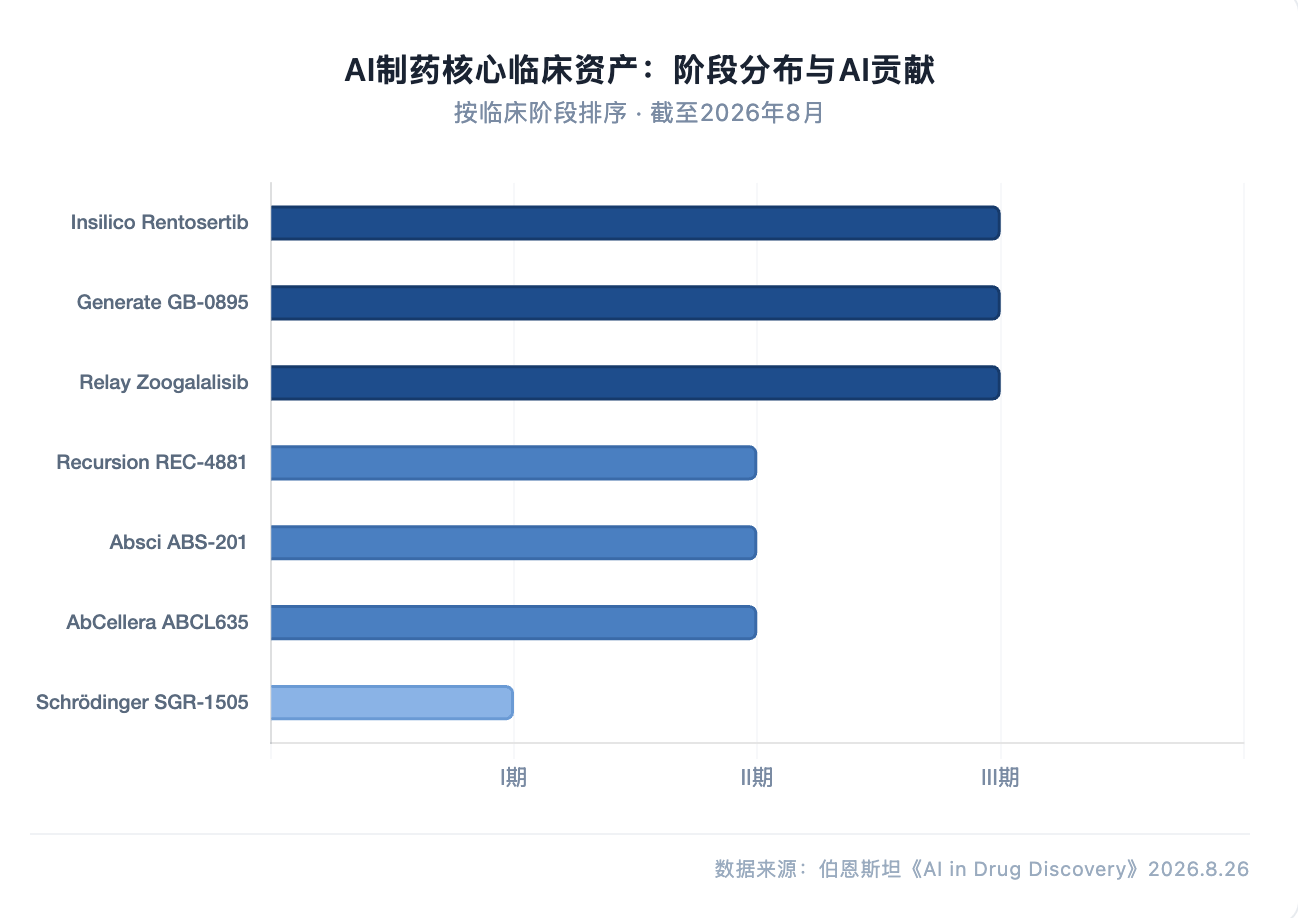
About 70 AI source projects are mainly concentrated in listed companies. There are vast differences in what they define as “AI,” ranging from AI drug repurposing to AI target discovery and AI molecular design—an extremely wide scope.
Insilico’s Rentosertib is a representative end-to-end AI drug discovery case. Its AI platform, PandaOmics, identified TNIK as a target for idiopathic pulmonary fibrosis; Chemistry42 then generated design molecules. From target hypothesis to preclinical candidates is about 18 months. The drug has entered Phase III, and major endpoints are expected to be read out in October 2029—one of the most important data points in the AI drug discovery industry.
Recursion drives target discovery through cell imaging and multi-omics, and it has collaborations with Roche, Bayer, and Sanofi.
Generate Biomedicines designs protein drugs. GB-0895 (TSLP antibody) has entered Phase III to validate whether AI-designed proteins can be translated into differentiated drug regimens.
Relay Therapeutics uses protein motion modeling to design drugs. Zoogalalisib (a PI3Kα inhibitor) has entered Phase III to test whether conformation-selective targeting can improve the therapeutic window.
Schrödinger follows a physics-based computation-first strategy. Zasocitinib (a TYK2 inhibitor) has been submitted for marketing approval. This target already has clinical validation provided by BMS’s deucravacitinib, so it should be viewed more as a compute-assisted optimization success case; breakthroughs in AI for discovering new targets have not yet been reflected here. From target selection to clinical trials takes 8 to 10 years, and the industry standard timeline has not been shortened.
FDA approval data has not yet reflected the impact of AI
In the past five years, the FDA approved an average of 48.5 new drugs per year, which is about 43% higher than the average of 33.8 from 1985 to 2025. Bernstein believes this more likely reflects regulatory modernization, the rise of biologics, and accumulated effects from past R&D investment; AI has not yet generated visible momentum in approval data. Given that the AI source pipeline is still small and clinical validation still takes time, this situation is not expected to change in the short term.
Bernstein’s conclusion is pragmatic. AI is already playing a role in molecular design, virtual screening, and target discovery, and some early projects have entered late-stage clinical development. The need to “cure all diseases” must overcome multiple bottlenecks across biological understanding, clinical trials, regulatory approvals, and healthcare system capacity—these are not problems that algorithm iteration can solve. The value of AI in drug discovery may be helping the industry make better decisions, not accelerating workflows. The real answer will still need another 3 to 5 years.
Disclaimer
This article is a compilation and interpretation by ChaoXiang Research of a third-party brokerage research report (Bernstein, August 26, 2026), combined with information from publicly available markets. The ratings, target prices, earnings forecasts, and related judgments cited in the article are solely the views of the brokerage’s analysts, representing only the position of their respective institution, not the views of ChaoXiang Research, and do not constitute any investment advice.
Market involves risks; decisions should be made independently. This article should not be taken as a basis for buying or selling any securities.