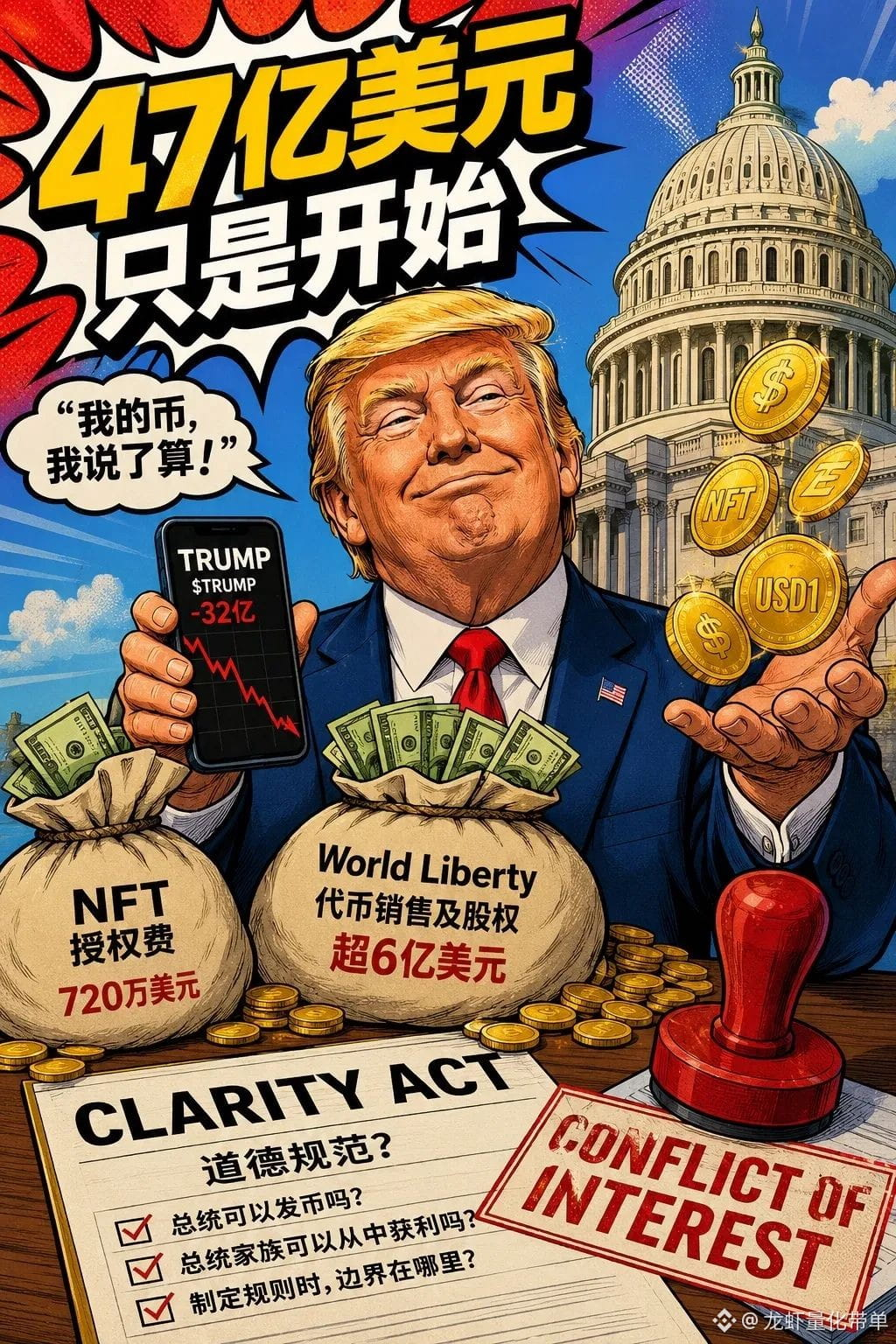
$4.7 billion is only the beginning—what will truly make trouble for Trump’s crypto business is still coming $TRUMP
Just received the latest report: that multiple digital asset projects involving Trump and his family since 2022 have put investors at least $4.7 billion in unrealized losses, with the TRUMP token accounting for roughly $3.2 billion. Meanwhile, the Trump family has also reportedly earned several hundred million dollars through NFT licensing and royalties, sales of World Liberty tokens, and related equity transactions.
At this point, I think the most interesting part of this news isn’t how big the $4.7 billion number is—it’s the three increasingly troublesome issues it exposes right after that.
First, the $4.7 billion isn’t “gone out of thin air.”
Most of the so-called losses caused by TRUMP are essentially a redistribution of wealth after the coin price drops. Early holders profit, while those who enter later eat the decline. So what’s really worth looking at isn’t just the line “investors are down $3.2 billion,” but in any given project: who captured the gains, and who bears the final volatility.
Second, what truly makes things sensitive is that the Trump family itself is also in this industry.
If it were just a normal project, price movements would simply be investors’ own choice. But the problem now is that the Trump family both participates in digital asset projects and is also pushing U.S. crypto regulation. So going forward, every time a new rule comes out, people will inevitably ask: is this setting rules for the industry—or is the rulemaker also sitting at the table?
Third, therefore, what’s really worth watching is the CLARITY Act.
There are already calls to write ethical standards for the president and his family’s involvement in digital asset projects into legislation. If this genuinely moves into the regulatory framework, the impact won’t be limited to just this one token, TRUMP.
Because if the U.S. truly wants to turn the crypto industry into a long-term business, it will eventually have to answer a very real question:
Can a president issue coins? Can the president’s family profit from them? And if so, where are the boundaries when it comes to making the rules?
So I think the $4.7 billion is just the surface of the news.
The real trouble is that the U.S. crypto industry is being forced to answer a question that people used to be reluctant to touch.
Just received the latest report: that multiple digital asset projects involving Trump and his family since 2022 have put investors at least $4.7 billion in unrealized losses, with the TRUMP token accounting for roughly $3.2 billion. Meanwhile, the Trump family has also reportedly earned several hundred million dollars through NFT licensing and royalties, sales of World Liberty tokens, and related equity transactions.
At this point, I think the most interesting part of this news isn’t how big the $4.7 billion number is—it’s the three increasingly troublesome issues it exposes right after that.
First, the $4.7 billion isn’t “gone out of thin air.”
Most of the so-called losses caused by TRUMP are essentially a redistribution of wealth after the coin price drops. Early holders profit, while those who enter later eat the decline. So what’s really worth looking at isn’t just the line “investors are down $3.2 billion,” but in any given project: who captured the gains, and who bears the final volatility.
Second, what truly makes things sensitive is that the Trump family itself is also in this industry.
If it were just a normal project, price movements would simply be investors’ own choice. But the problem now is that the Trump family both participates in digital asset projects and is also pushing U.S. crypto regulation. So going forward, every time a new rule comes out, people will inevitably ask: is this setting rules for the industry—or is the rulemaker also sitting at the table?
Third, therefore, what’s really worth watching is the CLARITY Act.
There are already calls to write ethical standards for the president and his family’s involvement in digital asset projects into legislation. If this genuinely moves into the regulatory framework, the impact won’t be limited to just this one token, TRUMP.
Because if the U.S. truly wants to turn the crypto industry into a long-term business, it will eventually have to answer a very real question:
Can a president issue coins? Can the president’s family profit from them? And if so, where are the boundaries when it comes to making the rules?
So I think the $4.7 billion is just the surface of the news.
The real trouble is that the U.S. crypto industry is being forced to answer a question that people used to be reluctant to touch.