
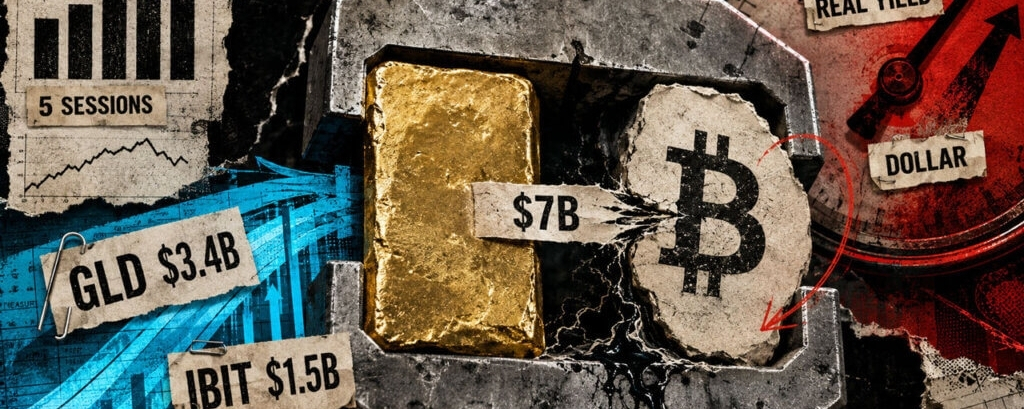

1. It drew Bitcoin and gold exchange-traded funds worth $7 billion over five consecutive U.S. trading sessions, in the highest combined inflow ever recorded between the two.
2. Most of this inflow is concentrated in two main funds, GLD and IBIT, reflecting renewed demand for scarce assets amid concerns about U.S. debt and a weakening currency.
3. The question remains: will Bitcoin maintain these flows if the dollar recovers or if real yields rise—an actual test of its standing as a defensive asset compared with gold?
## Details of Financial Flows
Gold and Bitcoin together attracted about $7 billion over five trading sessions, placing both assets at the heart of a new wave of demand for protection against currency weakness and escalating financial pressures.
- Gold fund GLD (SPDR Gold Shares): drew roughly $3.4 billion, and the fund manages assets exceeding $150 billion, making it the key institutional access point to the gold market.
- Bitcoin fund IBIT (BlackRock’s iShares Bitcoin Trust): attracted about $1.5 billion and holds assets of roughly $60 billion, making it the largest spot Bitcoin fund by volume.
- Together, these two funds accounted for about 70% of the total inflows associated with what markets call the "Debasement Trade".
According to Bloomberg Intelligence financial analyst Eric Balchunas, the total inflows over the five days are an undisputed record, as both funds entered the list of the ten largest U.S. funds by weekly inflows. He also noted that IBIT inflows since the start of the year have returned to the positive zone after earlier being in the red.
This inflow coincided with a sharp rise in the prices of both assets: Bitcoin broke above the $80,000 mark, while gold traded above $4,600 per ounce, continuing a move that is increasingly tying the two assets together through a shared scarcity narrative.
## Financial Pressures Revive Demand for Hard Assets
The buying wave accelerated in parallel with investors’ focus on rising U.S. debt, pressures in the Treasury bond market, and a weaker dollar.
- On August 19, the U.S. Treasury decided to double the maximum amount of long-term bond buybacks to $4 billion per operation, aiming to support market liquidity.
- This decision initially contributed to lowering long-term yields, at a time when U.S. public debt had already surpassed the $40 trillion mark.
- This mix of factors revived what’s known as the "Debasement Trade," as investors look for assets with limited supply to protect their purchasing power from persistent shortfalls and monetary expansion.
### Views of Experts and Analysts
- Matt Hougan, chief investment officer at Bitwise: said the appeal of these assets reflects partly the fact that traditional portfolios (60% stocks and 40% bonds) are fully exposed to fiat currency, stating that "a 60/40 portfolio is 100% exposed to fiat currency," adding that investors are increasingly looking for a simple diversification source as financial uncertainty intensifies.
- Matt Cole, CEO of Strive: linked the same shift to the concept of scarcity, stressing that falling dollar value expands the amount of capital seeking limited-supply assets, and that the ongoing "monetization" of Bitcoin allows it to capture an increasing share of this demand. Bitcoin’s fixed supply of 21 million units is a key factor making it a natural candidate for this trade, even though it remains far more volatile than gold and has a much shorter history as a defensive asset.
- Charlie Morris, founder of ByteTree: noted that both Bitcoin and gold have rising moving averages over 200 days, and both received the highest bullish rating in the company’s index (ByteTrend), at 5 out of 5, while the dollar received a rating of zero. Although this alignment doesn’t necessarily explain why investors are buying, it reinforces the clear gap between scarce assets and the currency they are valued against.
## Wall Street Outlook: A Long-Lasting Scarcity Trade
Some analysts believe the strongest argument for this trade is that the pressure could persist even after the recent pullback in yields and the dollar.
- Bernstein said the continued four-decade decline in interest rates appears to have ended at the same time that sovereign debt burdens reached record levels, making governments more exposed to rising costs of servicing debt. Rising yields could in turn increase interest bills, widen deficits, and raise the need for borrowing, making it harder to stabilize public finances.
- The company expects that policymakers will ultimately prefer allowing the currency to weaken rather than imposing long-term fiscal austerity, as this is seen as the path with fewer disruptions to political stability.
- Bernstein believes Bitcoin is well-positioned thanks to its fixed supply, the expansion of its institutional and retail investor base, and the holder base that has historically demonstrated the ability to withstand drawdowns exceeding 50%. The firm estimates that about 60% of Bitcoin is owned by investors who have held through these sharp declines.
- As BlackRock published research this month indicating that allocating between 1% and 2% of a traditional (60/40) investment portfolio to Bitcoin could have historically improved risk-adjusted performance.
## Conclusion: A Real Test of Bitcoin’s Standing
Gold has a well-established role as a hedge against monetary and financial uncertainty, while Bitcoin is still viewed as a candidate for the same scarcity-based role—but its track record is far shorter and its volatility is noticeably higher.
- If the dollar continues to weaken, or if real yields rise while Bitcoin fund flows continue, then the latest $7 billion inflow could represent a lasting shift in portfolio construction rather than merely a trade driven by temporary macroeconomic conditions.
- But if demand for Bitcoin falls while gold holds steady, then the two assets may have benefited from the same "debasement" narrative without Bitcoin yet achieving gold’s status in investors’ portfolios.