Recent Activity Patterns
Volatility is high: Burn rates swing dramatically in percentage terms because the baseline is often very low. Examples from mid-to-late August 2026 include:
A 441% spike (one report: ~41.8 million SHIB burned in 24 hours). An 88%+ daily increase (one period: ~39.23 million). Periods of sharp slowdowns (e.g., weekly burns dropping significantly after earlier spikes, with one report of weekly rate down ~28% and monthly rate sharply lower).
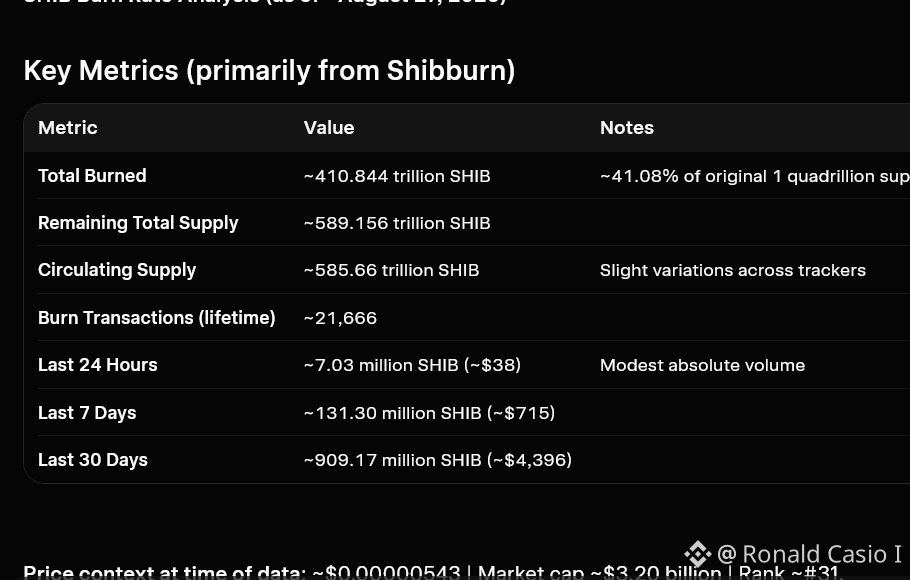
Daily burns in the recent quiet periods have often been in the low millions (e.g., 5–7 million range on some days), with occasional jumps into the tens of millions. Major contributors in recent periods include community wallets, exchanges (Robinhood frequently appears in small-to-medium burns), and occasional larger one-off transactions. Shibarium-related and ecosystem activity also contribute via fee mechanisms, though volumes remain relatively modest.
Structural Context & Limitations
The big picture is dominated by history: The vast majority of the ~410.84 trillion burned came from Vitalik Buterin’s massive 2021 burn. Ongoing community + ecosystem burns since then have been incremental. Absolute impact is tiny: Even a strong day of 40+ million burned is a tiny fraction of the remaining ~589 trillion supply (on the order of 0.000007% or less of remaining supply per strong day). Sustained multi-billion daily burns would be required for meaningful near-term scarcity effects. Burns are deflationary in direction but symbolic in scale at current rates. They demonstrate community engagement and reduce supply over very long time horizons, but they are not a primary short-term price driver. Percentage “burn rate” headlines (e.g., +441%, +5,000% on quieter comparison days) can look explosive but often reflect low prior baselines rather than large absolute destruction.
Broader Implications
Positive for narrative and community morale, especially when coinciding with other catalysts (Japan regulatory progress, technical breakouts, whale accumulation, etc.). Limited standalone effect on price or scarcity g
Volatility is high: Burn rates swing dramatically in percentage terms because the baseline is often very low. Examples from mid-to-late August 2026 include:
A 441% spike (one report: ~41.8 million SHIB burned in 24 hours). An 88%+ daily increase (one period: ~39.23 million). Periods of sharp slowdowns (e.g., weekly burns dropping significantly after earlier spikes, with one report of weekly rate down ~28% and monthly rate sharply lower).
Daily burns in the recent quiet periods have often been in the low millions (e.g., 5–7 million range on some days), with occasional jumps into the tens of millions. Major contributors in recent periods include community wallets, exchanges (Robinhood frequently appears in small-to-medium burns), and occasional larger one-off transactions. Shibarium-related and ecosystem activity also contribute via fee mechanisms, though volumes remain relatively modest.
Structural Context & Limitations
The big picture is dominated by history: The vast majority of the ~410.84 trillion burned came from Vitalik Buterin’s massive 2021 burn. Ongoing community + ecosystem burns since then have been incremental. Absolute impact is tiny: Even a strong day of 40+ million burned is a tiny fraction of the remaining ~589 trillion supply (on the order of 0.000007% or less of remaining supply per strong day). Sustained multi-billion daily burns would be required for meaningful near-term scarcity effects. Burns are deflationary in direction but symbolic in scale at current rates. They demonstrate community engagement and reduce supply over very long time horizons, but they are not a primary short-term price driver. Percentage “burn rate” headlines (e.g., +441%, +5,000% on quieter comparison days) can look explosive but often reflect low prior baselines rather than large absolute destruction.
Broader Implications
Positive for narrative and community morale, especially when coinciding with other catalysts (Japan regulatory progress, technical breakouts, whale accumulation, etc.). Limited standalone effect on price or scarcity g