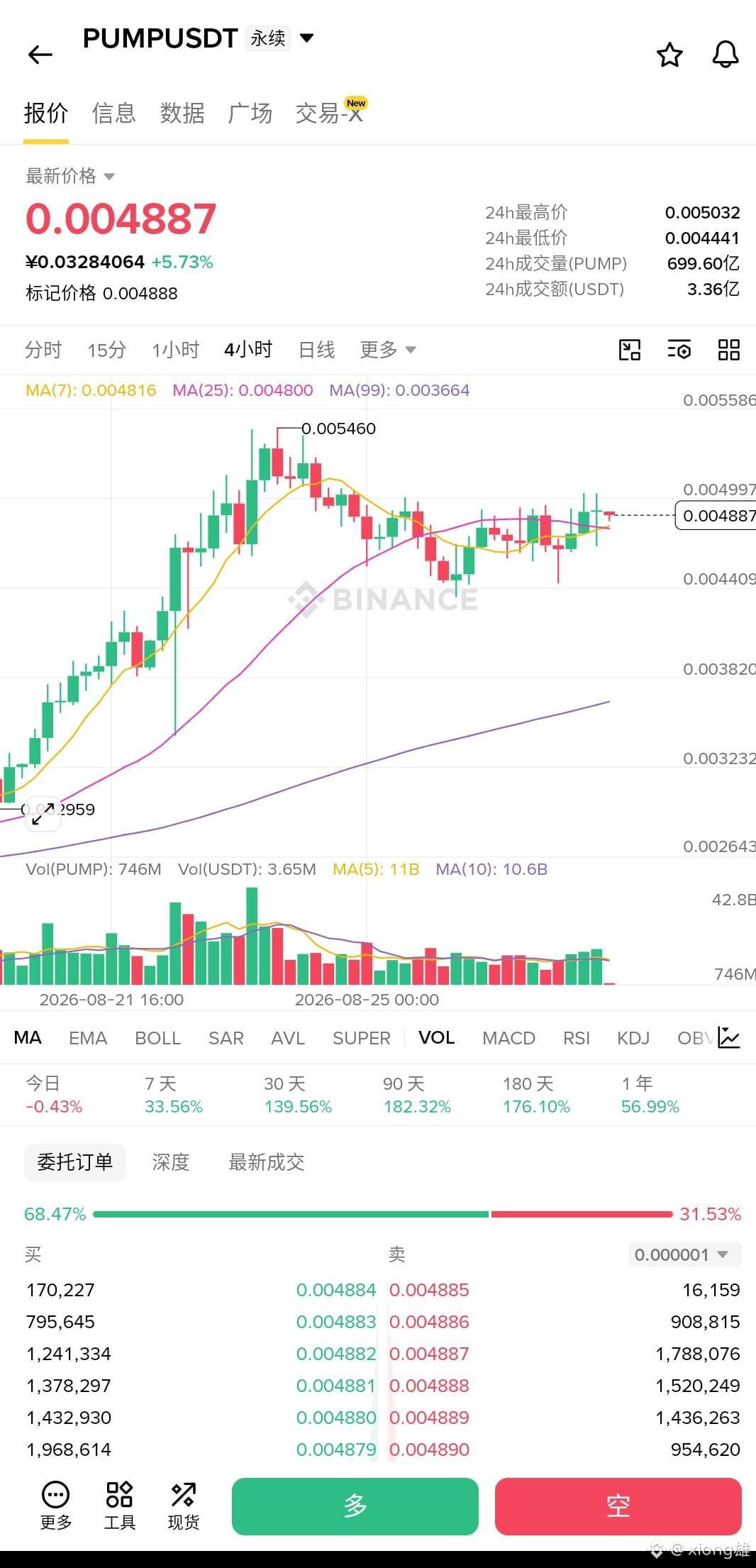
PUMP: Seven days from 0.003 to 0.0049—up 63%, hovering right at the upper end of the recent range. The whole board is bullish—open interest rises by 22% in a day, and the spot capital shows twelve consecutive green candles in three hours. But the big question is: who’s actually taking the other side this time? The data is already flipping.
First, the contract side shows cracks. Passive buying accounts for 42.8% only; the long/short ratio is 0.75. Sell pressure stacks up against the buy side, and the price action looks like distribution—not accumulation; it’s not soaking up demand, it’s distribution. Next, look at the funding rate: with positions built this high, the funding rate is nearly zero. Out of eight, only one is positive. This batch of positions isn’t here to bet on a rally—it’s here to wait to unload.
Spot is also uncomfortable. The net inflow over three hours is positive, but when you break it down, big orders see a net outflow of 1.6 billion for nearly an hour, and what gets filled in is more from smaller orders. The higher it rises, the more it looks like big players are handing out chips. After open interest spikes, it shrinks by 2.2% over the next seven hours—the engine sputters out first.
So I’m bearish on this move. The short thesis isn’t “it can’t go up,” but that the buyers taking the bids increasingly look like retail traders. If it rebounds to around 0.005, I’ll short—first target 0.0044, near the 24-hour low.
When does it turn? When there’s a breakout above 0.00503 on rising volume, active buying comes back for more than 50%, the funding rate heats back up, and big-order outflows flip into inflows—that’s when the new acceleration starts. Don’t stubbornly hold short positions.
#pump $PUMP
First, the contract side shows cracks. Passive buying accounts for 42.8% only; the long/short ratio is 0.75. Sell pressure stacks up against the buy side, and the price action looks like distribution—not accumulation; it’s not soaking up demand, it’s distribution. Next, look at the funding rate: with positions built this high, the funding rate is nearly zero. Out of eight, only one is positive. This batch of positions isn’t here to bet on a rally—it’s here to wait to unload.
Spot is also uncomfortable. The net inflow over three hours is positive, but when you break it down, big orders see a net outflow of 1.6 billion for nearly an hour, and what gets filled in is more from smaller orders. The higher it rises, the more it looks like big players are handing out chips. After open interest spikes, it shrinks by 2.2% over the next seven hours—the engine sputters out first.
So I’m bearish on this move. The short thesis isn’t “it can’t go up,” but that the buyers taking the bids increasingly look like retail traders. If it rebounds to around 0.005, I’ll short—first target 0.0044, near the 24-hour low.
When does it turn? When there’s a breakout above 0.00503 on rising volume, active buying comes back for more than 50%, the funding rate heats back up, and big-order outflows flip into inflows—that’s when the new acceleration starts. Don’t stubbornly hold short positions.
#pump $PUMP