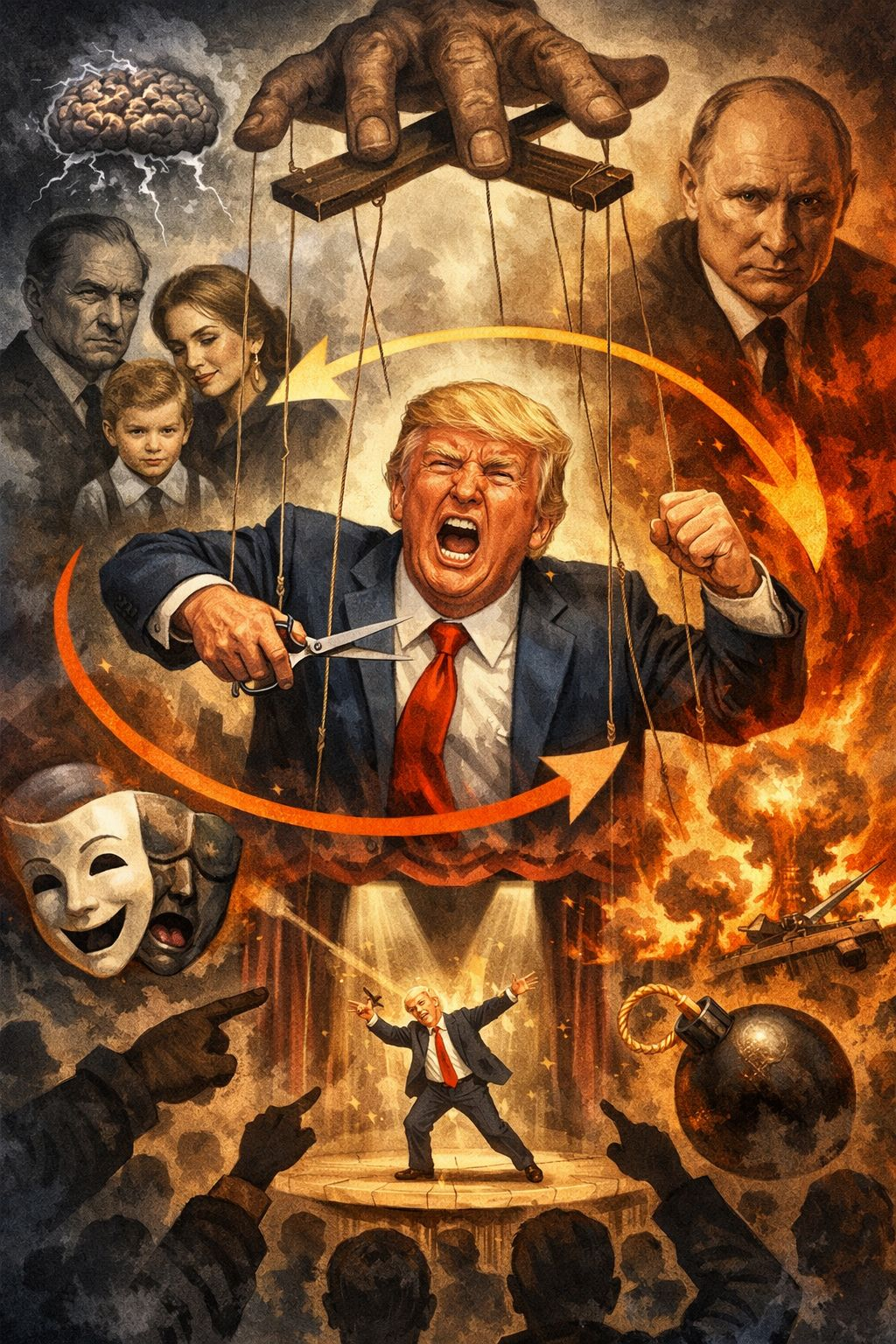
Trump is currently in a zone of systemic tension — not only political but also psychological. This is not about a crisis of decisions, but rather a crisis of regulation. He clearly feels the limits of what is acceptable; however, this feeling is not a product of reflection or strategic analysis. It is formed at the level of early adaptive patterns — automatically, bodily, almost pre-intellectually.
In such cases, it is more correct to speak not of "manipulation" as a conscious tool, but of unconscious regulation of affect through external interaction. What is commonly referred to in everyday discourse as abuse, in a psychodynamic sense, is often a consequence of chronic internal instability and the need to maintain control over the environment at any cost.
This explains his principled refusal of rigidly fixed agreements, pacts, his favorite "deals" and formal obligations in interaction with Putin. A formal contract means a boundary. And a boundary is a place where the anxiety of losing control can be actualized. Trump intuitively feels it and avoids it, without consciously formulating it. Interestingly, Iran seems to have misread this dynamic, confusing instinctive leveling of tension with a political strategy — and fell into an affective trap. But Iran is not a resource state and itself tends towards a tight bond and support from the outside. (Attribution error and as a consequence — a false strategic choice. Betting on material security and dependent generosity of an ally)
If we look deeper, this behavior model fits well into the logic of personality development in an ambivalent family system. A soft, emotionally vulnerable maternal figure on one side and a harsh, dominant, authoritarian father on the other. For the child, this means one thing: the one who can quickly read tension and extinguish conflict by changing roles survives. Without understanding — but by reacting.
Here, a non-reflexive "I" is formed, but an adaptive reactive-I. Later, in adulthood, these mechanisms do not integrate but only become more complicated. Against the backdrop of age-regressive processes, they manifest as a victim position, defended through external reacting. In classical psychodynamics, this is distinguished quite clearly:
abreaction — is the conscious re-experiencing of traumatic experience with the release of affect,
while acting out is the unconscious reproduction of a traumatic scenario in action. (In cycles, — again and again - endlessly)
In Trump, we are dealing precisely with acting out. His behavior is not aimed at awareness or integration of experience — it is aimed at reducing internal tension here and now. This is a fundamental difference from the aggressive abreaction demonstrated by the aggressor from the Kremlin (in his superior role in the tandem — as the leading figure that acts, shows, teaches, and leads), where affect breaks through in the form of a direct destructive impulse. In Trump, however, the infantile form currently prevails — demonstrative, theatrical reacting, which can potentially evolve into more rigid manic discharges. (In the concept of his exclusive process of "maturation" and appropriation of more adult models of reactions already — in the typical form of "abreaction")
A key point that often falls out of political analysis: Trump's behavior is not purposeful in the classical sense. It is not built as a chain of decisions. It is rather a series of automatic reactions to stimuli, the source of which often lies outside of himself. That is why he is unable to leave himself real space for maneuver in interaction with Putin — psychologically he is dependent on the external 'locus of excitation' that he sets. And to take a pause means — to lose control and fall out of the game. Which is extremely dangerous for him! (Considering his narcissistic compensatory needs)
His typical way of interacting with reality is projective testing. He throws provocative, often absurd stimuli into the social field and observes where the system cracks. From the perspective of characterology, this aligns well with the combination of accentuations of demonstrativeness, hyperthymia, and excitability according to Leongard. Add to this expressive acting abilities and impulsivity — and we get a figure that functions more as a stage regulator of his own affect in reflection from the masses, rather than as a classic political subject.
The function of deep reflection in him is poorly developed. Thinking tends to rely on stereotypes, conditional reflexes, and repetitive response patterns. That is why he intuitively needs figures around him who perform the role of external stabilizers of reality — people capable of maintaining a rational framework where he cannot hold it himself. (The only adequate conductor here is M. Rubio, whom he obviously values unconditionally. A potential diplomatic lever in interaction with the EU)
And in this sense, Trump is not a cause, but a symptom. A symptom of a system that, in a critical moment, proved to be more sensitive to affect than to thinking.