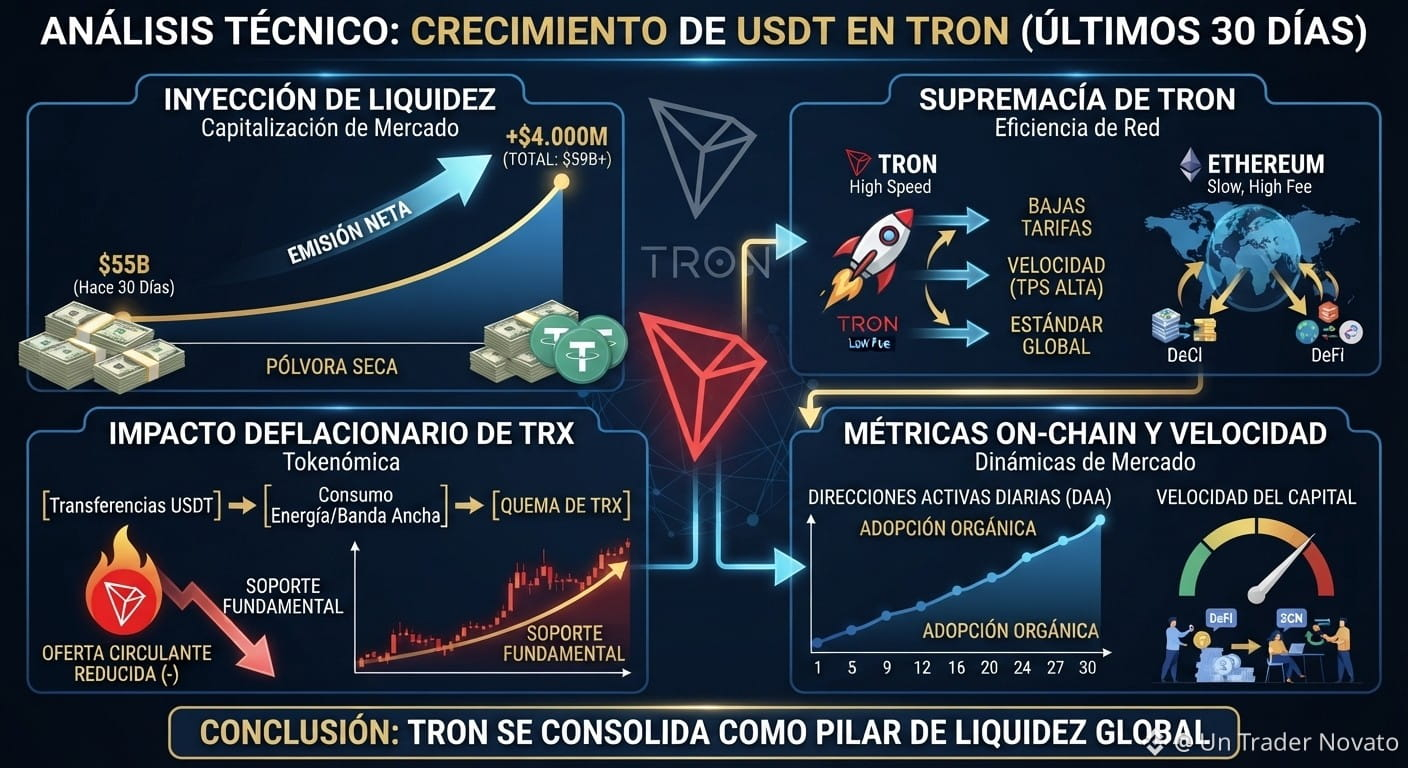
The increase of $4 billion in the market capitalization of USDT on the Tron network over the past 30 days reflects a highly relevant macroeconomic and on-chain technical phenomenon 📊. This massive inflow of capital is not an isolated figure; it represents a direct expansion of available liquidity and a notable shift in the operating dynamics of market participants 🌐.
Net liquidity injection and dry powder The rise in the market capitalization of a stablecoin via direct issuance indicates a net inflow of fiat-backed capital 💵. Having an additional $4k million in USDT is equivalent to "dry powder" ready to be deployed in spot markets, derivatives, or decentralized finance (DeFi) protocols—often preceding phases of greater volatility or accumulation.
Tron dominance in efficiency and costs Concentrating this flow on the Tron network confirms its infrastructure as the preferred route for global value transfer ⚡. Its low transaction fees and high speed make it the standard for arbitrage between exchanges and trading in emerging regions, optimizing operational costs for large and mid-sized capital.
Deflationary impact on the TRX token From a tokenomics perspective, a massive increase in USDT transfers boosts resource consumption on the network (Energy and Bandwidth) 🔋. This accelerates the algorithmic burn of TRX tokens, reducing circulating supply and providing a fundamental long-term support for the native asset’s price 📈.
On-Chain Metrics and capital velocity To validate the sustainability of this trend, it’s essential to analyze daily active addresses (DAA) and the asset’s circulation speed 🔍. If the injected capital translates into sustained transaction volume, it confirms organic adoption and real usage rather than passive accumulation. $USDT
This growth consolidates Tron as a fundamental pillar of liquidity in cryptocurrencies, projecting a scenario of high operational activity.
Net liquidity injection and dry powder The rise in the market capitalization of a stablecoin via direct issuance indicates a net inflow of fiat-backed capital 💵. Having an additional $4k million in USDT is equivalent to "dry powder" ready to be deployed in spot markets, derivatives, or decentralized finance (DeFi) protocols—often preceding phases of greater volatility or accumulation.
Tron dominance in efficiency and costs Concentrating this flow on the Tron network confirms its infrastructure as the preferred route for global value transfer ⚡. Its low transaction fees and high speed make it the standard for arbitrage between exchanges and trading in emerging regions, optimizing operational costs for large and mid-sized capital.
Deflationary impact on the TRX token From a tokenomics perspective, a massive increase in USDT transfers boosts resource consumption on the network (Energy and Bandwidth) 🔋. This accelerates the algorithmic burn of TRX tokens, reducing circulating supply and providing a fundamental long-term support for the native asset’s price 📈.
On-Chain Metrics and capital velocity To validate the sustainability of this trend, it’s essential to analyze daily active addresses (DAA) and the asset’s circulation speed 🔍. If the injected capital translates into sustained transaction volume, it confirms organic adoption and real usage rather than passive accumulation. $USDT
This growth consolidates Tron as a fundamental pillar of liquidity in cryptocurrencies, projecting a scenario of high operational activity.