
阿尔法灰
8k Posts

阿尔法灰
先人一步,做 Alpha 🔥 Join me on X @Alpha_Grey8
Open Trade
Frequent Trader
4 Years
772 Following
9.3K Followers
3.3K+ Liked
Posts
Portfolio
All
Quotes
Live
PINNED
Hello guys let's share some🎁🎁🫂 reward to grab the reward you just need to hit the like and comment button go go before it's too late 🎉🎉😻😻
$BMT $TMX $EDEN
#USIranReportedlyReachCeasefireConsensus
#HKJulyGoldNetExportsToMainland56.193Tons
#JapanNoAdditionalOilReserveReleaseInSepOct
#Binance
$BMT $TMX $EDEN
#USIranReportedlyReachCeasefireConsensus
#HKJulyGoldNetExportsToMainland56.193Tons
#JapanNoAdditionalOilReserveReleaseInSepOct
#Binance
Verified
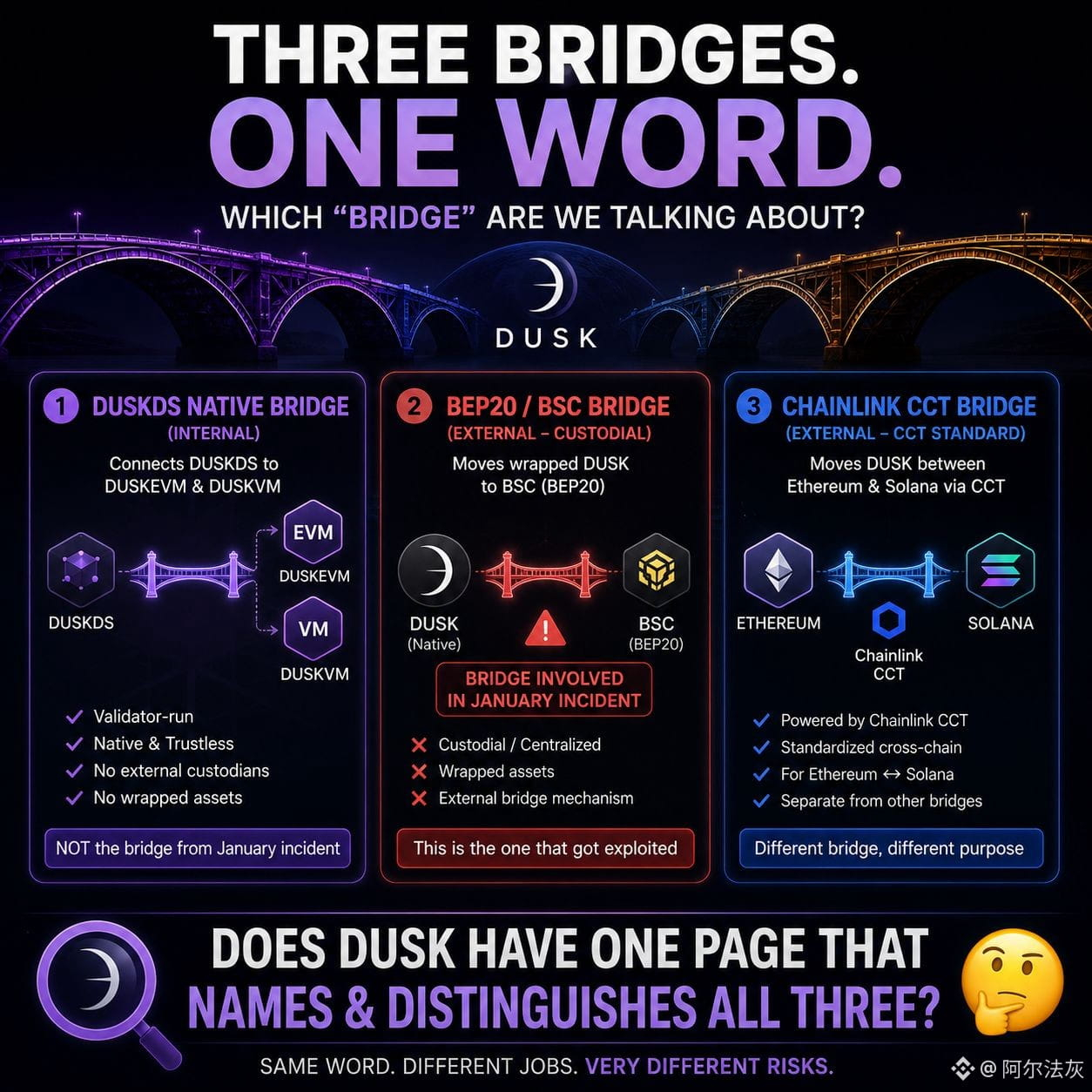
docs.dusk.network's own core components page mentions "native bridging" as part of duskds, connecting duskevm and duskvm to the base layer. that's the third thing i've now found called a "bridge" in dusk's stack. i went and actually confirmed whether that's the same mechanism that got hit in january — and honestly i almost assumed it was, given how loosely "bridge" gets used everywhere — but it's not. dusk's own multilayer architecture post describes this one specifically as "validator-run, native and trustless, no external custodians or wrapped assets required," while the incident notice from january ties directly back to the old bep20 bridge address, a completely different, custodial-style mechanism for moving wrapped dusk to bsc.
so that's three separate bridges confirmed: the internal duskds-to-duskevm native bridge, the external bep20/bsc bridge that got hit, and the chainlink cct pathway for eth-solana. all real, all distinct, all sharing the word "bridge" with nothing distinguishing them by name anywhere i've found.
i don't think that's dusk being deceptive, modular architectures genuinely need multiple bridging layers for different jobs. i just think "dusk's bridge had an incident" is doing a lot of unearned precision for a sentence that could mean three different things depending on which one you mean.
does dusk have a single page anywhere that names and distinguishes all three by name in one place? 🧐
#dusk $DUSK @Dusk
so that's three separate bridges confirmed: the internal duskds-to-duskevm native bridge, the external bep20/bsc bridge that got hit, and the chainlink cct pathway for eth-solana. all real, all distinct, all sharing the word "bridge" with nothing distinguishing them by name anywhere i've found.
i don't think that's dusk being deceptive, modular architectures genuinely need multiple bridging layers for different jobs. i just think "dusk's bridge had an incident" is doing a lot of unearned precision for a sentence that could mean three different things depending on which one you mean.
does dusk have a single page anywhere that names and distinguishes all three by name in one place? 🧐
#dusk $DUSK @Dusk

·
--
🎙️ Building Binance Square, DCA BNB|Wednesday, BTC still couldn’t stay above 80,000. What do you think the market will do next? Let’s chat~

End
05 h 21 m 38 s
9.4k
38
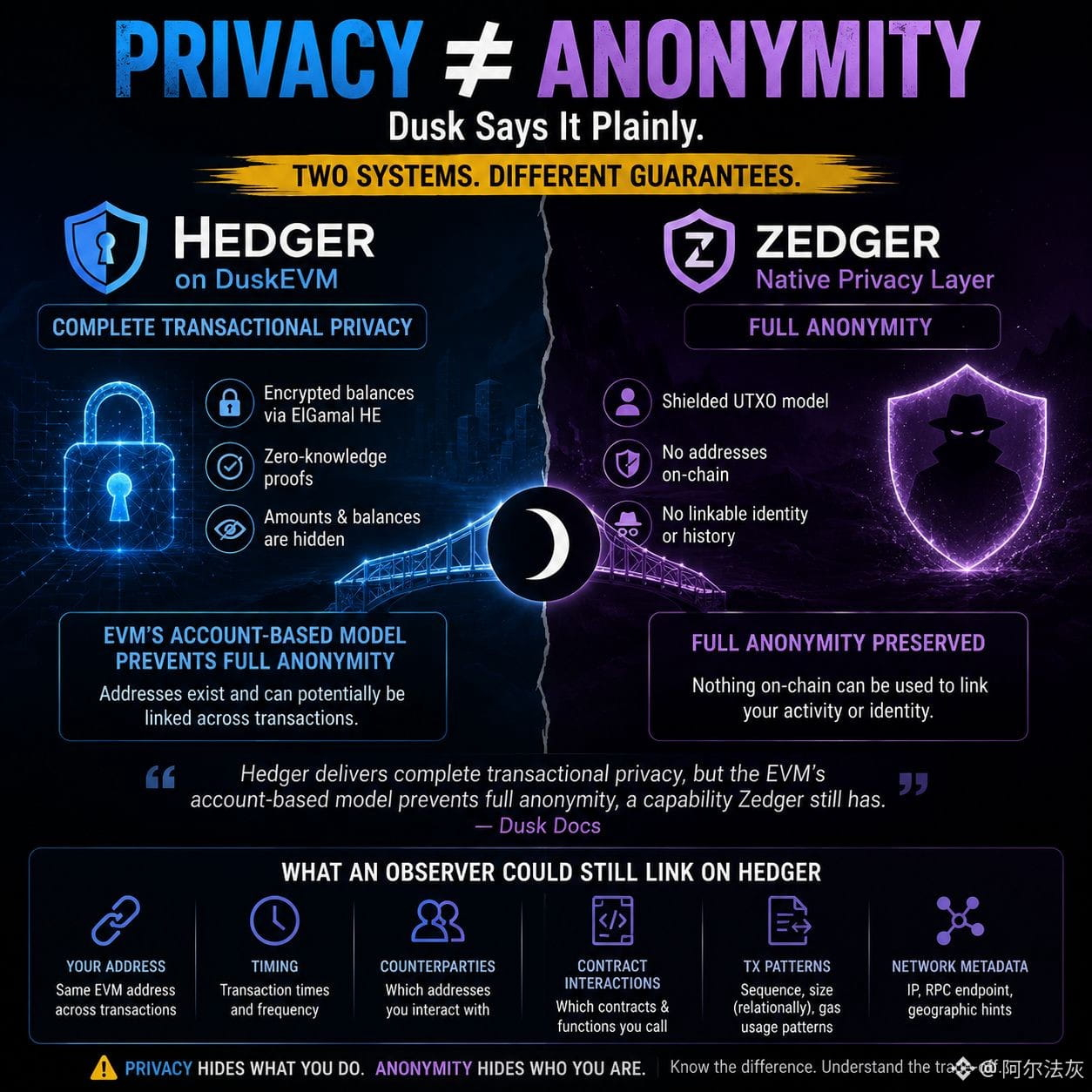
dusk's own page on hedger makes an admission i didn't expect to find stated so plainly — hedger delivers "complete transactional privacy" but the evm's account-based model "prevents full anonymity," a capability zedger still has. so the two privacy systems living on the same network aren't actually equivalent, and dusk says so itself rather than letting people assume duskevm gets the same guarantee as the native side.
privacy and anonymity get used interchangeably constantly in this space, but they're not the same claim, and honestly i had to read that line on their page twice before i realized they weren't just hedging, they were stating an actual architectural limit. privacy usually means your amounts and balances are hidden. anonymity means your actual identity or address linkage is hidden too. hedger apparently does the first solidly — encrypted balances via elgamal homomorphic encryption plus zk proofs — but the account model underneath still means addresses exist and can potentially be linked across transactions in a way a fully shielded utxo model like zedger avoids.
i think that's a reasonable tradeoff for solidity compatibility, most evm privacy tools don't even get this far. i just don't think "hedger brings confidential transactions to duskevm" gets read by most people as "except for full anonymity," and dusk's own docs are more precise about that gap than the marketing framing tends to be.
does anyone know exactly what an observer could still link together on hedger even with balances fully encrypted? 🧐
#dusk $DUSK @Dusk
privacy and anonymity get used interchangeably constantly in this space, but they're not the same claim, and honestly i had to read that line on their page twice before i realized they weren't just hedging, they were stating an actual architectural limit. privacy usually means your amounts and balances are hidden. anonymity means your actual identity or address linkage is hidden too. hedger apparently does the first solidly — encrypted balances via elgamal homomorphic encryption plus zk proofs — but the account model underneath still means addresses exist and can potentially be linked across transactions in a way a fully shielded utxo model like zedger avoids.
i think that's a reasonable tradeoff for solidity compatibility, most evm privacy tools don't even get this far. i just don't think "hedger brings confidential transactions to duskevm" gets read by most people as "except for full anonymity," and dusk's own docs are more precise about that gap than the marketing framing tends to be.
does anyone know exactly what an observer could still link together on hedger even with balances fully encrypted? 🧐
#dusk $DUSK @Dusk
Verified
30D trade $DUSK 362.4 USDT
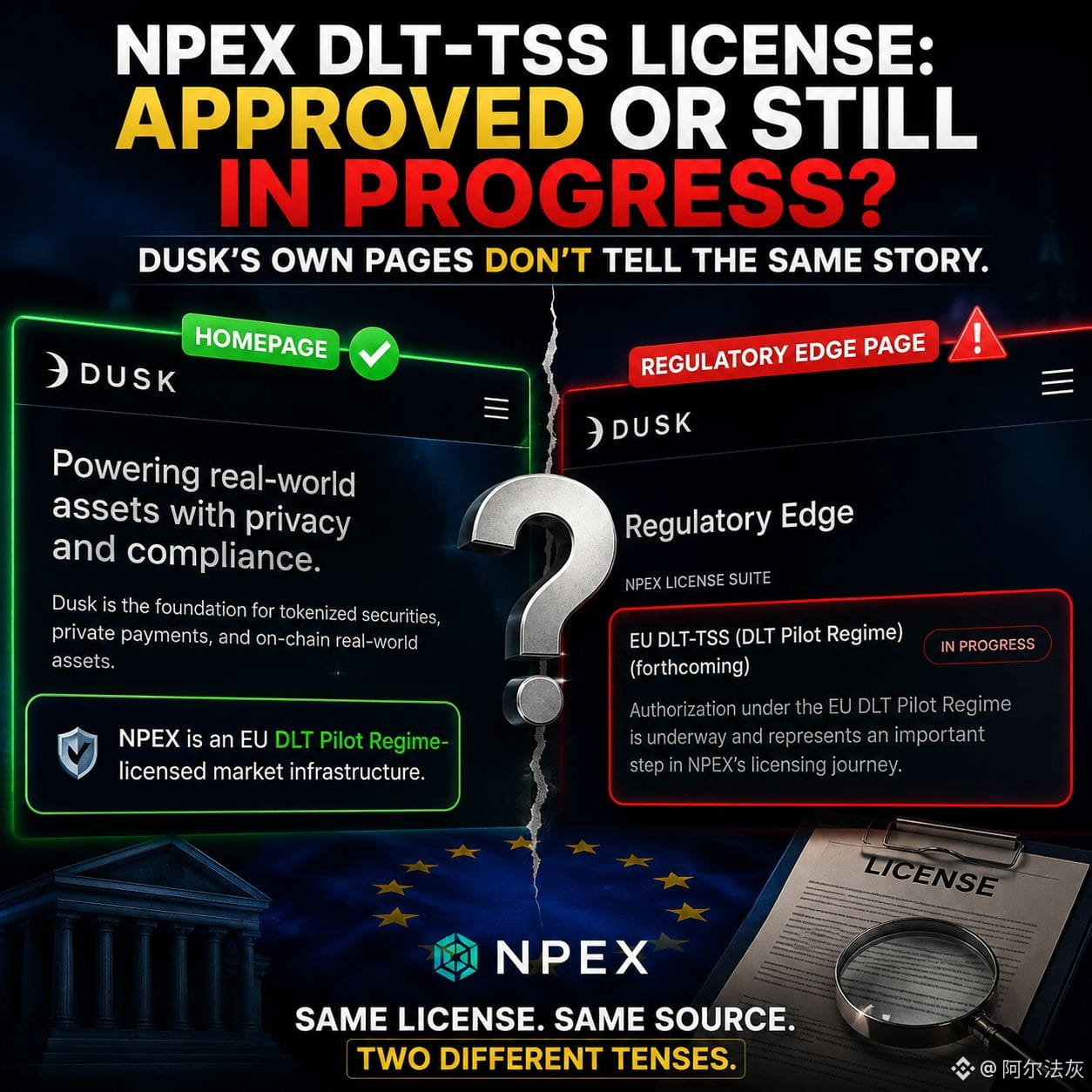
dusk.network's current homepage describes npex as "eu dlt pilot regime-licensed market infrastructure." that's present tense, done deal language. but dusk's own regulatory edge page, still live on their site, spells out the exact same license — actually, i had to check twice that "dlt-tss" and "dlt pilot regime" were even the same thing before treating this as a real conflict, they are, it's labeled explicitly "(in progress)" there, called the "forthcoming" piece of npex's license suite.
same license, same source, two different tenses. one page treats it as secured, the other as pending. i went looking for a newer announcement confirming npex actually got approved between those two pieces of content and couldn't find one, which doesn't mean it didn't happen, just that i can't confirm it did.
to be fair, this isn't an aggregator mangling dusk's words this time, it's dusk's own site being inconsistent with itself, which honestly feels like a bigger deal than the earlier version of this problem. a regulated-finance protocol should have its own current-status language matching across its own pages.
did npex's dlt-tss approval actually come through, or is the homepage just running ahead of what's confirmed on dusk's own regulatory edge page? 🧐
#dusk $DUSK @Dusk
same license, same source, two different tenses. one page treats it as secured, the other as pending. i went looking for a newer announcement confirming npex actually got approved between those two pieces of content and couldn't find one, which doesn't mean it didn't happen, just that i can't confirm it did.
to be fair, this isn't an aggregator mangling dusk's words this time, it's dusk's own site being inconsistent with itself, which honestly feels like a bigger deal than the earlier version of this problem. a regulated-finance protocol should have its own current-status language matching across its own pages.
did npex's dlt-tss approval actually come through, or is the homepage just running ahead of what's confirmed on dusk's own regulatory edge page? 🧐
#dusk $DUSK @Dusk
Hello guys let's share some🎁🎁🫂 reward to grab the reward you just need to hit the like and comment button go go before it's too late 🎉🎉😻😻
$PROM $PORTAL $TUT
#SP500FuturesFall
#BrentDrops1.87% .#SamsungFalls8.97%DraggingKospiDown3.24%
#SolanaGovernanceVoteToDoubleDeflationRate
$PROM $PORTAL $TUT
#SP500FuturesFall
#BrentDrops1.87% .#SamsungFalls8.97%DraggingKospiDown3.24%
#SolanaGovernanceVoteToDoubleDeflationRate

·
--
🎙️ Wan Zhi Breaks the Grid|AI Intelligent Agents Reshape a New On-Chain Financial Ecosystem!
End
03 h 48 m 43 s
19.7k
46
·
--
🎙️ Today getting ready to place an order at dusk—go long or go short?
End
02 h 46 m 53 s
11.9k
18
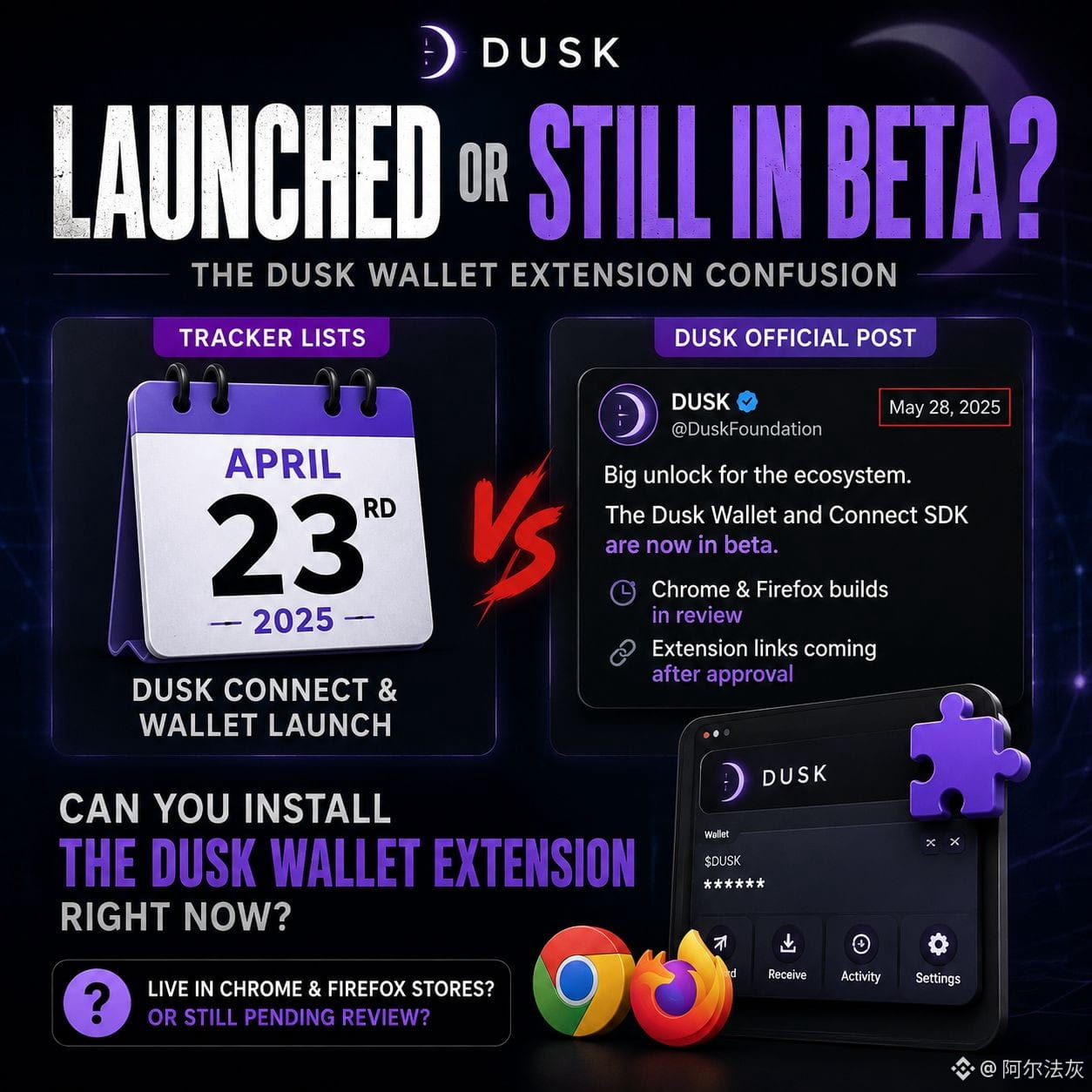
a tracker lists "dusk connect & wallet launch" as an april 23rd event. dusk's own account tells a different story in a post dated over a month later — may 28th, calling the wallet and connect sdk "now in beta," chrome and firefox builds still "in review," extension links promised "after approval" — and i actually had to reread that x post twice because i assumed "big unlock for the ecosystem" meant it was already usable, it's explicitly not yet.
those two things can't both be describing a finished launch. either april 23rd was something smaller that got labeled "launch" prematurely by a tracker, or dusk quietly walked something back to beta status for store review after it went out. i can't tell which from what's public.
it's a small gap in the scheme of things, wallet infra shipping in stages isn't unusual for any project. but for something this basic — can i actually install the extension right now or not — a five-week difference between "launched" and "still pending approval" shouldn't be this unclear.
is the dusk wallet extension actually live in the chrome and firefox stores at this point, or still sitting in review since that may post? 🧐
#dusk $DUSK @Dusk
those two things can't both be describing a finished launch. either april 23rd was something smaller that got labeled "launch" prematurely by a tracker, or dusk quietly walked something back to beta status for store review after it went out. i can't tell which from what's public.
it's a small gap in the scheme of things, wallet infra shipping in stages isn't unusual for any project. but for something this basic — can i actually install the extension right now or not — a five-week difference between "launched" and "still pending approval" shouldn't be this unclear.
is the dusk wallet extension actually live in the chrome and firefox stores at this point, or still sitting in review since that may post? 🧐
#dusk $DUSK @Dusk
Hello guys just give me few minutes...
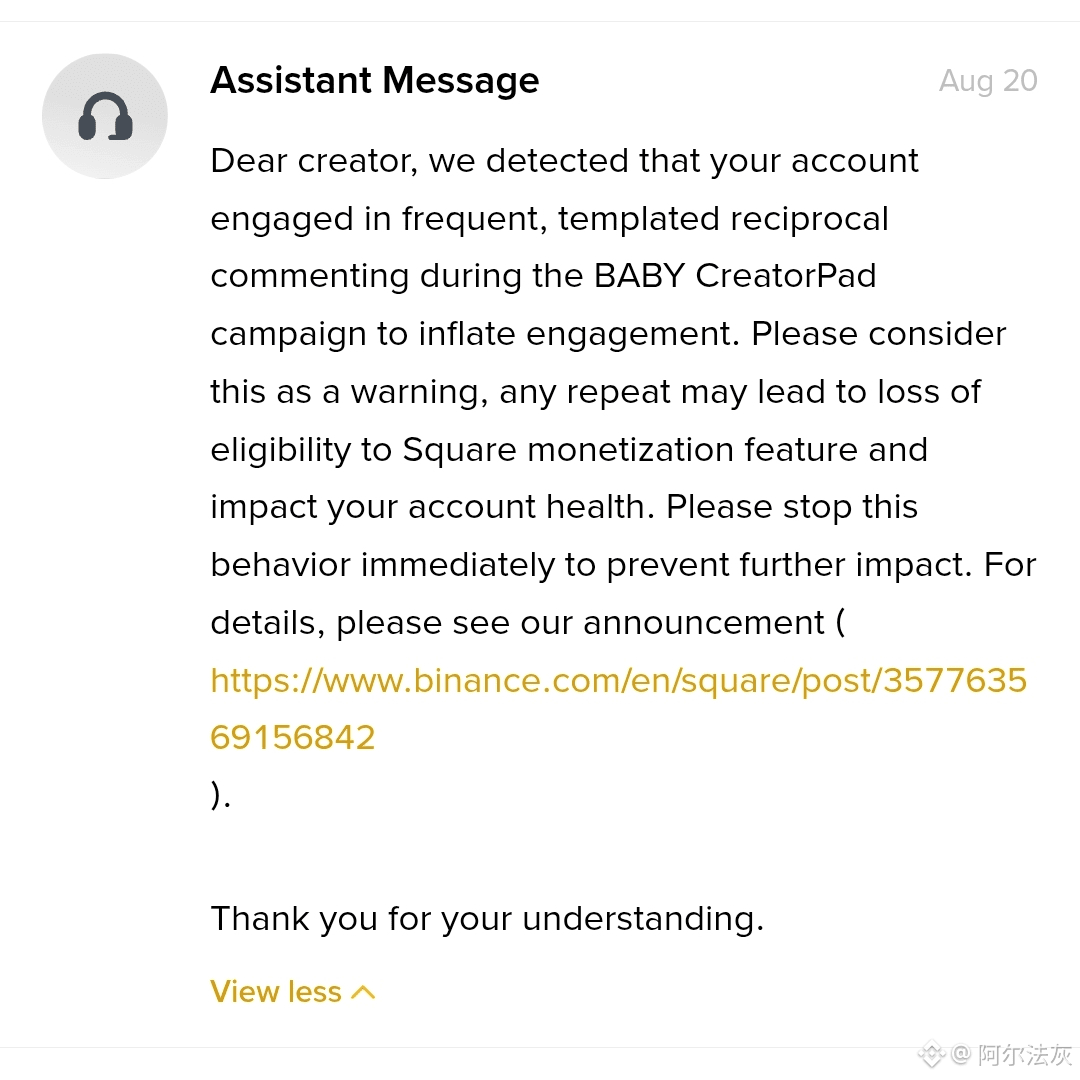
⚠️⚠️⚠️⚠️⚠️Got that Binance Square warning about repetitive/copy-paste comments? Don't just read it and move on.
That warning's real — keep it up and it can hit your reach, your monetization, your shot at future campaigns.
If you're still doing the same thing after getting flagged... that's the sign to stop🚫🚫🚫🚫, not push through.
A few extra points now isn't worth torching an account you've put time into....
#Binnacesquare #Binance #creatorpad #campiagns
⚠️⚠️⚠️⚠️⚠️Got that Binance Square warning about repetitive/copy-paste comments? Don't just read it and move on.
That warning's real — keep it up and it can hit your reach, your monetization, your shot at future campaigns.
If you're still doing the same thing after getting flagged... that's the sign to stop🚫🚫🚫🚫, not push through.
A few extra points now isn't worth torching an account you've put time into....
#Binnacesquare #Binance #creatorpad #campiagns


Binance Square Official
·
--
Real conversation is what makes Binance Square worth being part of.
- Posting a high volume of repetitive, templated, AI-generated, or empty comments, far more than a normal user would, goes against our rules. In serious cases it can lead to losing monetization eligibility and being muted.
- The same goes for accounts that keep trading templated replies to fake engagement for points or rewards. It hurts your account health and reach, and serious cases can also lose monetization eligibility.
Based on the above, and since many of you have shared feedback about CreatorPad, we reviewed the award winners of the BABY CreatorPad. Here's what we found:
- 27 accounts were commenting at rates far beyond normal interaction. Their reward eligibility has been revoked, they've been flagged as a violation.
- 265 accounts were part of reciprocal spamming. They've been warned, and it's been noted on the account.
Binance Square is about real community interaction. We've added detection for meaningless comment spam, small-circle reciprocal commenting, and repeatedly asking others to leave comments. From this announcement on, it applies to all features and campaigns going forward, including the current CreatorPad campaigns. Anyone whose behavior falls into these patterns might lose reward eligibility.
Thank you to everyone who keeps creating with care. Let's keep the community fair, together.
We'd also like to hear from you. Drop your thoughts on CreatorPad and Binance Square in the comments — we'll pick 3 commenters to receive a reward red packet. Your honest feedback helps us make this better.
- Posting a high volume of repetitive, templated, AI-generated, or empty comments, far more than a normal user would, goes against our rules. In serious cases it can lead to losing monetization eligibility and being muted.
- The same goes for accounts that keep trading templated replies to fake engagement for points or rewards. It hurts your account health and reach, and serious cases can also lose monetization eligibility.
Based on the above, and since many of you have shared feedback about CreatorPad, we reviewed the award winners of the BABY CreatorPad. Here's what we found:
- 27 accounts were commenting at rates far beyond normal interaction. Their reward eligibility has been revoked, they've been flagged as a violation.
- 265 accounts were part of reciprocal spamming. They've been warned, and it's been noted on the account.
Binance Square is about real community interaction. We've added detection for meaningless comment spam, small-circle reciprocal commenting, and repeatedly asking others to leave comments. From this announcement on, it applies to all features and campaigns going forward, including the current CreatorPad campaigns. Anyone whose behavior falls into these patterns might lose reward eligibility.
Thank you to everyone who keeps creating with care. Let's keep the community fair, together.
We'd also like to hear from you. Drop your thoughts on CreatorPad and Binance Square in the comments — we'll pick 3 commenters to receive a reward red packet. Your honest feedback helps us make this better.
Partly True
30D trade $DUSK 314.6 USDT
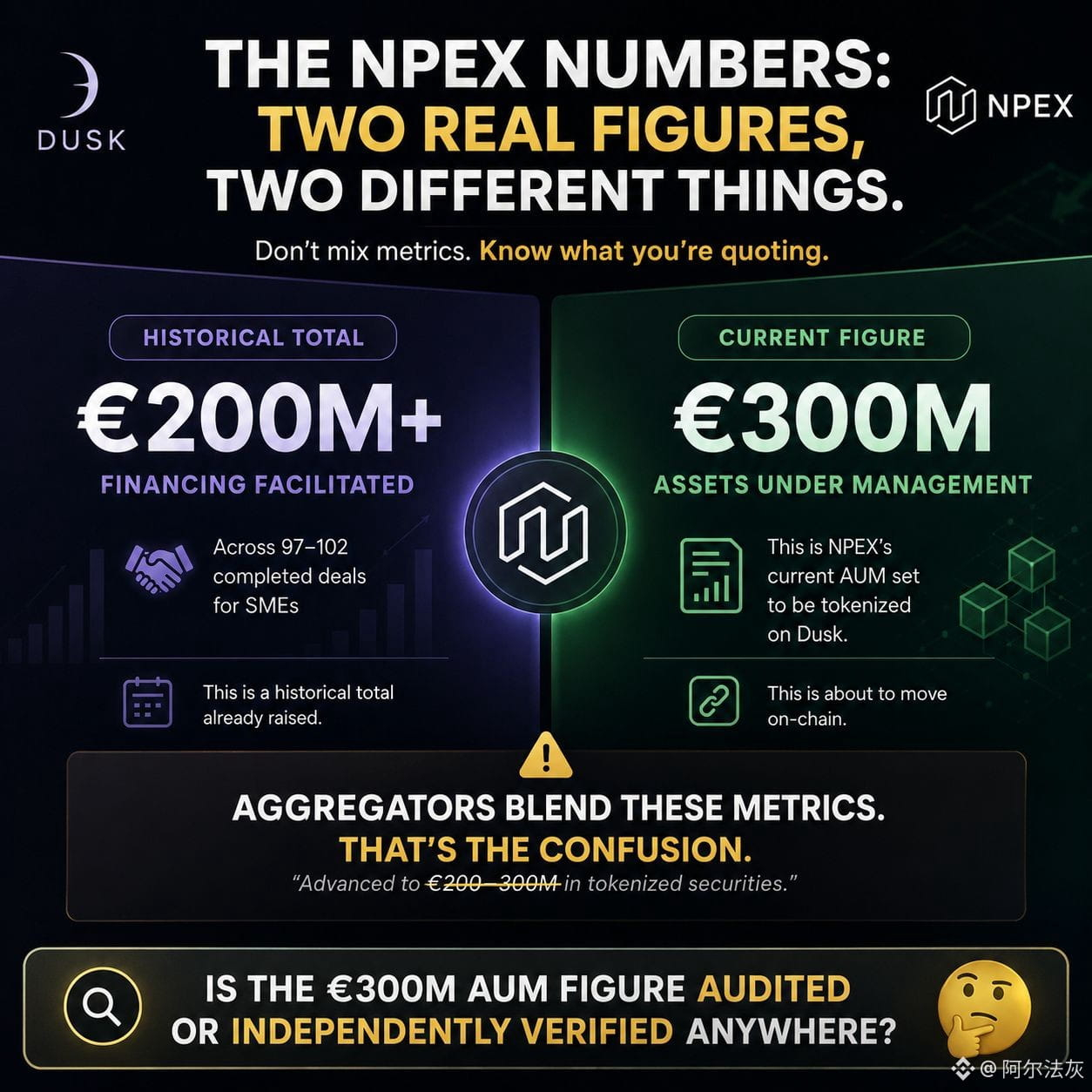
i went back to dusk's npex numbers since they get cited constantly, and there are actually two different real figures being used almost interchangeably. npex's own materials describe over €200 million in financing facilitated historically, across 97 to 102 completed deals for smes. separately, dusk's own binance us listing post and a later x announcement cite npex's current €300m in assets under management as what's actually getting tokenized onto dusk going forward.
those aren't the same number describing the same thing, one's a historical total already raised, the other's a current aum figure about to move on-chain — actually, i had to stop and reread both source posts side by side because at first glance they read like they were just updating the same figure over time, they're not, they're measuring two completely different things. i even found a clean example of the blend, one dusk buying guide describes the partnership as having "advanced to €200-300m in tokenized securities," treating two separate metrics as one moving range.
to be fair, dusk and npex have both stated their own individual numbers clearly, it's the aggregator layer collapsing two distinct metrics that's the actual problem, not the primary sources contradicting themselves. i just think anyone quoting "the npex number" should specify which one they mean.
is the €300m aum figure itself audited or independently verified anywhere, or is that one self-reported the same way the €200m financing total is? 🧐
#dusk $DUSK @Dusk
those aren't the same number describing the same thing, one's a historical total already raised, the other's a current aum figure about to move on-chain — actually, i had to stop and reread both source posts side by side because at first glance they read like they were just updating the same figure over time, they're not, they're measuring two completely different things. i even found a clean example of the blend, one dusk buying guide describes the partnership as having "advanced to €200-300m in tokenized securities," treating two separate metrics as one moving range.
to be fair, dusk and npex have both stated their own individual numbers clearly, it's the aggregator layer collapsing two distinct metrics that's the actual problem, not the primary sources contradicting themselves. i just think anyone quoting "the npex number" should specify which one they mean.
is the €300m aum figure itself audited or independently verified anywhere, or is that one self-reported the same way the €200m financing total is? 🧐
#dusk $DUSK @Dusk

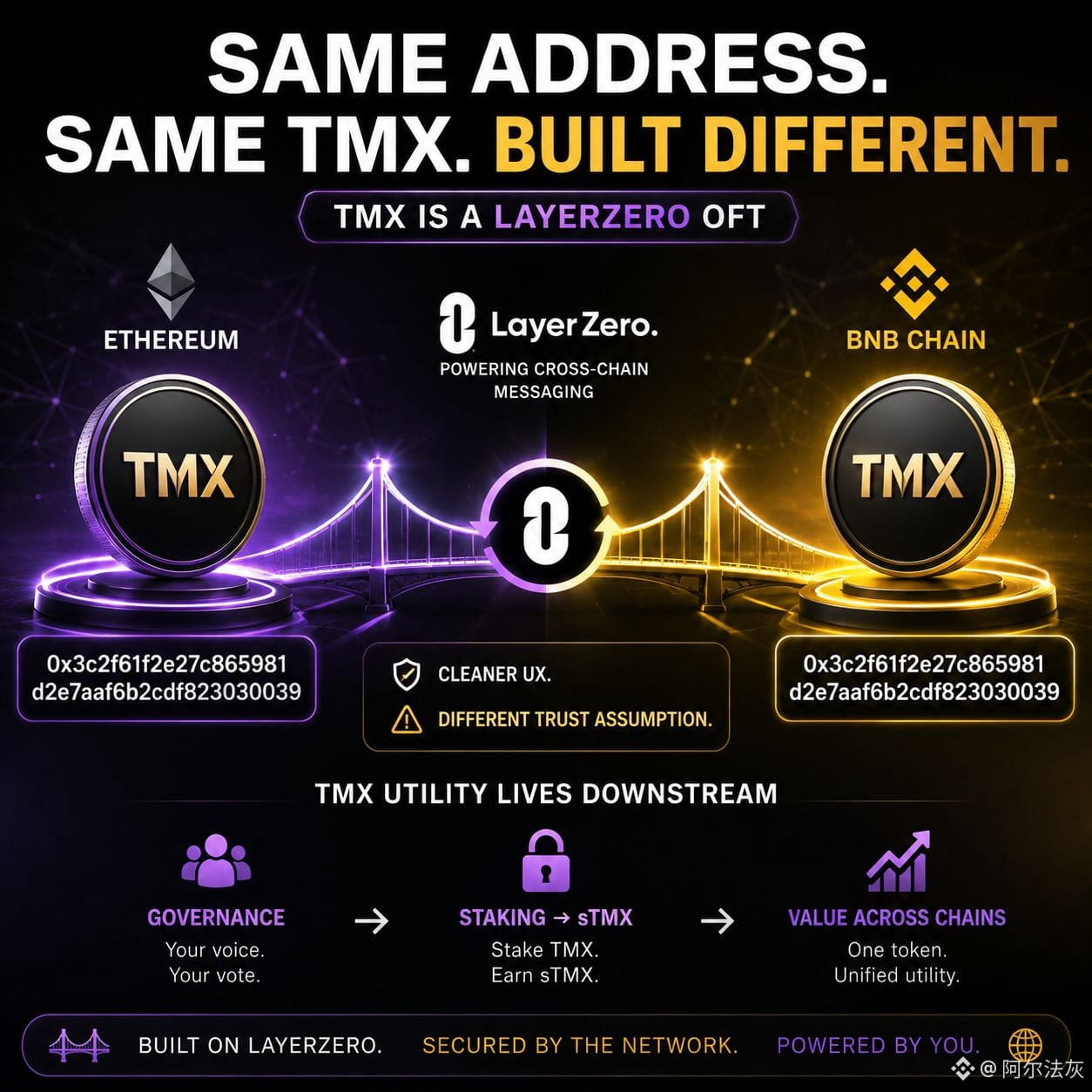
tmx's contract address is the exact same string on ethereum and bnb chain — 0x3c2f61f2e27c865981d2e7aaf6b2cdf823030039, letter for letter. i had to check twice because that's not how bridged tokens normally work. it's like that because tmx is issued as a layerzero oft, not something you're wrapping and rebridging manually across chains.
what that quietly means is tmx's actual utility — governance weight, staking into stmx, all of it — sits downstream of layerzero's messaging layer working correctly every time value needs to move between chains. cleaner ux than the old wrap-and-bridge model, i'll give it that, but it's trading one trust assumption for a different one, not removing the dependency entirely.
not losing sleep over it, layerzero's already used by plenty of major tokens at this point. still, sTMX staking and governance being downstream of an external messaging layer is a dependency worth actually knowing about before you're mid-transaction 🌉
#termmax @TermMax
what that quietly means is tmx's actual utility — governance weight, staking into stmx, all of it — sits downstream of layerzero's messaging layer working correctly every time value needs to move between chains. cleaner ux than the old wrap-and-bridge model, i'll give it that, but it's trading one trust assumption for a different one, not removing the dependency entirely.
not losing sleep over it, layerzero's already used by plenty of major tokens at this point. still, sTMX staking and governance being downstream of an external messaging layer is a dependency worth actually knowing about before you're mid-transaction 🌉
#termmax @TermMax
🔥🔥🔥

Shalluu
·
--
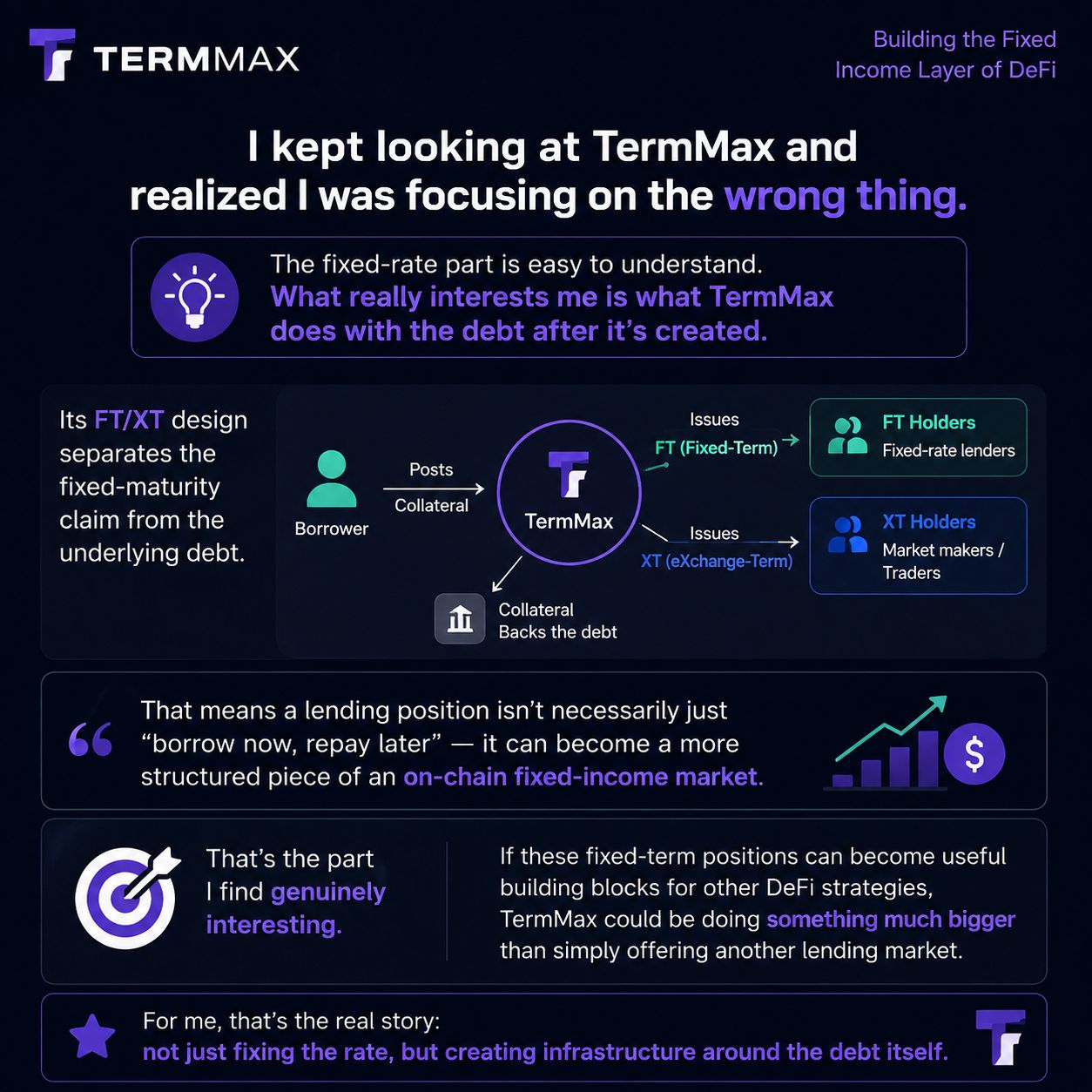
#termmax @TermMax kept looking at TermMax and realized I was focusing on the wrong thing.
The fixed-rate part is easy to understand. What really interests me is what TermMax does with the debt after it’s created.
Its FT/XT design separates the fixed-maturity claim from the underlying debt. That means a lending position isn’t necessarily just “borrow now, repay later” — it can become a more structured piece of an on-chain fixed-income market.
That’s the part I find genuinely interesting.
If these fixed-term positions can become useful building blocks for other DeFi strategies, TermMax could be doing something much bigger than simply offering another lending market.
For me, that’s the real story: not just fixing the rate, but creating infrastructure around the debt itself.
The fixed-rate part is easy to understand. What really interests me is what TermMax does with the debt after it’s created.
Its FT/XT design separates the fixed-maturity claim from the underlying debt. That means a lending position isn’t necessarily just “borrow now, repay later” — it can become a more structured piece of an on-chain fixed-income market.
That’s the part I find genuinely interesting.
If these fixed-term positions can become useful building blocks for other DeFi strategies, TermMax could be doing something much bigger than simply offering another lending market.
For me, that’s the real story: not just fixing the rate, but creating infrastructure around the debt itself.
Verified
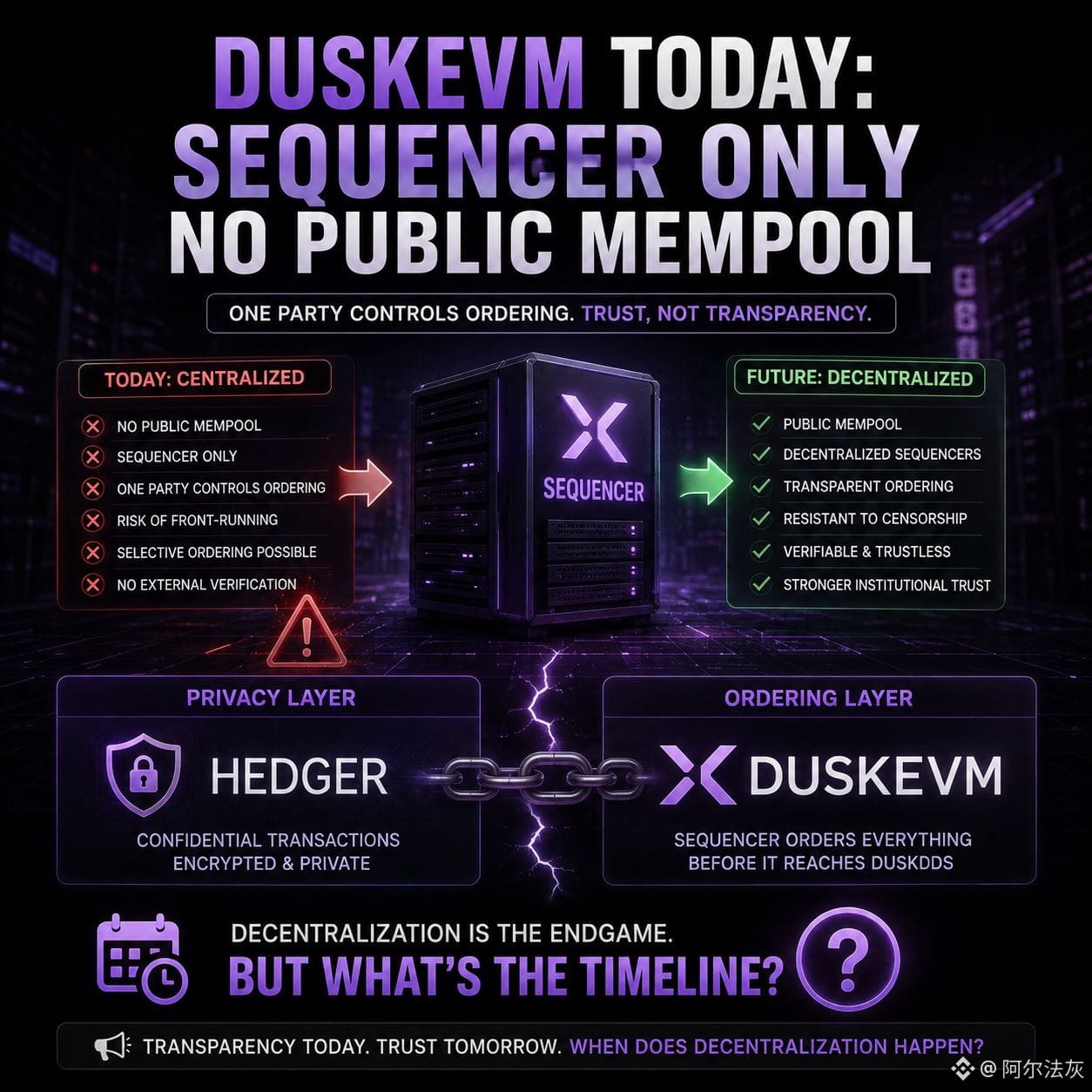
i went to check how duskevm actually orders transactions, since rollups built on op stack usually get judged by how decentralized their sequencer setup is. dusk's own docs say it plainly — duskevm currently has no public mempool, sequencer only, and i actually went back and reread that line assuming i'd misunderstood "sequencer only" as just meaning "no third-party relayers," it means no public mempool at all, full stop.
that means right now, one party controls transaction ordering and inclusion timing on that whole layer. it's not unusual for a new op stack rollup, most launch this way and decentralize the sequencer later, but it's also not a small detail for a chain positioning itself around institutional trust and deterministic settlement. a private mempool is exactly the kind of thing that lets front-running or selective ordering happen without anyone external being able to verify it isn't.
what's actually interesting is the pairing — hedger exists specifically to add confidential transaction flows on top of duskevm, but if the sequencer itself can see and order everything before anything reaches DuskDS, the privacy guarantee and the ordering guarantee are sitting in two completely different places, one cryptographic, one just trust-based.
is there a published timeline anywhere for when the duskevm sequencer actually decentralizes? 🧐
#dusk $DUSK @Dusk
that means right now, one party controls transaction ordering and inclusion timing on that whole layer. it's not unusual for a new op stack rollup, most launch this way and decentralize the sequencer later, but it's also not a small detail for a chain positioning itself around institutional trust and deterministic settlement. a private mempool is exactly the kind of thing that lets front-running or selective ordering happen without anyone external being able to verify it isn't.
what's actually interesting is the pairing — hedger exists specifically to add confidential transaction flows on top of duskevm, but if the sequencer itself can see and order everything before anything reaches DuskDS, the privacy guarantee and the ordering guarantee are sitting in two completely different places, one cryptographic, one just trust-based.
is there a published timeline anywhere for when the duskevm sequencer actually decentralizes? 🧐
#dusk $DUSK @Dusk
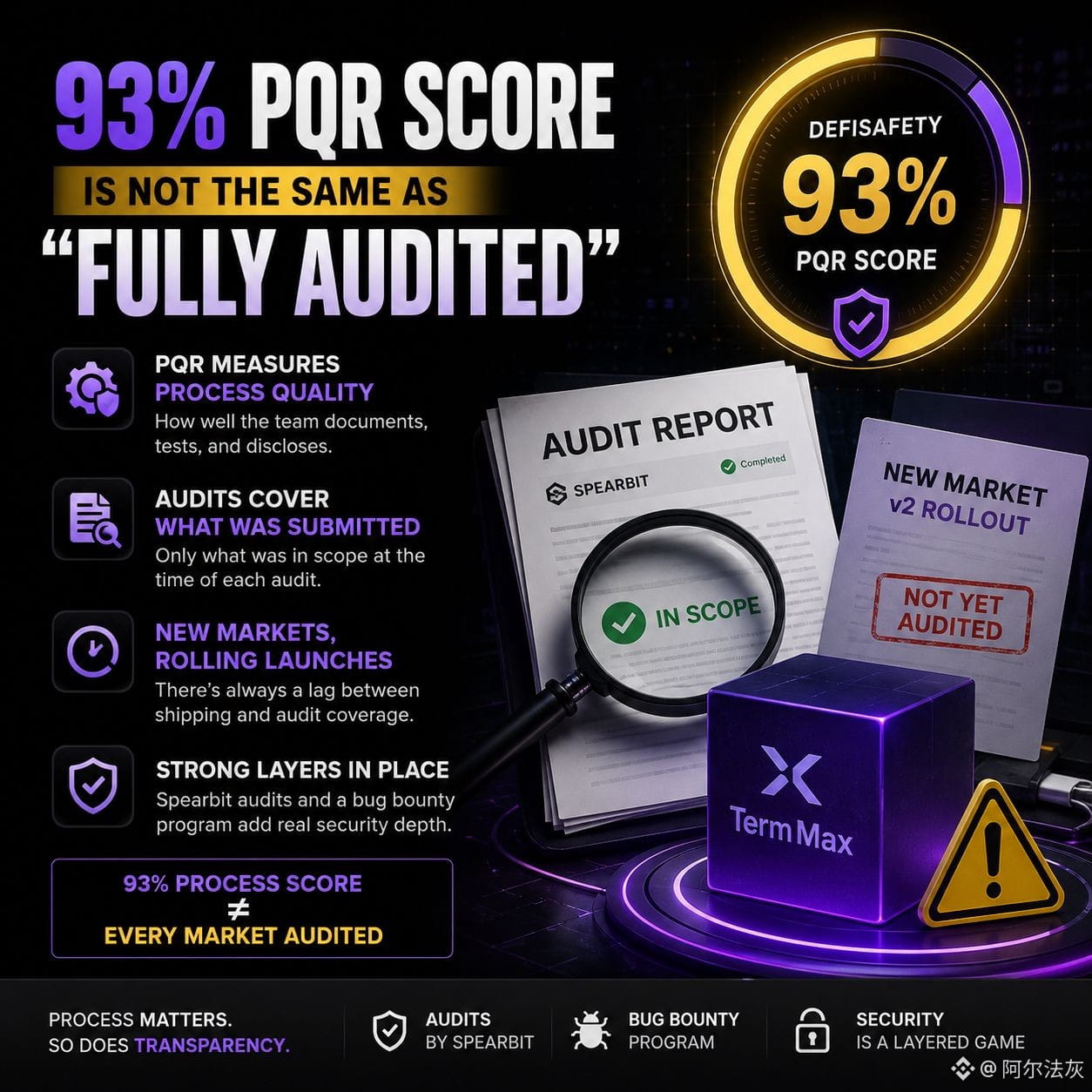
defisafety gave termmax a 93% pqr score, and i keep seeing that number repeated like it's interchangeable with "fully audited." it's not the same claim. pqr measures process quality — whether the team documents, tests, and discloses things properly. it's not a line-by-line security review of every contract that's live right now.
the actual audit reports sit on github, and they only cover what was formally submitted for review at the time each one was published. new markets and vault configs keep launching on a rolling basis, v2 rollout included, so there's — well, there's a real lag between something shipping and something actually getting audit coverage.
not saying the process score is hollow or the audits are weak, spearbit and the bug bounty program are genuinely solid layers on top of it. it just means a 93% process score and "every live market is audited" are two separate claims, and only one of them is actually true at any given moment 🔎
#termmax @TermMax
the actual audit reports sit on github, and they only cover what was formally submitted for review at the time each one was published. new markets and vault configs keep launching on a rolling basis, v2 rollout included, so there's — well, there's a real lag between something shipping and something actually getting audit coverage.
not saying the process score is hollow or the audits are weak, spearbit and the bug bounty program are genuinely solid layers on top of it. it just means a 93% process score and "every live market is audited" are two separate claims, and only one of them is actually true at any given moment 🔎
#termmax @TermMax
Log in to explore more content