$1,490 SNDK—are you daring to buy the dip?
First, look at the surface: it fell from 2354 to 1490, down 36%—retail investors are panicking and cursing.
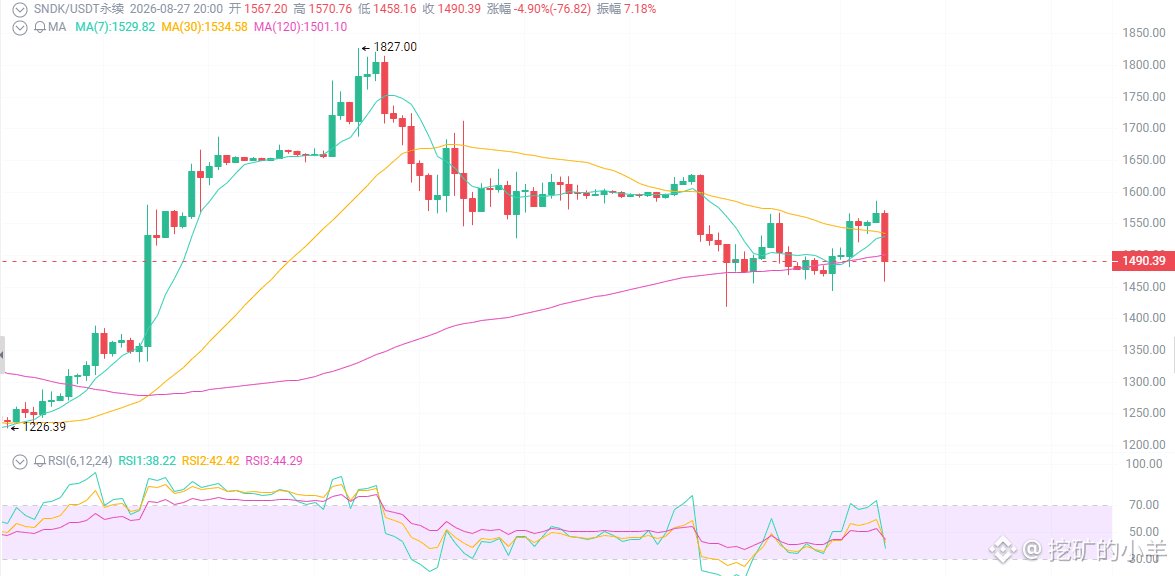
It topped on June 22 at 2354, then traded in a choppy downward trend. In mid-August it surged to 1780+, then rapidly got smashed down to 1416–1420, before rebounding to the 1480–1520 range. The AI storage leader has gained 500%+ in a year, but it has pulled back 36% now. The candlestick chart tells you this: 1420 has been defended three times, forming the beginnings of a double-bottom, while selling pressure is gradually running out.
First thing: the company’s fundamentals are ridiculously strong, but you’ve been scared by the candlesticks.
In mid-August, SanDisk (Flash-based storage) rolled out a “new business model”: multi-year floor-price long-term contracts, with a weighted duration of about 4 years. The floor-contract value is $93.9 billion, plus another $16.5 billion in customer financial guarantees. Management’s goals for FY2028–2030: gross margin around 80%, with excess cash returned to shareholders at 100%.
For FY2026, revenue is about $20.25 billion (YoY +175%), net income about $11.43 billion, and EPS about $7.38. Q4 gross margin briefly surged to 84.6%.
Second thing: institutions and SK hynix promote HBF standards, while Kioxia is planning expansion in Japan of over $31 billion.
The direction is clear: grab AI inference-side storage, not just consumer-grade SD cards.
Retail investors are still stuck on the old framework of “consumer electronics recovery,” but institutions are already trading a new valuation model—“AI storage long-term contracts cash cow.” Up over 500% YTD, they’ve made enough money, but they haven’t fully exited—they’re waiting for the next catalyst.
Third thing: the candlestick chart shows a signal you must take seriously.
Around 1420: the August 24 hammer low, the takeover zone after the late-August plunge, and the third time since June that it has held. This is early evidence of a three-bottom structure—the ironclad proof that buy-side strength is gradually increasing.
But at 1600–1690, SNDK has hit two walls as well. The battle between bulls and bears is imminent.
Trading strategy
Short-term traders:
Go long at 1450–1465. Stop loss 1410. Targets 1528–1550; if it breaks out, watch 1580–1600. Try a short at 1570–1600. Stop loss 1625–1640. Target 1520–1485. As long as the range isn’t broken, sell high and buy low.
Swing traders:
Wait for a false breakdown below 1420, then quickly reclaim it and stand back above 1450—treat it as a false breakdown and chase longs targeting 1528–1580. Alternatively, wait for the daily chart to close firmly above 1600, then get in from the right side.
Longer-term traders:
1350–1450 is a high-quality add-on zone. As long as 1420 doesn’t close below the weekly chart, the longer-term bias remains moderately bullish. Next observation window: early November earnings—when guidance and whether gross margin can keep going is truly put to the test.
First, look at the surface: it fell from 2354 to 1490, down 36%—retail investors are panicking and cursing.
It topped on June 22 at 2354, then traded in a choppy downward trend. In mid-August it surged to 1780+, then rapidly got smashed down to 1416–1420, before rebounding to the 1480–1520 range. The AI storage leader has gained 500%+ in a year, but it has pulled back 36% now. The candlestick chart tells you this: 1420 has been defended three times, forming the beginnings of a double-bottom, while selling pressure is gradually running out.
First thing: the company’s fundamentals are ridiculously strong, but you’ve been scared by the candlesticks.
In mid-August, SanDisk (Flash-based storage) rolled out a “new business model”: multi-year floor-price long-term contracts, with a weighted duration of about 4 years. The floor-contract value is $93.9 billion, plus another $16.5 billion in customer financial guarantees. Management’s goals for FY2028–2030: gross margin around 80%, with excess cash returned to shareholders at 100%.
For FY2026, revenue is about $20.25 billion (YoY +175%), net income about $11.43 billion, and EPS about $7.38. Q4 gross margin briefly surged to 84.6%.
Second thing: institutions and SK hynix promote HBF standards, while Kioxia is planning expansion in Japan of over $31 billion.
The direction is clear: grab AI inference-side storage, not just consumer-grade SD cards.
Retail investors are still stuck on the old framework of “consumer electronics recovery,” but institutions are already trading a new valuation model—“AI storage long-term contracts cash cow.” Up over 500% YTD, they’ve made enough money, but they haven’t fully exited—they’re waiting for the next catalyst.
Third thing: the candlestick chart shows a signal you must take seriously.
Around 1420: the August 24 hammer low, the takeover zone after the late-August plunge, and the third time since June that it has held. This is early evidence of a three-bottom structure—the ironclad proof that buy-side strength is gradually increasing.
But at 1600–1690, SNDK has hit two walls as well. The battle between bulls and bears is imminent.
Trading strategy
Short-term traders:
Go long at 1450–1465. Stop loss 1410. Targets 1528–1550; if it breaks out, watch 1580–1600. Try a short at 1570–1600. Stop loss 1625–1640. Target 1520–1485. As long as the range isn’t broken, sell high and buy low.
Swing traders:
Wait for a false breakdown below 1420, then quickly reclaim it and stand back above 1450—treat it as a false breakdown and chase longs targeting 1528–1580. Alternatively, wait for the daily chart to close firmly above 1600, then get in from the right side.
Longer-term traders:
1350–1450 is a high-quality add-on zone. As long as 1420 doesn’t close below the weekly chart, the longer-term bias remains moderately bullish. Next observation window: early November earnings—when guidance and whether gross margin can keep going is truly put to the test.