
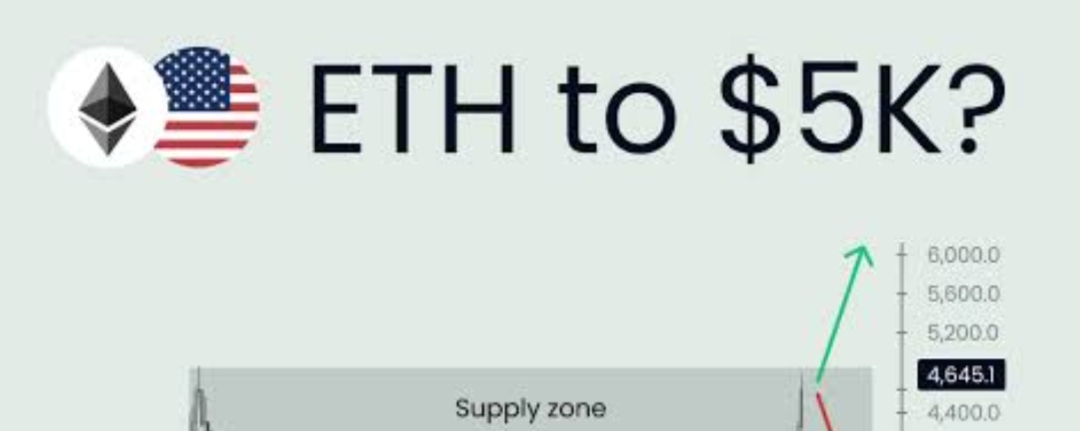


Ethereum is back in the spotlight, and traders are once again asking the big question: could ETH make a serious run toward $5,000?
The $5K level would put Ethereum around its previous record territory, so getting there would require more than a short-term pump. Strong institutional demand, growing network usage and favorable market conditions would likely need to come together.
Here are five catalysts that could strengthen Ethereum’s next major move.
1. Ethereum ETF Demand Is Heating Up
Institutional money is becoming an increasingly important part of the ETH story.
U.S. spot Ether ETFs attracted roughly $697 million in net inflows during the week ending August 21, their strongest weekly result of 2026 so far. Trading volume also jumped sharply.
If ETF demand stays strong, it could provide Ethereum with a more consistent source of buying pressure.
The important signal isn't one huge inflow day. It's whether institutions continue allocating capital over several weeks or months.
2. Stablecoins Could Become a Huge Ethereum Catalyst
Stablecoins may look boring compared with meme coins, but they are becoming one of crypto's biggest real-world use cases.
Ethereum remains a major settlement layer for stablecoins. Ethereum's institutional portal currently reports about $159 billion in stablecoins on Ethereum mainnet, with another roughly $12 billion across its Layer-2 ecosystem.
Traditional finance is paying attention too. Major banks are exploring stablecoins and tokenized deposits as blockchain-based payments become increasingly important.
If stablecoin adoption keeps expanding, Ethereum could benefit from increased settlement and network activity.
3. Wall Street Is Moving Assets On-Chain
Tokenization could become an even bigger catalyst.
Stocks, bonds, funds and other traditional assets can increasingly be represented and settled on blockchain networks.
Ethereum already plays a leading role in this market. Its institutional ecosystem reports billions of dollars in tokenized real-world assets deployed on the network.
Institutional interest is broader than just a few experiments. A 2026 survey of institutional decision-makers found 64% of asset managers were interested in tokenizing assets, while more than 60% expected tokenization to significantly affect market structure.
If tokenization becomes a major part of traditional finance, Ethereum could be one of the networks positioned to capture that activity.
4. Ethereum Is Still Scaling
One of Ethereum's biggest historical problems has been scalability.
The network's roadmap is designed to keep increasing capacity while Layer-2 networks handle larger amounts of activity at lower costs.
The Ethereum Foundation's 2026 roadmap includes work around higher gas limits, additional blob scaling, parallel execution, account abstraction and other improvements.
Better scalability could make Ethereum more attractive for applications requiring large transaction volumes.
More capacity combined with lower costs could also help Ethereum compete as other fast Layer-1 networks continue expanding.
5. A Broader Altcoin Rally Could Give ETH the Final Push
Ethereum doesn't trade in isolation.
If Bitcoin remains strong and investors become more comfortable taking additional risk, capital can begin rotating toward major altcoins.
ETH is naturally one of the first assets traders watch during that transition because of its size, liquidity and established ecosystem.
A combination of Bitcoin strength, improving crypto sentiment and sustained institutional ETH demand could create a much stronger environment for Ethereum to challenge higher levels.
So, Can Ethereum Really Reach $5K?
The ingredients are there, but $5K isn't guaranteed.
Ethereum would need sustained demand rather than temporary speculation. ETF inflows, stablecoin activity, tokenization, network improvements and broader market momentum would all strengthen the bullish case.
There are also risks.
Weak network activity, ETF outflows, tougher macroeconomic conditions or delays in crypto regulation could slow momentum. Citi previously noted that ETH remains particularly sensitive to network usage, while stablecoins and tokenization could become important sources of future activity.
That makes the next phase especially interesting.
If institutional capital continues arriving while Ethereum captures more stablecoin and tokenized-asset activity, $5K could shift from a hype target into a level the market seriously tests.
The real question isn't simply whether ETH can reach $5,000.
It's whether Ethereum can generate enough real demand to stay there.
What do you think comes first $5K ETH or another major market correction?
This article is for informational purposes only and is not financial advice.