
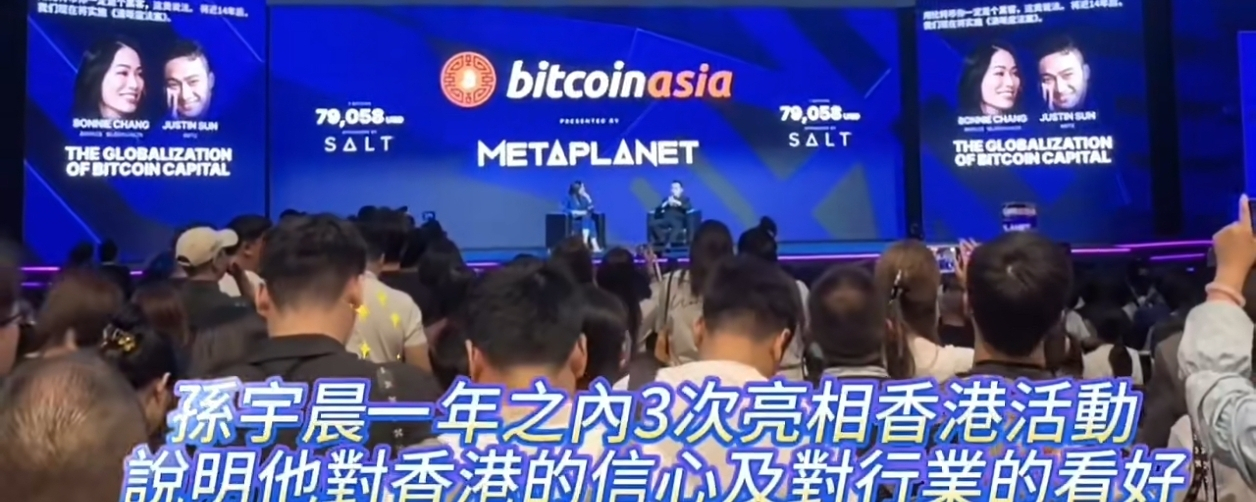

August 27, Hong Kong’s Bitcoin Asia.
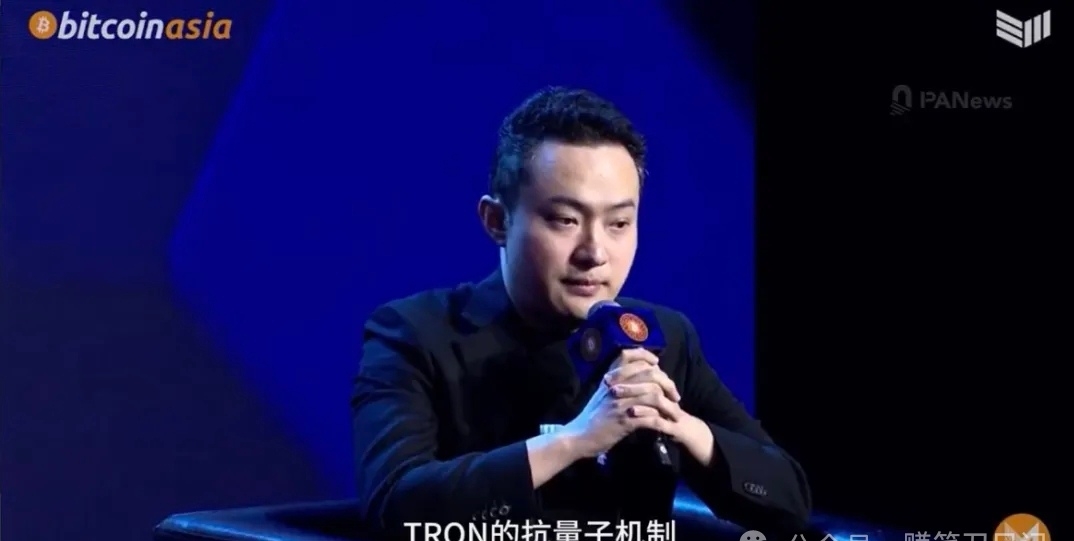
Sun Yuchen’s fireside conversation has a very high information density. He made four judgments. I’ll help you squeeze out the fluff.
First, the day of quantum decryption may be left with only two years.
Sun Yuchen said that if the pace of AI development remains moderate, the day of quantum decryption could arrive in about two years.
By the end of this year, TRON plans to upgrade to a quantum-resistant network. His exact words were: “TRON is the only mainstream network with a clear timetable for quantum resistance.”
His message to the Bitcoin community is also very straightforward: you should start seriously discussing quantum-resistant solutions right now.
Because achieving quantum resistance consensus for Bitcoin takes a very long time—miners, exchanges, WBTC, and multiple parties coordinating—so the pace is slow. TRON can upgrade quickly; it’s high decision-making efficiency, not showmanship.
What he’s essentially saying is that your decentralization advantage could be a disadvantage in the face of quantum threats.
Second, his assets are 100% in crypto.
Sun Yuchen also said, “My assets are indeed 100% in crypto.”
However, it can’t be verified; it sounds reasonable.
Forbes estimates his net worth at about $8.5 billion, mainly sourced from TRX, Bitcoin, Ethereum, and other digital assets—all 100% concentrated in this space.
He thinks that in the future, people may only need blockchain and won’t need the traditional financial system anymore.
It doesn’t matter whether you believe him or not—if he truly does exactly that.
But the consensus in the industry is that what he says shows some judgment, yet to invest in his projects, forget it—once you have his fame, you’ve got the “Sun Ge” effect.
These two things aren’t contradictory.
Third, the four-year cycle is still there, but the weight is declining.
Sun Yuchen said the “four-year cycle” still exists, but it’s no longer as important as it used to be.
Because the incremental supply changes brought by the halving are getting smaller and smaller, stablecoins, derivatives, and more assets are jointly driving the market.
He’s right to say that. The market structure has changed—using old methods to solve new problems won’t work.
Fourth, AI agents may become an important user of Bitcoin in its next phase.
This is the most counterintuitive point. He says that in the future, AI will find Bitcoin easier to understand and trust because it can directly verify Bitcoin’s decentralization, trading volume, and holder distribution—no need to trust any third party.
With the rapid growth in the number of AI agents, AI may become one of Bitcoin’s important users too.
Put it into plain language: when AI agents run autonomously, it needs an asset it can verify and trust.
Bitcoin’s ledger is public, verifiable, and tamper-proof—AI naturally trusts something like that.
Here’s another set of data: TRON currently accounts for about 50% of the stablecoin payment market share. The on-chain stablecoin issuance volume was about $94 billion last week, and it is expected to break $100 billion this year.
In this conversation, Sun Yuchen isn’t talking about the next trading cycle; he’s talking about what crypto’s infrastructure over the next few years will look like.
Quantum threats, the scale of stablecoins, AI agent adoption, and the weakening of the four-year cycle—all point in the same direction: this industry is moving from “trading coins” to “infrastructure.”
But we have to admit that there’s a consensus in the industry: his judgment is worth listening to, but you shouldn’t invest in him.
The logic is clear-eyed. Project execution history and the way someone trades/manages positions are another matter.
