

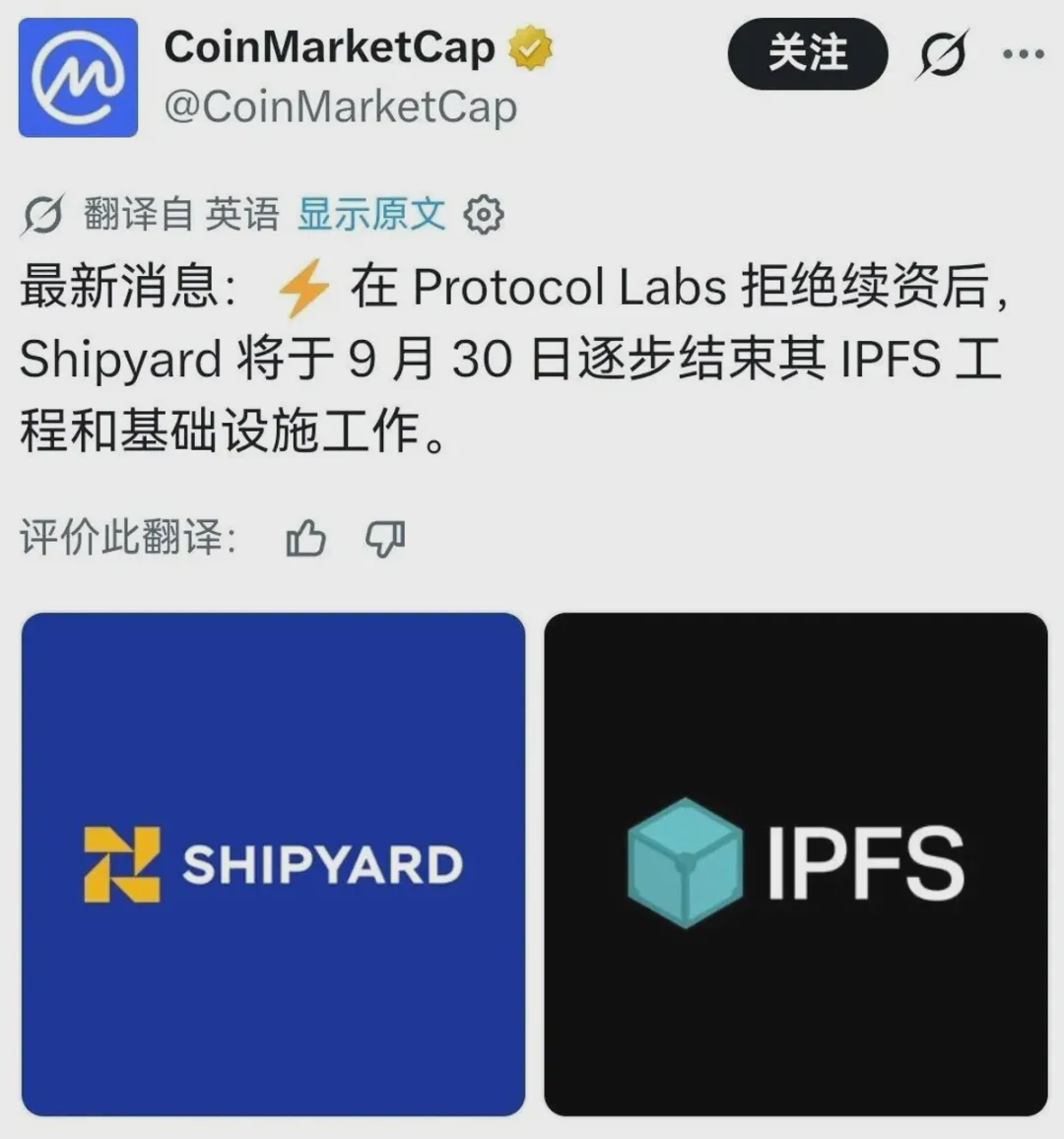
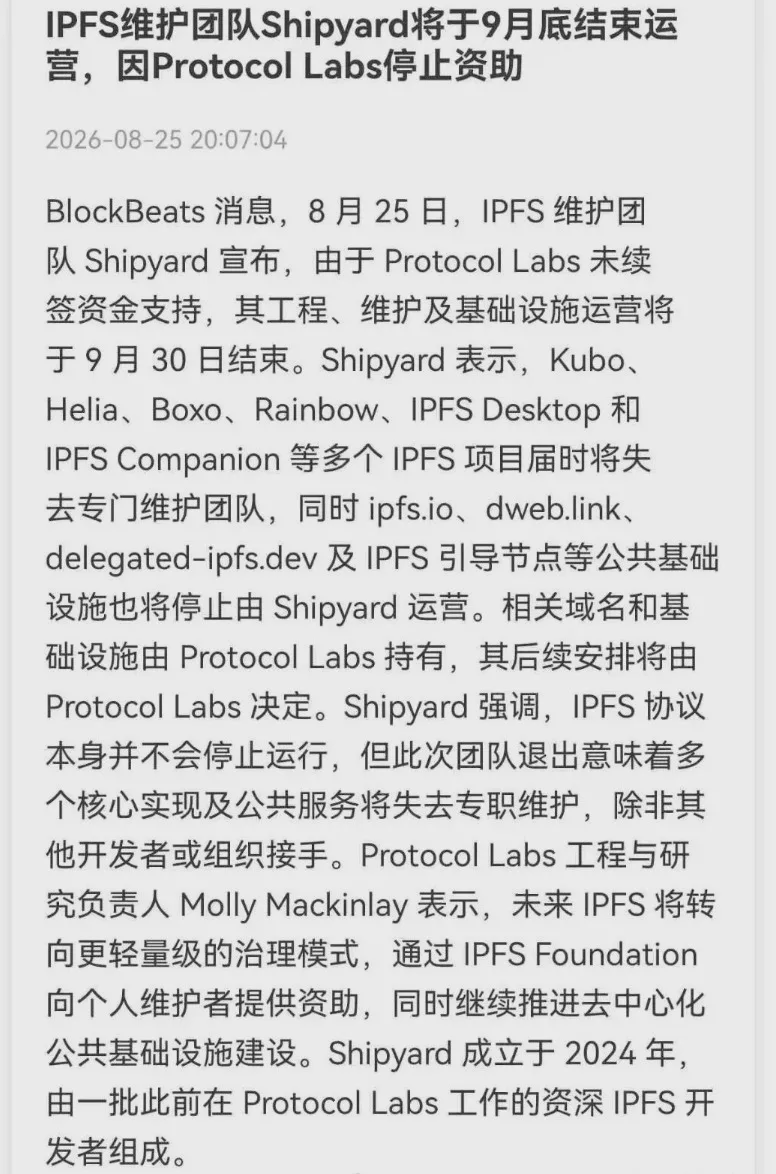
IPFS core maintenance team Shipyard, due to its primary funder Protocol Labs no longer renewing funding, announced that it will stop all IPFS-related engineering, maintenance, and infrastructure operations on September 30, 2026.
Shipyard’s role: Shipyard was founded in 2024 as an independent engineering team composed of senior IPFS developers from the former Protocol Labs. It is responsible for maintaining the most widely used core components and public infrastructure within the IPFS ecosystem.
Direct impact:
Core projects lose dedicated maintenance
Projects such as Kubo and Helia will no longer have dedicated teams responsible for developing new features, fixing bugs, and issuing security patches.
Public infrastructure stops operating
The Shipyard will stop operating public gateways such as ipfs.io and dweb.link. The future of these services will be decided by Protocol Labs.
Why it matters: Shipyard’s exit means a vacuum will form in the IPFS ecosystem’s main implementations and the maintenance of public services. In the short term, this may lead to slower tool updates, increased safety risks, and a decline in user experience for those relying on public gateways.
Impact on Filecoin
Filecoin is the incentive layer of IPFS. Technically, they are highly complementary, but they are not fully coupled. Therefore, Shipyard’s exit has an indirect and limited impact on Filecoin—it will not shake its core network or token economics.
Impact on technology and fundamentals
Direct shock is controllable: Filecoin has its own independent implementations (such as Lotus, Forest, etc.). Ongoing development is funded continuously by the Filecoin Foundation and Protocol Labs. Core functions—including storage deals, proof mechanisms, and consensus—do not fully depend on Shipyard-maintained Kubo or Helia. Therefore, the Filecoin network’s core storage and validation functions will not be directly affected.
Indirect risk:
Developer experience
As contributions to shared libraries (e.g., Boxo) and underlying network libraries (libp2p) decrease, Filecoin developer tooling updates may slow down, increasing development friction.
Ecosystem adoption
If maintenance of the main IPFS implementations (Kubo, Helia) stalls, it will increase the difficulty of adopting the “IPFS + Filecoin” combined stack in scenarios such as NFTs and AI data pipelines.
Convenience of retrieval
With the shutdown of public gateways (ipfs.io), users’ experience of conveniently retrieving Filecoin-stored data via browsers will be reduced in the short term.
Positive factors: The IPFS Foundation has already planned to shift to a lighter personal-funding model and to prioritize support for standardization, testing, and implementation diversity, which aligns with the spirit of decentralization. Filecoin itself is also pushing toward a paid-services economy (e.g., the Solstice proposal) and AI storage, focusing resources on revenue-generating use cases rather than relying on subsidized public gateways.
Impact on the secondary market
Mild near-term volatility
FIL’s price showed normal fluctuations around the announcement (Aug 24–26) and did not see a “crash” independent of the broader market. The market is more likely to view this as an adjustment to IPFS public goods rather than a core crisis for Filecoin.
Impact on sentiment and narrative
This event may bring a slightly negative sentiment, especially among investors who follow both IPFS and Filecoin. They may interpret it as “Protocol Labs shrinking public-goods spending.” However, the official stance is clear that the IPFS protocol will continue and shift to a funding model, which limits the spread of panic.
Key in the medium to long term
Risk
If there is a vacuum in maintaining the IPFS toolchain, leading to developer attrition, it could weaken the core narrative of “Filecoin as the incentive layer for IPFS,” indirectly suppressing valuation premium.
Opportunity
Conversely, if more resources are concentrated on Filecoin’s paid services, AI storage, and other commercial use cases—and fundamentals improve—the market may give more positive recognition.
Conclusion:
Shipyard’s exit has a controllable and mostly indirect impact on Filecoin’s technical fundamentals.
As a decentralized storage network with an independent economic model and a robust network foundation, Filecoin has strong resilience.
The short-term impact on the secondary market is mild. The key in the medium to long term is whether the IPFS community can effectively fill the tool maintenance gap, and whether Filecoin’s own paid adoption and commercial closed-loop execution can accelerate. It is recommended to watch the Filecoin Foundation’s updates to retrieval tools and the follow-through on funding by the IPFS Foundation.
Source of materials: official media / online news. For reference, learning, and communication only. Please strictly comply with laws and regulations in your jurisdiction. This article does not constitute any investment advice.