
Ahmed Ali Nizamani
981 Posts

Ahmed Ali Nizamani
 Square Verified+
Live: 7 - 9 PM (PKT) | X: AhmedAliNizaman
Frequent Trader
4.2 Years
520 Following
42.3K+ Followers
28.6K+ Liked
Posts
All
Quotes
Videos
Live
PINNED
454 + 444 = 🎁🎁🎁🎁🎁✅

Coin king

Coin--King
·
--
People don’t look at their own behavior, yet they still ask why we changed.
🎁 🎁
$BICO $DUSK $BMT
#XRPLeadsCryptoPullbackDropsNearly7% #DollarPostsBiggestGainInNearlyFourWeeks #NvidiaRises4%OnRevenueBeat #XRPRallies44%InAWeek
🎁 🎁
$BICO $DUSK $BMT
#XRPLeadsCryptoPullbackDropsNearly7% #DollarPostsBiggestGainInNearlyFourWeeks #NvidiaRises4%OnRevenueBeat #XRPRallies44%InAWeek
Prince

Prince-7³
·
--
welcome square family 😊
claim 🧧 Follow 🧧 Repost 🧧
$BTC
$BNB
$ETH
#GIVEAWAY🎁
claim 🧧 Follow 🧧 Repost 🧧
$BTC
$BNB
$ETH
#GIVEAWAY🎁

Join
@ETHcryptohub
is speaking[LIVE] 🎙️ Let's discuss about Market and Pala Pala each other
177 listens

Eth
ETHcryptohub
·
--
🎁🎁🎁🎁 Gifts for Everyone 🎁🎁🎁🎁
Comment: Yes
LIKE + Follow + Repost
🎉🎉🎉🎉🎉🎉🎉🎉🎉🎉🎉
#Ethcryptohub
$BNB $BTC
Comment: Yes
LIKE + Follow + Repost
🎉🎉🎉🎉🎉🎉🎉🎉🎉🎉🎉
#Ethcryptohub
$BNB $BTC
Abdul

AbdullRauf
·
--
GIVEAWAY ALERT 🧧
We're giving away 2000 gifts to our Square Family as a huge thank you for your support!
To Enter:
✅ Follow
✅ Share this post
✅ Comment "666 !"
Random winners will be selected. Good luck, everyone! 🚀
We're giving away 2000 gifts to our Square Family as a huge thank you for your support!
To Enter:
✅ Follow
✅ Share this post
✅ Comment "666 !"
Random winners will be selected. Good luck, everyone! 🚀

Bilvers
Bilverse
·
--
🚨 WHO WANTS TO WAKE UP TO FREE ETH? 👀
One community. One mission. One chance to be part of the ETH giveaway. 💎🚀
#Bilverse is making noise — and your ETH reward could be waiting. 👀
👇 Want to claim a portion of ETH?
💬 Comment “ETH” below to claim your reward! 🎁
The Bilverse Army is growing. 🟡
Click here to DOUBLE your Rewards! 🧧🚀
Are you in?
#ETH #RedPacketMission #CryptoGiveaway #CryptoCommunity
One community. One mission. One chance to be part of the ETH giveaway. 💎🚀
#Bilverse is making noise — and your ETH reward could be waiting. 👀
👇 Want to claim a portion of ETH?
💬 Comment “ETH” below to claim your reward! 🎁
The Bilverse Army is growing. 🟡
Click here to DOUBLE your Rewards! 🧧🚀
Are you in?
#ETH #RedPacketMission #CryptoGiveaway #CryptoCommunity

Jannat

JANNAT BM_
·
--
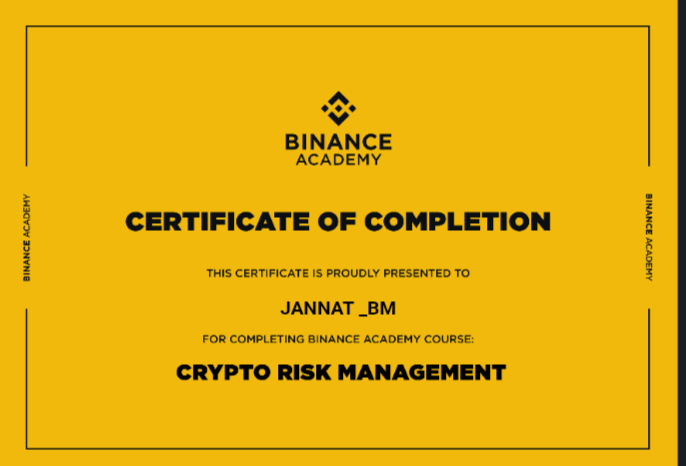
Thank you #Binance 💛
My first certificate form @Binance Academy 💛💛💛
My first certificate form @Binance Academy 💛💛💛
Dt

DT_Singh
·
--
The person who bought $SOL at 75, today their face is finally smiling 😂
From 75.39 (Sell Avg) to 108.44 — that means a 43% move! And this isn’t some random pump—it's a STEADY climb:
• 7 Days: +32%
• 30 Days: +43%
• 90 Days: +31%
BUT — 1 Year: -44% — which means old holders are still in the “waiting to come to breakeven” mode 💀
Look at the chart—the pattern shows consistent higher lows and consistent higher highs. This has a “recovery” vibe, not a “pump and dump” vibe.
Funny part:
People who entered at 75 and saw it drop to 65 thinking “Should I sell?”—today are seeing a 40% profit.
And people buying at 108 right now will have to think, “Wasn’t the top last week?”
In the order book, there are 47.78% sellers—so the “booking profit” mode is strong. When so many people are selling at the top, what happens next?
This is what happens with Solana too—slow recovery ↗️, then a crash in a day or two ↘️, then back to recovery 😅
Did someone recently enter with SOL? Or are you still waiting for the recovery to complete? 👇
#SOL #solanAnalysis #RecoveryStory #CryptoReality
From 75.39 (Sell Avg) to 108.44 — that means a 43% move! And this isn’t some random pump—it's a STEADY climb:
• 7 Days: +32%
• 30 Days: +43%
• 90 Days: +31%
BUT — 1 Year: -44% — which means old holders are still in the “waiting to come to breakeven” mode 💀
Look at the chart—the pattern shows consistent higher lows and consistent higher highs. This has a “recovery” vibe, not a “pump and dump” vibe.
Funny part:
People who entered at 75 and saw it drop to 65 thinking “Should I sell?”—today are seeing a 40% profit.
And people buying at 108 right now will have to think, “Wasn’t the top last week?”
In the order book, there are 47.78% sellers—so the “booking profit” mode is strong. When so many people are selling at the top, what happens next?
This is what happens with Solana too—slow recovery ↗️, then a crash in a day or two ↘️, then back to recovery 😅
Did someone recently enter with SOL? Or are you still waiting for the recovery to complete? 👇
#SOL #solanAnalysis #RecoveryStory #CryptoReality
Mahi

mahii_23
·
--
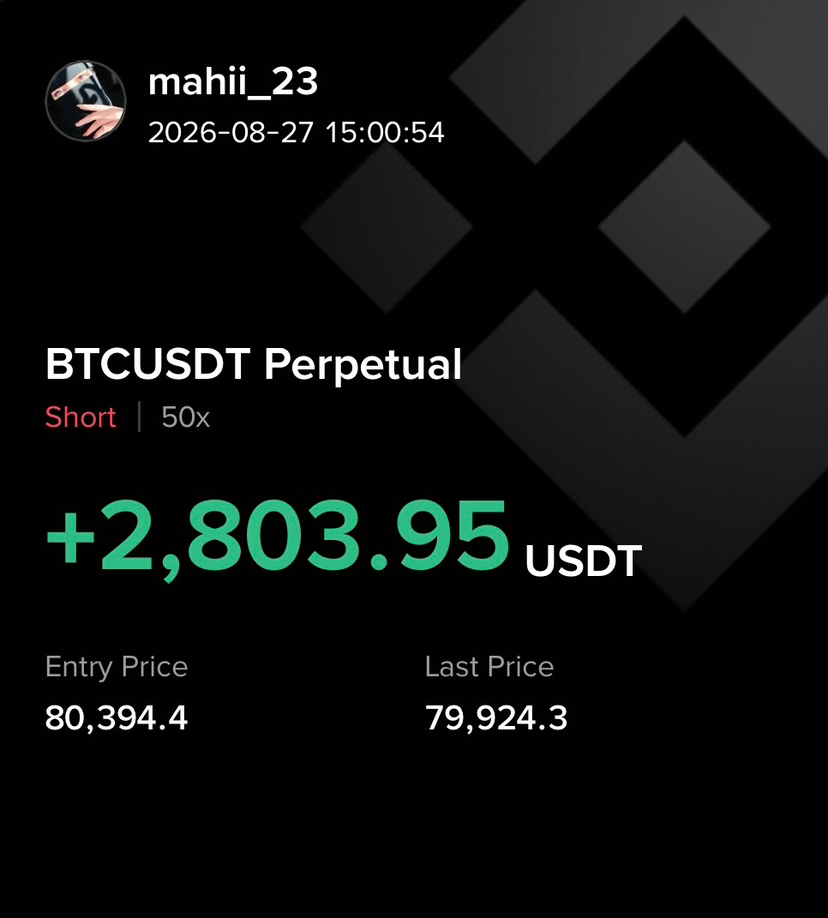
$BTC 🎁 Smart trading is not about being right every time 💫📉
It’s about patience, proper risk management, and trusting your setup.💰
Trade smart, stay focused, and let the strategy work. 💎✨
$BTC
$ETH
#BitcoinHoldsNear$79400
It’s about patience, proper risk management, and trusting your setup.💰
Trade smart, stay focused, and let the strategy work. 💎✨
$BTC
$ETH
#BitcoinHoldsNear$79400
yash

YASH DHALIWAL 31_加密 143
·
--
🌄🌄🌄🌄🌄🌄🔥🔥🔥🔥🌹🌹🥰🌹🤠🌹🌉😊🌹🤪🌄🌄😊😁🌉😁🥰😁🌉🎂🌉😁😽🌄🤪🌄😊🥰🌄😊😊😁😽🎂😜🥰🌄😽🎉🤠
When I research a crypto asset, I don’t start with the upside. I start by asking what am I actually risking and what justifies taking that risk?
For $DUSK that question is especially interesting because the thesis isn’t built purely around speculation. Dusk Network is targeting a difficult market: regulated financial infrastructure, tokenized securities, privacy, compliance and settlement.
From my research and experience tracking crypto projects I’ve learned that strong narratives are not enough. The real test is whether the technology can attract developers, users, institutions and sustainable network activity.
That’s where I see both the opportunity and the risk in $DUSK
The opportunity comes from Dusk’s focus on combining confidentiality with regulatory requirements rather than treating privacy and compliance as competing ideas.
The risk is execution Institutional adoption takes time, competition is intense and technical infrastructure only becomes valuable when real applications use it.
So I don’t view $DUSK as a simple momentum trade. I view it as a higher-risk infrastructure thesis where the future payoff depends heavily on adoption and execution.
In my views risk management comes first. The technology can be compelling but the market ultimately decides whether the thesis works.
@Dusk #DUSK
For $DUSK that question is especially interesting because the thesis isn’t built purely around speculation. Dusk Network is targeting a difficult market: regulated financial infrastructure, tokenized securities, privacy, compliance and settlement.
From my research and experience tracking crypto projects I’ve learned that strong narratives are not enough. The real test is whether the technology can attract developers, users, institutions and sustainable network activity.
That’s where I see both the opportunity and the risk in $DUSK
The opportunity comes from Dusk’s focus on combining confidentiality with regulatory requirements rather than treating privacy and compliance as competing ideas.
The risk is execution Institutional adoption takes time, competition is intense and technical infrastructure only becomes valuable when real applications use it.
So I don’t view $DUSK as a simple momentum trade. I view it as a higher-risk infrastructure thesis where the future payoff depends heavily on adoption and execution.
In my views risk management comes first. The technology can be compelling but the market ultimately decides whether the thesis works.
@Dusk #DUSK

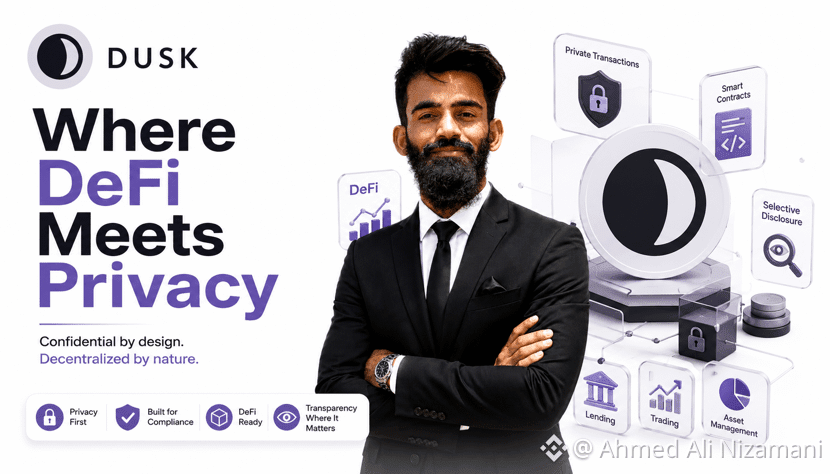
After watching DeFi evolve I’ve learned that the next challenge isn’t simply putting more financial activity onchain. It’s making that activity usable without exposing everything publicly.
Here we find Dusk interesting.
Most DeFi systems make transparency a default. That works for many use cases, but financial markets often involve sensitive positions, balances, counterparties and transaction details. Making all of that permanently visible can create problems for serious capital.
Dusk takes a different direction by combining smart contract execution with privacy focused infrastructure. Its architecture is designed around cryptographic primitives that can support confidential transactions and selective disclosure while still allowing applications to operate onchain.
the more interesting part is the potential DeFi use case.
Imagine lending, trading or asset management where users can prove the information required by a protocol without exposing their entire financial history to everyone watching the blockchain.
That could create a different model for DeFi: privacy where it matters transparency where it is required.
I’m not saying Dusk automatically solves DeFi’s biggest problems. Adoption, liquidity, developers and real applications still matter.
But if DeFi moves toward more sophisticated financial products, privacy may become infrastructure rather than an optional feature.
That’s why everyone keeping $DUSK on my radar.
@Dusk #Dusk
Here we find Dusk interesting.
Most DeFi systems make transparency a default. That works for many use cases, but financial markets often involve sensitive positions, balances, counterparties and transaction details. Making all of that permanently visible can create problems for serious capital.
Dusk takes a different direction by combining smart contract execution with privacy focused infrastructure. Its architecture is designed around cryptographic primitives that can support confidential transactions and selective disclosure while still allowing applications to operate onchain.
the more interesting part is the potential DeFi use case.
Imagine lending, trading or asset management where users can prove the information required by a protocol without exposing their entire financial history to everyone watching the blockchain.
That could create a different model for DeFi: privacy where it matters transparency where it is required.
I’m not saying Dusk automatically solves DeFi’s biggest problems. Adoption, liquidity, developers and real applications still matter.
But if DeFi moves toward more sophisticated financial products, privacy may become infrastructure rather than an optional feature.
That’s why everyone keeping $DUSK on my radar.
@Dusk #Dusk
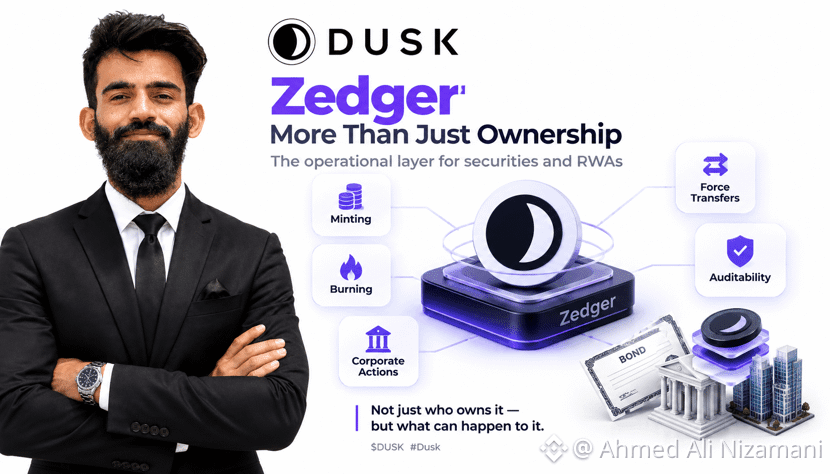
A wallet address can show who owns a token.
But for a financial security ownership is only the starting point.
The harder question is what happens when something changes around that asset.
An issuer may need to execute a corporate action. An asset may need to be created or removed. A transfer could require specific controls. Authorized participants may also need a reliable way to verify the asset’s history.
This is where Zedger gets interesting to me.
Dusk describes Zedger as infrastructure for securities and RWAs, with capabilities including minting, burning, corporate actions, force transfers and auditability.
To me those functions point to a broader idea
A financial asset needs more than a balance. It needs operational rules.
That distinction matters for RWAs.
Simply representing a bond fund or other financial instrument as a token doesn’t automatically recreate the processes surrounding the real-world asset.
Zedger is designed around this missing layer, providing mechanisms for actions that can occur throughout an asset’s lifecycle.
So instead of asking only
“Who owns it?”
We can also ask
“What can happen to it, who can trigger it and how can that activity be verified?”
That’s the part of @Dusk I find compelling.
$DUSK #Dusk
But for a financial security ownership is only the starting point.
The harder question is what happens when something changes around that asset.
An issuer may need to execute a corporate action. An asset may need to be created or removed. A transfer could require specific controls. Authorized participants may also need a reliable way to verify the asset’s history.
This is where Zedger gets interesting to me.
Dusk describes Zedger as infrastructure for securities and RWAs, with capabilities including minting, burning, corporate actions, force transfers and auditability.
To me those functions point to a broader idea
A financial asset needs more than a balance. It needs operational rules.
That distinction matters for RWAs.
Simply representing a bond fund or other financial instrument as a token doesn’t automatically recreate the processes surrounding the real-world asset.
Zedger is designed around this missing layer, providing mechanisms for actions that can occur throughout an asset’s lifecycle.
So instead of asking only
“Who owns it?”
We can also ask
“What can happen to it, who can trigger it and how can that activity be verified?”
That’s the part of @Dusk I find compelling.
$DUSK #Dusk
Verified
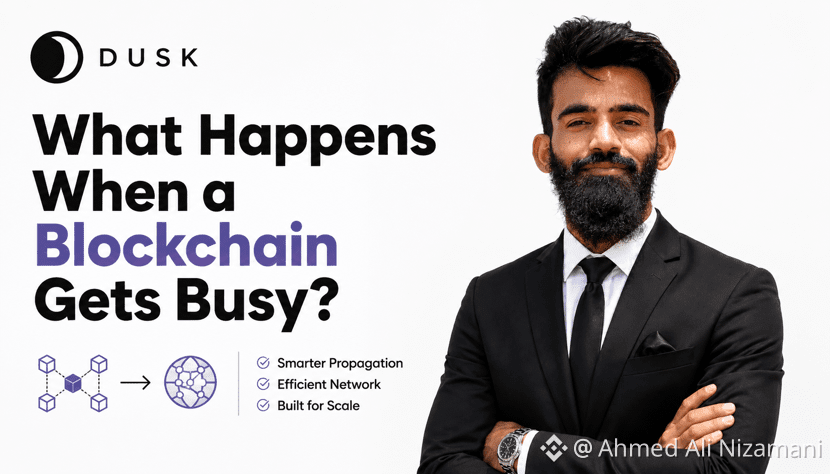
What Happens When a Blockchain Gets Busy?
I think one of the more overlooked questions in blockchain design is what happens between producing a message and everyone receiving it.
As network activity grows the challenge isn’t simply creating more transactions.
The network also has to coordinate more information without turning communication overhead into a hidden scalability limit.
This is where Dusk’s choice of Kadcast becomes interesting to me.
Its approach to propagation is designed around structured peer selection rather than having every node repeatedly relay information across the network.
That changes the efficiency equation.
The goal isn’t just:
“Can the network send the message?”
It is;
“Can the network distribute the message without wasting resources doing it?”
That distinction becomes particularly relevant for infrastructure intended to support financial activity, where predictable network behavior can matter just as much as raw throughput.
I find this a more interesting way to look at blockchain scalability.
Sometimes scalability isn’t only about processing more.
It’s also about communicating more intelligently.
That’s the engineering layer I think is worth paying attention to when looking at @Dusk
$DUSK #Dusk
I think one of the more overlooked questions in blockchain design is what happens between producing a message and everyone receiving it.
As network activity grows the challenge isn’t simply creating more transactions.
The network also has to coordinate more information without turning communication overhead into a hidden scalability limit.
This is where Dusk’s choice of Kadcast becomes interesting to me.
Its approach to propagation is designed around structured peer selection rather than having every node repeatedly relay information across the network.
That changes the efficiency equation.
The goal isn’t just:
“Can the network send the message?”
It is;
“Can the network distribute the message without wasting resources doing it?”
That distinction becomes particularly relevant for infrastructure intended to support financial activity, where predictable network behavior can matter just as much as raw throughput.
I find this a more interesting way to look at blockchain scalability.
Sometimes scalability isn’t only about processing more.
It’s also about communicating more intelligently.
That’s the engineering layer I think is worth paying attention to when looking at @Dusk
$DUSK #Dusk
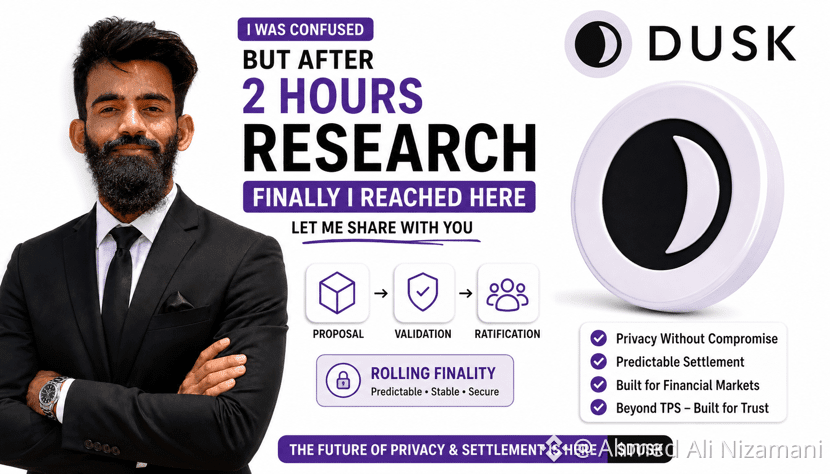
I was confused but after 2hours research finally i reached here let me share with you
Most crypto discussions treat consensus as a question of decentralization or staking.
But financial markets have another requirement: predictable settlement.
That’s where Dusk’s consensus architecture gets interesting.
Succinct Attestation uses committee based proof of stake with deterministic sortition. A block moves through proposal → validation → ratification, with attestations helping establish agreement and rolling finality determining how stable the chain becomes over time.
Why does this matter?
Because confirmation and final settlement are not the same question.
A financial application doesn’t just need a transaction to process quickly. It needs a clear answer to
When can this transaction be treated as final?
That’s an important infrastructure question for tokenized securities, regulated assets and institutional settlement.
So I think @Dusk should be evaluated beyond the usual privacy narrative.
The deeper $DUSK thesis is whether its consensus, confidentiality and application layers can work together to deliver something financial markets actually require:
privacy without sacrificing predictable settlement.
That’s a much more interesting proposition than TPS alone.
#Dusk
#dusk $DUSK
Most crypto discussions treat consensus as a question of decentralization or staking.
But financial markets have another requirement: predictable settlement.
That’s where Dusk’s consensus architecture gets interesting.
Succinct Attestation uses committee based proof of stake with deterministic sortition. A block moves through proposal → validation → ratification, with attestations helping establish agreement and rolling finality determining how stable the chain becomes over time.
Why does this matter?
Because confirmation and final settlement are not the same question.
A financial application doesn’t just need a transaction to process quickly. It needs a clear answer to
When can this transaction be treated as final?
That’s an important infrastructure question for tokenized securities, regulated assets and institutional settlement.
So I think @Dusk should be evaluated beyond the usual privacy narrative.
The deeper $DUSK thesis is whether its consensus, confidentiality and application layers can work together to deliver something financial markets actually require:
privacy without sacrificing predictable settlement.
That’s a much more interesting proposition than TPS alone.
#Dusk
#dusk $DUSK
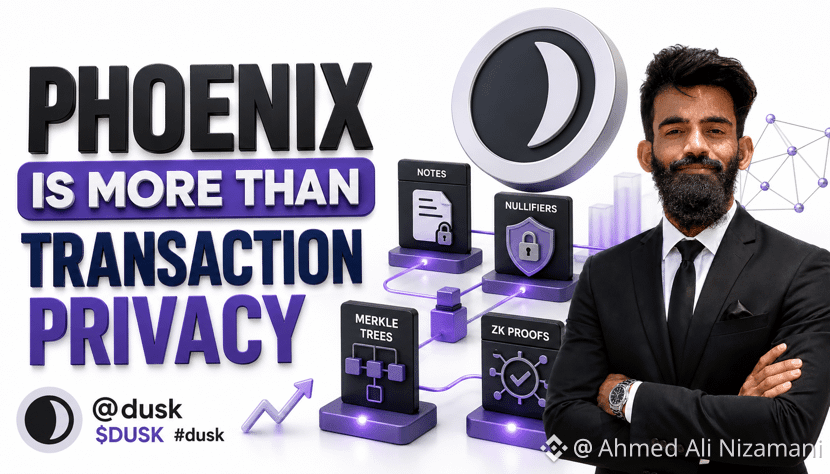
I think that Phoenix becomes more interesting when you look beyond the word “privacy.”
Its architecture uses notes, nullifiers, Merkle trees and zero-knowledge proofs to preserve transaction validity while limiting what information becomes publicly visible.
For example the network can verify a Phoenix proof without directly checking the underlying transaction details. Nullifiers help prevent the same note from being spent twice while the ZK proof demonstrates that the transaction follows the network rules.
That matters because regulated financial systems still need strong guarantees around ownership balances and settlement.
Privacy without integrity would be useless.
What I find particularly interesting is the delegation model. Dusk describes how view keys can allow transaction scanning to be delegated without giving the third party the complete secret needed to spend the notes. ZK proof generation can also be delegated without compromising transaction integrity.
To me that shows the design is thinking about practical usage, not just cryptographic theory.
That’s one of the reasons I keep looking deeper into @Dusk
$DUSK #Dusk
Its architecture uses notes, nullifiers, Merkle trees and zero-knowledge proofs to preserve transaction validity while limiting what information becomes publicly visible.
For example the network can verify a Phoenix proof without directly checking the underlying transaction details. Nullifiers help prevent the same note from being spent twice while the ZK proof demonstrates that the transaction follows the network rules.
That matters because regulated financial systems still need strong guarantees around ownership balances and settlement.
Privacy without integrity would be useless.
What I find particularly interesting is the delegation model. Dusk describes how view keys can allow transaction scanning to be delegated without giving the third party the complete secret needed to spend the notes. ZK proof generation can also be delegated without compromising transaction integrity.
To me that shows the design is thinking about practical usage, not just cryptographic theory.
That’s one of the reasons I keep looking deeper into @Dusk
$DUSK #Dusk
$DASH $LPT and $2Z Getting Attention in search 🔥🔥🔥
DASH stands out with strong search activity and notable short-term trader interest. The key question is whether current buying momentum can overcome the heavier selling pressure seen across longer timeframes.
LPT is showing a different setup. Search interest is lower but both top holders and traders have recently leaned toward buying making it an interesting momentum watch.
2Z is attracting attention as well, but the data is more cautious. Despite rising interest top holders and traders are showing significant selling pressure across recent timeframes.
Where you want click 👇👇👇👇
DASH stands out with strong search activity and notable short-term trader interest. The key question is whether current buying momentum can overcome the heavier selling pressure seen across longer timeframes.
LPT is showing a different setup. Search interest is lower but both top holders and traders have recently leaned toward buying making it an interesting momentum watch.
2Z is attracting attention as well, but the data is more cautious. Despite rising interest top holders and traders are showing significant selling pressure across recent timeframes.
Where you want click 👇👇👇👇
$2Z
31%
$DASH
56%
$LPT
13%
52 votes • Voting closed
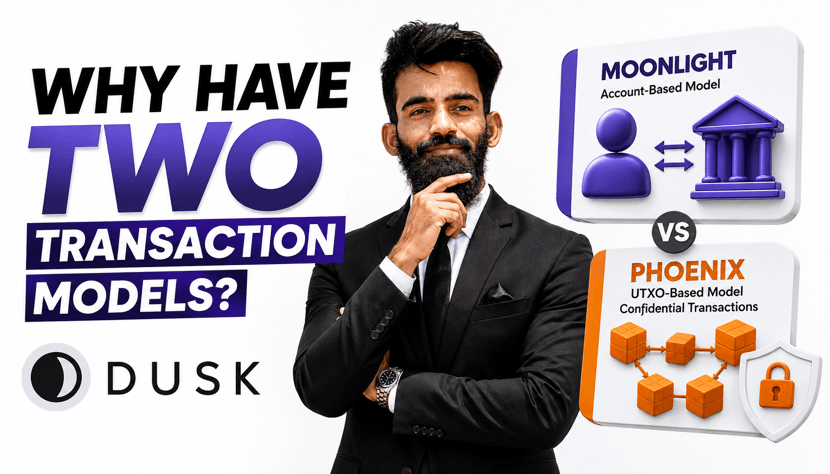
Why Have Two Transaction Models?
At first, I wondered why Dusk would need two different transaction models.
Wouldn’t one be enough?
Then I looked at what each model is actually trying to achieve.
Moonlight uses an account-based model while Phoenix uses a UTXO-based design with support for confidential transactions.
And that made me look at the architecture differently.
The interesting question isn’t really “Which model is better?”
It’s “Why force every type of transaction to behave the same way?”
Financial activity doesn’t always have the same information requirements.
Sometimes transparency is useful.
Sometimes revealing the underlying transaction details creates unnecessary exposure.
Phoenix uses zero-knowledge proofs to allow properties such as ownership and balance integrity to be verified without simply exposing the information being protected.
That’s a subtle but important distinction.
Privacy doesn’t always mean hiding everything.
Sometimes it means proving what needs to be proven without revealing everything else.
That’s why I think calling Dusk simply a “privacy blockchain” misses part of the architecture.
The more interesting idea is giving different financial activities different ways to handle information while operating within the same network.
For me that’s a much stronger reason to have two transaction models.
@Dusk $DUSK #Dusk
At first, I wondered why Dusk would need two different transaction models.
Wouldn’t one be enough?
Then I looked at what each model is actually trying to achieve.
Moonlight uses an account-based model while Phoenix uses a UTXO-based design with support for confidential transactions.
And that made me look at the architecture differently.
The interesting question isn’t really “Which model is better?”
It’s “Why force every type of transaction to behave the same way?”
Financial activity doesn’t always have the same information requirements.
Sometimes transparency is useful.
Sometimes revealing the underlying transaction details creates unnecessary exposure.
Phoenix uses zero-knowledge proofs to allow properties such as ownership and balance integrity to be verified without simply exposing the information being protected.
That’s a subtle but important distinction.
Privacy doesn’t always mean hiding everything.
Sometimes it means proving what needs to be proven without revealing everything else.
That’s why I think calling Dusk simply a “privacy blockchain” misses part of the architecture.
The more interesting idea is giving different financial activities different ways to handle information while operating within the same network.
For me that’s a much stronger reason to have two transaction models.
@Dusk $DUSK #Dusk
🔥$CLO vs $VVV vs $GPS Which Setup Looks Strongest?✅🔥🔥🔥
CLO is still a high-risk recovery setup. After its sharp July decline the key question isn’t whether it can bounce it’s whether buyers can build a sustainable base. I’d watch support, volume and the first strong higher low before chasing.
VVV is sitting in a more neutral structure. The $11–$12 zone is important but bulls still need a convincing breakout and follow-through above resistance. Until then patience may be better than forcing a trade.
GPS is the momentum leader of the three. Strong price expansion and elevated volume show aggressive market participation. But after a major move, chasing becomes the biggest risk. A healthy consolidation or support retest could provide a cleaner setup.
My ranking:
1️⃣GPS - strongest momentum
2️⃣ VVV- waiting for confirmation
3️⃣ CLO- speculative recovery
The key variables now: volume + support + BTC direction.
Which setup would you trade right now?
CLO is still a high-risk recovery setup. After its sharp July decline the key question isn’t whether it can bounce it’s whether buyers can build a sustainable base. I’d watch support, volume and the first strong higher low before chasing.
VVV is sitting in a more neutral structure. The $11–$12 zone is important but bulls still need a convincing breakout and follow-through above resistance. Until then patience may be better than forcing a trade.
GPS is the momentum leader of the three. Strong price expansion and elevated volume show aggressive market participation. But after a major move, chasing becomes the biggest risk. A healthy consolidation or support retest could provide a cleaner setup.
My ranking:
1️⃣GPS - strongest momentum
2️⃣ VVV- waiting for confirmation
3️⃣ CLO- speculative recovery
The key variables now: volume + support + BTC direction.
Which setup would you trade right now?
$GPS
76%
$VVV
15%
$CLO
9%
45 votes • Voting closed
Log in to explore more content