The prototype of the movie *The Big Short*: that reclusive genius who, before the 2008 subprime mortgage crisis, shorted real estate while taking ridicule from the entire world, made a $750 million windfall on a trading scale of $600 million—net return rate of 489.34%. He has just opened a “long position” on a stock he has been shorting for more than a year.
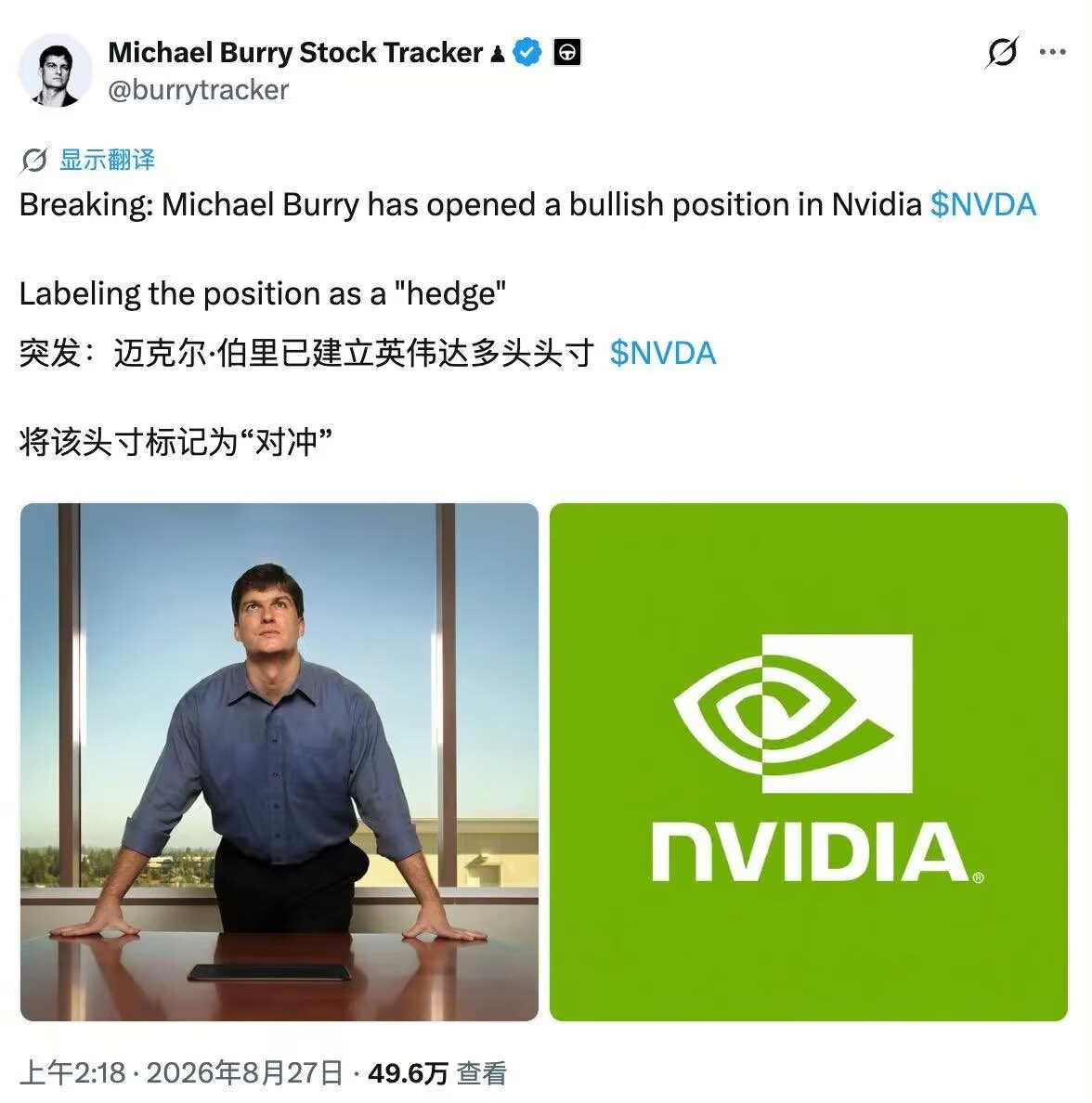
Michael Burry has just disclosed that he bought a long position in Nvidia (NVDA) with the identifier $NVDA , and labeled it “hedge.”
But pay attention to his wording: “hedge” is not “go long.”
He isn’t suddenly bullish on Nvidia. On the contrary—while buying calls, he continues to add to his short position in Nvidia. Currently, short stock positions account for more than 21% of his entire portfolio. The call options he bought have a strike price in the mid-to-high $200 range and expire in December. In plain terms, this is spending a little money to buy insurance—just to prevent a post-earnings surge from wiping out his shorts in one wave.
Even more interesting: at the same time, he also increased his short positions in Oracle with $ORCL , Micron with $MU , Palantir, Nebius, and Caterpillar. Almost nothing in the entire AI and infrastructure chain escaped him.
He talks about hedging, but his body keeps shorting. That person who bet on a collapse in the housing market back in 2005—before the Nvidia earnings report, the signal he sends to the market is still only one: I’m still betting it will fall.
If it truly drops after the earnings report, his short positions will make a lot of money, and it won’t matter if the calls go to zero. But if it surges instead, at least these calls can help cushion the blow—win twice, or lose less once. *The Big Short* is still *the Big Short*, always tallying up accounts others can’t quite calculate.
Michael Burry has just disclosed that he bought a long position in Nvidia (NVDA) with the identifier $NVDA , and labeled it “hedge.”
But pay attention to his wording: “hedge” is not “go long.”
He isn’t suddenly bullish on Nvidia. On the contrary—while buying calls, he continues to add to his short position in Nvidia. Currently, short stock positions account for more than 21% of his entire portfolio. The call options he bought have a strike price in the mid-to-high $200 range and expire in December. In plain terms, this is spending a little money to buy insurance—just to prevent a post-earnings surge from wiping out his shorts in one wave.
Even more interesting: at the same time, he also increased his short positions in Oracle with $ORCL , Micron with $MU , Palantir, Nebius, and Caterpillar. Almost nothing in the entire AI and infrastructure chain escaped him.
He talks about hedging, but his body keeps shorting. That person who bet on a collapse in the housing market back in 2005—before the Nvidia earnings report, the signal he sends to the market is still only one: I’m still betting it will fall.
If it truly drops after the earnings report, his short positions will make a lot of money, and it won’t matter if the calls go to zero. But if it surges instead, at least these calls can help cushion the blow—win twice, or lose less once. *The Big Short* is still *the Big Short*, always tallying up accounts others can’t quite calculate.