
Recently, I’ve been increasingly feeling that what will be truly scarce in AI’s next phase might not be computing power, but rather trustworthy human data.
The internet has never lacked data. What’s missing is whether you can prove:
that these data come from real people—not bots, mass accounts, or content generated by AI itself.
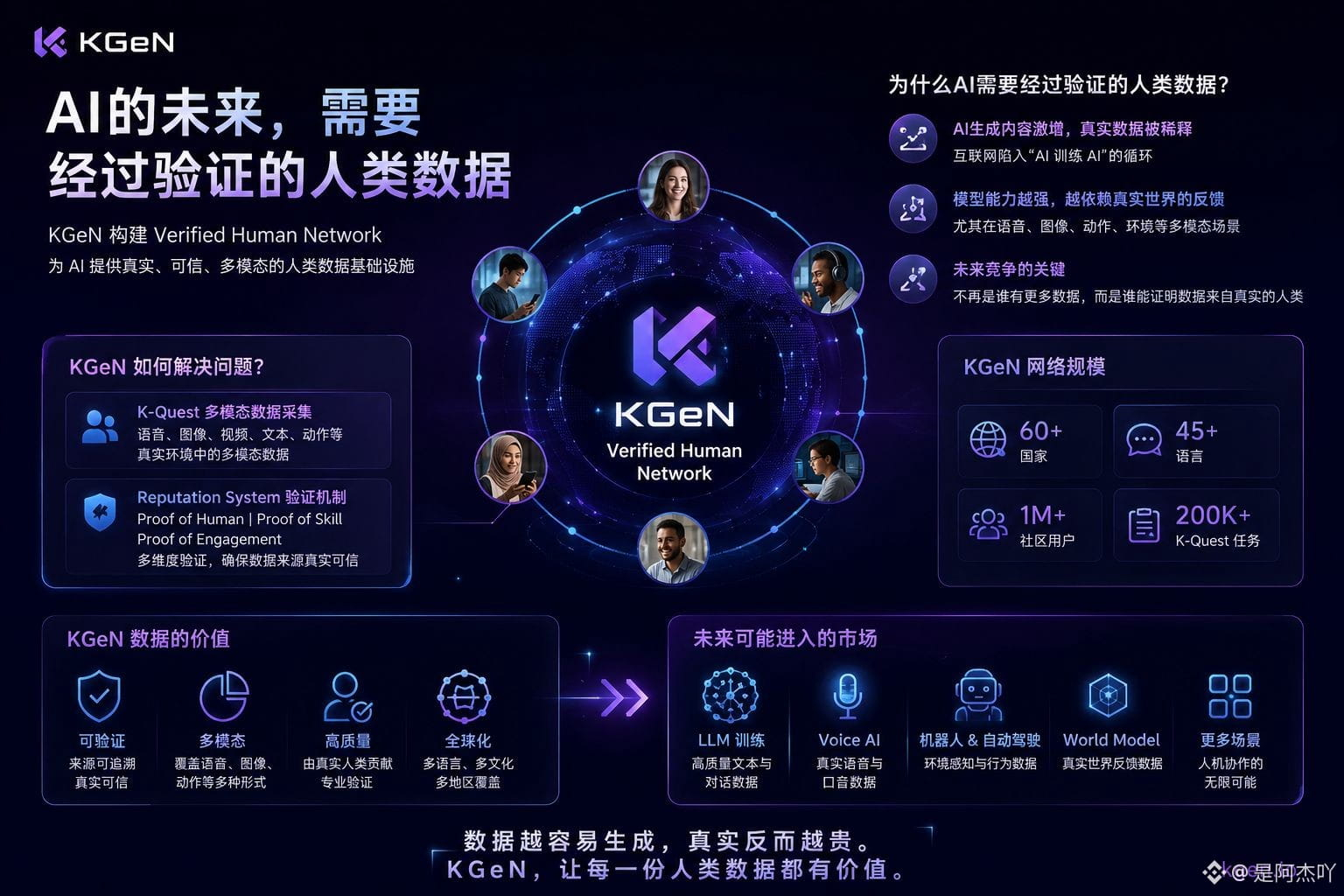
This problem is getting more and more severe. As models get stronger and AI-generated content grows, the internet is more likely to fall into a loop:
AI reads human data → generates more content → new models train on these AI-generated contents.
In the end, the total data volume keeps growing, but the effective signals that actually originate from the human world get diluted.
KGeN isn’t a simple data annotation platform. It’s building a layer called the Verified Human Network.
Today its network covers 60+ countries and 45+ languages. K-Quest can collect multimodal data such as voice, images, video, and data from real environments. Behind it, a Reputation System continuously verifies participants across dimensions like Proof of Human, Proof of Skill, and Proof of Engagement.
These two layers working together are crucial.
In the future, what AI companies buy may be not just one million data points, but:
one million data points from which people, which regions, which languages, and which real environments—and data with verifiable source information.
Especially as AI moves from chat boxes into robotics, autonomous driving, Voice AI, and World Models, data requirements will shift from text to sound, actions, space, and feedback from the real world.
KGeN is already expanding toward Physical AI. The multimodal data it emphasizes—Sound, Sight, Motion, and more—is, in essence, betting on the next phase’s data entry point.
And I think this is also where $KGEN is worth observing most.
If Verified Human Data ultimately becomes foundational resource in the AI industry chain, then the market KGeN is targeting won’t be limited to Web3 or just user growth for games. It may keep extending into LLM training, model evaluation, Voice AI, robotics, World Models, and even a broader human-machine collaboration data market. Its KAI network already covers human experts in specialized fields like Coding, Healthcare, Financial Services, and Legal.
In the past, the AI era competed over who had more data.
Next, it may be about:
who can prove these data truly come from humans.
The easier data is to generate, the more real it becomes—meaning real data becomes more expensive.
That might be the long-term narrative that KGeN is most worth paying attention to.
The internet has never lacked data. What’s missing is whether you can prove:
that these data come from real people—not bots, mass accounts, or content generated by AI itself.
This problem is getting more and more severe. As models get stronger and AI-generated content grows, the internet is more likely to fall into a loop:
AI reads human data → generates more content → new models train on these AI-generated contents.
In the end, the total data volume keeps growing, but the effective signals that actually originate from the human world get diluted.
KGeN isn’t a simple data annotation platform. It’s building a layer called the Verified Human Network.
Today its network covers 60+ countries and 45+ languages. K-Quest can collect multimodal data such as voice, images, video, and data from real environments. Behind it, a Reputation System continuously verifies participants across dimensions like Proof of Human, Proof of Skill, and Proof of Engagement.
These two layers working together are crucial.
In the future, what AI companies buy may be not just one million data points, but:
one million data points from which people, which regions, which languages, and which real environments—and data with verifiable source information.
Especially as AI moves from chat boxes into robotics, autonomous driving, Voice AI, and World Models, data requirements will shift from text to sound, actions, space, and feedback from the real world.
KGeN is already expanding toward Physical AI. The multimodal data it emphasizes—Sound, Sight, Motion, and more—is, in essence, betting on the next phase’s data entry point.
And I think this is also where $KGEN is worth observing most.
If Verified Human Data ultimately becomes foundational resource in the AI industry chain, then the market KGeN is targeting won’t be limited to Web3 or just user growth for games. It may keep extending into LLM training, model evaluation, Voice AI, robotics, World Models, and even a broader human-machine collaboration data market. Its KAI network already covers human experts in specialized fields like Coding, Healthcare, Financial Services, and Legal.
In the past, the AI era competed over who had more data.
Next, it may be about:
who can prove these data truly come from humans.
The easier data is to generate, the more real it becomes—meaning real data becomes more expensive.
That might be the long-term narrative that KGeN is most worth paying attention to.