


Key points
As exchanges in the United States move toward trading 23×5 to meet global demand, Binance has provided users with 24/7 access to traditional market products.
The end-of-week monthly trading volume of perpetual contracts linked to traditional market assets on crypto exchanges has increased from about $4.5 billion to $28 billion by mid-August this year, with Binance accounting for nearly half.
Shunyet Jan, Head of Exchange & Trading at Binance, explains why simply extending trading hours isn’t enough to create an always-on market—and where Binance still has a 24/7 advantage.
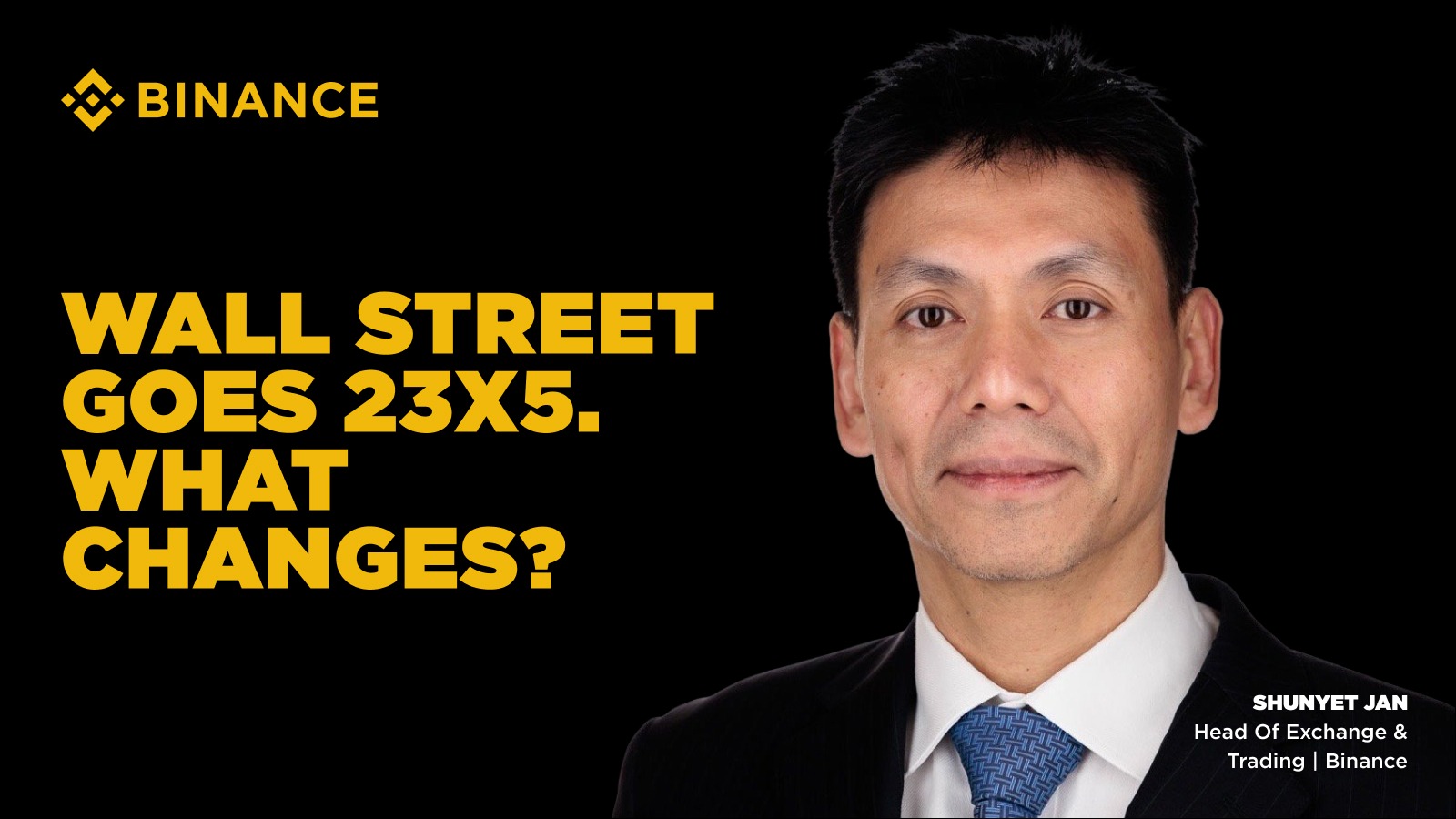
Wall Street is extending the trading day. Both Nasdaq and NYSE are expected to move to longer trading hours this year to meet growing global demand to access U.S. markets outside of New York’s schedule.
On Binance, users have had 24/7 access to traditional market products. According to Binance Research, more than half (62%) of bStocks volume takes place outside regular U.S. trading hours in July. For comparison, even though after-hours trading was available, July still saw 89.2% of U.S. equity stock volume concentrated in the regular session.
We spoke with Shunyet Jan, Head of Exchange & Trading at Binance, about the factors driving this change, why having only off-hours access doesn’t necessarily create liquidity, and why 23×5 still hasn’t solved everything.
A global market aligned with New York hours
U.S. securities have traded in extended-hours for decades. However, most liquidity has remained overwhelmingly concentrated in the main session: 80.7% of the time across the entire week is outside standard U.S. market trading hours, but in July, after-hours trading accounted for only 10.8% of total equity share volume. Activity is even lower significantly at night—and especially on weekends.
According to Shunyet, part of the reason lies in the market’s “structural” factors. U.S. securities are still mostly driven by institutions, and large investors typically trade where liquidity is concentrated the most and where market protection mechanisms are strongest.
“That demand has existed for a long time,” he said. “But for major exchanges to adapt to that demand, they have to change a lot of things.”
That includes not only the exchanges themselves, but also clearing companies, banks, market makers, and other parts of the traditional financial system.
Where does overnight trading demand come from?
That demand is expanding beyond U.S. trading hours. NYSE data shows that overnight activity peaks at around 21:00 ET, coinciding with the Asian market opening, and again at around 03:00 ET when they close. Binance also observed a similar pattern: in July, 62% of bStocks volume occurred while the U.S. market was closed, with especially strong activity during Asian hours.
The explanation may simply be time zones: users want to trade when they’re awake, instead of having to coordinate their trading around New York time.
The crypto market was built from the start around that kind of global competition. “With Bitcoin, we can’t say, ‘I want to sleep at night, so our exchange only runs eight hours a day,’” Shunyet said. “Bitcoin can move anywhere. There will be other competitors that run it 24/7.”
Traditional stocks have historically not faced the same level of competitive pressure. Bitcoin can be traded on competing exchanges around the world, creating an incentive for each platform to be ready whenever the market is moving. Stock trading, by contrast, has traditionally been more tightly tied to the trading hours and infrastructure of the underlying market itself.
TradFi is becoming a bigger part of Binance
Crypto exchanges are seeing growing demand to access traditional markets, including beyond regular after-hours trading. According to Binance Research, weekend trading volume across all crypto exchanges for perpetual contracts linked to traditional market assets increased from about $4.5 billion to $28 billion by mid-August this year, with Binance accounting for nearly half.
This shift is also reflected clearly in Binance’s overall trading mix. Perpetual contracts tied to TradFi make up 37% of Binance’s perp volume as of this point in August. In a recent 24-hour snapshot, they account for 10 of the top 15 contracts by volume and represent 59% of volume in the top 15. According to Binance Research, SNDK is even ranked #1, ahead of BTC-USDT.
The way Binance users trade those products is also different from the traditional U.S. stock market. “If you look at a typical portfolio in the U.S., you’ll see names like Apple, Microsoft, and maybe add a few financial stocks,” Shunyet said. “Our users are more technology- and momentum-oriented. They like semiconductors, AI tickers, memory makers, chip companies—generally whatever is ‘hot’ at the time.”
Where do Binance users trade from?
What Binance users trade isn’t the only difference. Where they trade from is also an important factor. More than 90% of Binance Direct Stocks and bStocks users come from emerging markets, where access to international markets traditionally has more barriers.
“Take someone in Bangladesh as an example. Previously, they could mostly access their domestic market, and accessing U.S. stocks was expensive,” Shunyet said. “Suddenly, they can access a much wider range of markets in the same place. That’s a major source of our growth—users simply didn’t have access to this kind of opportunity before.”
Explore price action after the market close bell
24/7 access becomes especially valuable when the market is volatile while traditional platforms are closed.
Cisco and Coherent recently reported earnings at 16:05 ET, five minutes after the U.S. market closed. Their underlying stocks could no longer be traded in the regular session while TradFi perps on Binance continued trading and repriced as investors reacted to the results.
Binance Research observed a similar pattern on weekend occasions. Over seven weekends, bStocks prices reflected the median 92% price move volatility captured when the underlying stock reopened for trading on Monday. And when Monday volatility was larger than 3%, bStocks correctly predicted the direction in all 41 observed cases.
Shunyet clearly distinguishes between price discovery during regular trading hours and when those markets are unavailable.
“When the U.S. market opens, the scale of it is much larger and naturally leads price discovery,” Shunyet said. “But on weekends, those markets are closed. In those windows, platforms like Binance can help set prices.”
Beyond 23×5
Moving to 23×5 will significantly expand traditional trading hours. But even under the proposed schedules, there will still be about 53 hours per week when no U.S. equity trading venue is open—equivalent to roughly 31.5% of the calendar week.
Achieving a fully continuous operating market presents another challenge. It requires trading infrastructure—from banks to payments—to also operate continuously.
“Weekends are harder because not only do exchanges need to be open, but the banking system also has to operate seven days a week,” he said. “That’s very different in crypto. Stablecoins run 24/7 and enable instant settlement, so we don’t depend on the banks’ business hours in the same way.”
Even if traditional exchanges extend operating hours, the differences extend beyond trading hours. Weekend continuity, stablecoin settlement, and cross-asset margin are all part of what makes a market truly always-on, versus simply one that stays open longer.
Summary
Nasdaq and NYSE moving toward extended trading hours is a significant shift. It reflects growing demand from global investors to access U.S. assets on their own schedules rather than only during the traditional session in New York.
On Binance, users have been trading traditional market products across time zones and even on weekends, with much of the activity coming from markets that previously had more limited access to capital. At the same time, products linked to TradFi are becoming an increasingly large part of what Binance users trade.
As traditional exchanges move toward 23×5, trading hours will better align with the needs of global investors. Binance will continue to cover the time windows they’re not operating, supported by infrastructure designed for continuous trading and settlement.
Read more
Binance Never Sleeps: AI earnings report released after trading hours
Introducing bStocks – Tokenized U.S. stock trading and holding 1:1 on Binance
Disclaimer: The products referenced above may not be available in your jurisdiction.
Nest Trading Limited acts as your introducing broker and transmits your orders to the Securities to its clearing broker-counterparty partner, Alpaca Securities LLC, for execution, clearing, settlement and custody. Binance does not handle or custody your Securities. Securities are subject to market risk and higher liquidity risk, along with price volatility (especially outside traditional trading hours). The value of your investment may decrease or increase and you may not receive back the amount of money you invested. You are solely responsible for your investment decisions and Binance is not responsible for any loss you may incur. Past performance is not a reliable indicator of future performance. Before trading, you should independently evaluate the suitability of the transaction based on your own objectives and circumstances, including potential risks and benefits. Consult your own advisers where appropriate. This information is not intended to be financial or investment advice. Binance may receive payment for order flow when transmitting your orders. To learn more about how to protect yourself, please visit our Responsible Trading page. For more information, please refer to our Terms of Use, Terms for Trading Products, and Risk Warnings.
Tokenized bStocks securities are classified as Certificates representing certain Financial Instruments (paragraph 92, Appendix 1 of the FSMR). bStocks are not shares or equity interests and bStocks do not allow holders to directly own any share or equity interest in the underlying listed company. bStocks do not represent any relationship with the issuer of the underlying assets. bStocks are offered through a Prospectus approved by ADGM and are not offered in any other jurisdiction. No public offer is made outside ADGM. The tokenized securities are only available to eligible users in the permitted jurisdictions and only on a secondary market basis. You are fully responsible for ensuring that access to and trading of tokenized securities is legal in your jurisdiction before proceeding. Accessing this product from a jurisdiction where the product is prohibited or restricted creates no responsibility or obligation for Binance. We may restrict, suspend, refuse, cancel or reverse access or trading rights or transactions if we determine, at our sole discretion, that your access or trading may violate applicable law, product restrictions, eligibility criteria, sanctions order requirements or relevant offering documents. Tokenized securities may be held and transferred on-chain outside the CSD environment. Transferring tokenized securities back to the CSD environment depends on conditions and you may be unable to trade, withdraw/convert or otherwise deal with the tokenized securities in the CSD environment if those conditions are not met.
The price of digital assets can fluctuate significantly. The value of your investment may decrease or increase and you may not receive back the amount of money you invested. You are solely responsible for your investment decisions and Binance is not responsible for any loss you may incur. TradFi Perps carry high market risk and price volatility (especially outside traditional trading hours). You may be required at short notice to deposit additional margin or pay interest. If required margin deposits or interest payments are not made within the specified time, your collateral may be liquidated. In addition, you remain responsible for any deficits that arise in your account and the interest charged on your account. All of your margin balance may be liquidated in the event of adverse price movements. Past performance is not a reliable indicator of future performance. TradFi Perps do not represent an ownership interest in the relevant underlying assets. Before trading, you should independently evaluate the suitability of the transaction based on your own objectives and circumstances, including potential risks and benefits. Consult your own advisers where appropriate. This information is not intended to be financial or investment advice. To learn more about how to protect yourself, please visit our Responsible Trading page. For more information, please see our Terms of Use, Trading Venue Rules, Clearing House Rules, Trading Venue Procedures, Clearing House Procedures, Contract Specifications and Risk Warnings.
No information displayed in relation to tokenized securities is intended to form an offer, solicitation, promotion, recommendation or invitation to buy or sell securities in any jurisdiction. Tokenized securities are not offered, sold, distributed, provided, or made available in the United States or to, or for the account or benefit of, U.S. persons. Tokenized securities have not been and will not be registered under the U.S. Securities Act of 1933 or any applicable U.S. state securities laws and no public offering of bStocks will be made in the United States or any other jurisdiction (other than ADGM). By accessing this product, you represent and warrant that you are not a U.S. person, are not located in the United States, are not acting for the account or benefit of any U.S. person and will not access, buy, sell, transfer, exchange or enter into any other transaction related to tokenized securities from within the United States.
The price of digital assets is heavily affected by market risk and price volatility. The value of your investment may decrease or increase and you may not receive back the amount of money you invested. You are solely responsible for your investment decisions and Binance does not assume responsibility for any losses you may incur. Past performance is not a reliable indicator of future performance. This document is not intended to be financial advice.
All content referencing specific companies, ticker symbols, or securities is for informational and illustrative purposes only. Such references do not constitute a recommendation, endorsement, or solicitation to buy, sell, or hold any securities and should not be understood as an affiliation, sponsorship, or endorsement by, or an affiliation with, the companies mentioned. Binance is not affiliated with, sponsored by, or endorsed by any company mentioned in this article.
For more information, please see Terms of Use, Trading Venue Rules, Trading Venue Procedures, Prospectus (if applicable to you and understood that this offer is only made in ADGM; no public offers are made elsewhere; and viewing the prospectus does not constitute a solicitation or an offer outside ADGM), Terms for Product Issuance and Conversion of bStocks, Trading Approval Notice, and Risk Warnings.
Please note: There may be differences between the original English content and any translated versions (these versions may be generated by AI). Please refer to the original English version for the most accurate information in case of any differences.