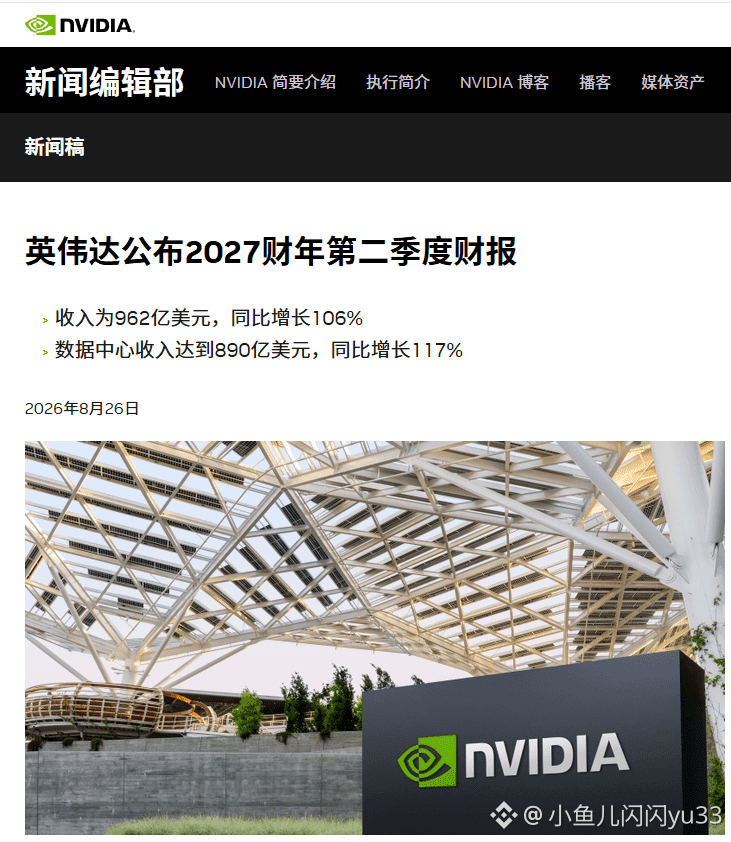

NVIDIA’s earnings report: the numbers are “really exploding”:
Q2 revenue was $96.2 billion—more than double year over year, up 106%.
Wall Street had expected roughly $92.2 billion, and NVIDIA left it far behind.
Q3 guidance: $108 billion, with a variation of ±2%, also above the market’s expectation of about $104 billion. Data center revenue was $89 billion, up 117% year over year—about 90% of the company’s total revenue is tied to this.
But the strangest part isn’t the numbers—it’s what happened after the report.
After the earnings were released, the stock price first dropped about 1% to 2%.
Only after the earnings call ended did it rebound; at one point in after-hours trading it rose around 4% to 5%.
This has been similar in recent quarters: results beat expectations, yet the stock’s first reaction is often soft. It’s not that the numbers are bad—it’s that expectations have already been priced in too aggressively.
On the same day, there were two more hard confirmations.
Amazon announced it will purchase another 2 million NVIDIA GPUs, deploy them to AWS, covering 2027 to 2028. NVIDIA’s CFO said that the capital expenditures of the five largest hyperscale cloud providers this year are close to $800 billion, and could reach $1.3 trillion by 2027.
Demand is still ramping up—this isn’t a situation where nobody is buying chips.
So here’s the contradiction right now: the books look better and better, but the stock is getting harder to lift in one go just by “beating expectations.”
So for NVIDIA’s earnings report, is it good news already fully priced in, or is the pullback giving people a chance to get on board?$NVDA
Q2 revenue was $96.2 billion—more than double year over year, up 106%.
Wall Street had expected roughly $92.2 billion, and NVIDIA left it far behind.
Q3 guidance: $108 billion, with a variation of ±2%, also above the market’s expectation of about $104 billion. Data center revenue was $89 billion, up 117% year over year—about 90% of the company’s total revenue is tied to this.
But the strangest part isn’t the numbers—it’s what happened after the report.
After the earnings were released, the stock price first dropped about 1% to 2%.
Only after the earnings call ended did it rebound; at one point in after-hours trading it rose around 4% to 5%.
This has been similar in recent quarters: results beat expectations, yet the stock’s first reaction is often soft. It’s not that the numbers are bad—it’s that expectations have already been priced in too aggressively.
On the same day, there were two more hard confirmations.
Amazon announced it will purchase another 2 million NVIDIA GPUs, deploy them to AWS, covering 2027 to 2028. NVIDIA’s CFO said that the capital expenditures of the five largest hyperscale cloud providers this year are close to $800 billion, and could reach $1.3 trillion by 2027.
Demand is still ramping up—this isn’t a situation where nobody is buying chips.
So here’s the contradiction right now: the books look better and better, but the stock is getting harder to lift in one go just by “beating expectations.”
So for NVIDIA’s earnings report, is it good news already fully priced in, or is the pullback giving people a chance to get on board?$NVDA