


Written by: Rita
The internet sector’s summer performance ended with a choppy finish. Over the past week, internet companies covered by Morgan Stanley fell an average of 2%, in line with the S&P 500 and the Nasdaq. However, stock-level performance varied significantly: Meta fell by about 7%, Amazon by about 2%, and Google was nearly flat.
On August 25, Morgan Stanley released a valuation dynamics report for the internet industry, providing a detailed breakdown of the valuation positions of the three major tech giants. Amazon currently corresponds to a forward P/E of 19x for 2026, a 36% discount to its historical average; Google at 17x, a 36% premium; and Meta at 17x, a 24% discount. The valuation premium for Google is in contrast to Meta’s deep discount. Morgan Stanley maintained an “attractive” rating for the internet industry.
This summer, the market’s pricing logic for three companies diverged fundamentally. AI capability is becoming the core variable driving valuation differentiation.
Google’s valuation premium coexists with Meta’s deep discount
Google is the only company among the three tech giants whose valuation is above its historical average. Measured by EV/EBITDA, it is currently 15.1x, representing an 8% premium versus the 2-year average and a 12% premium versus the 3-year average.
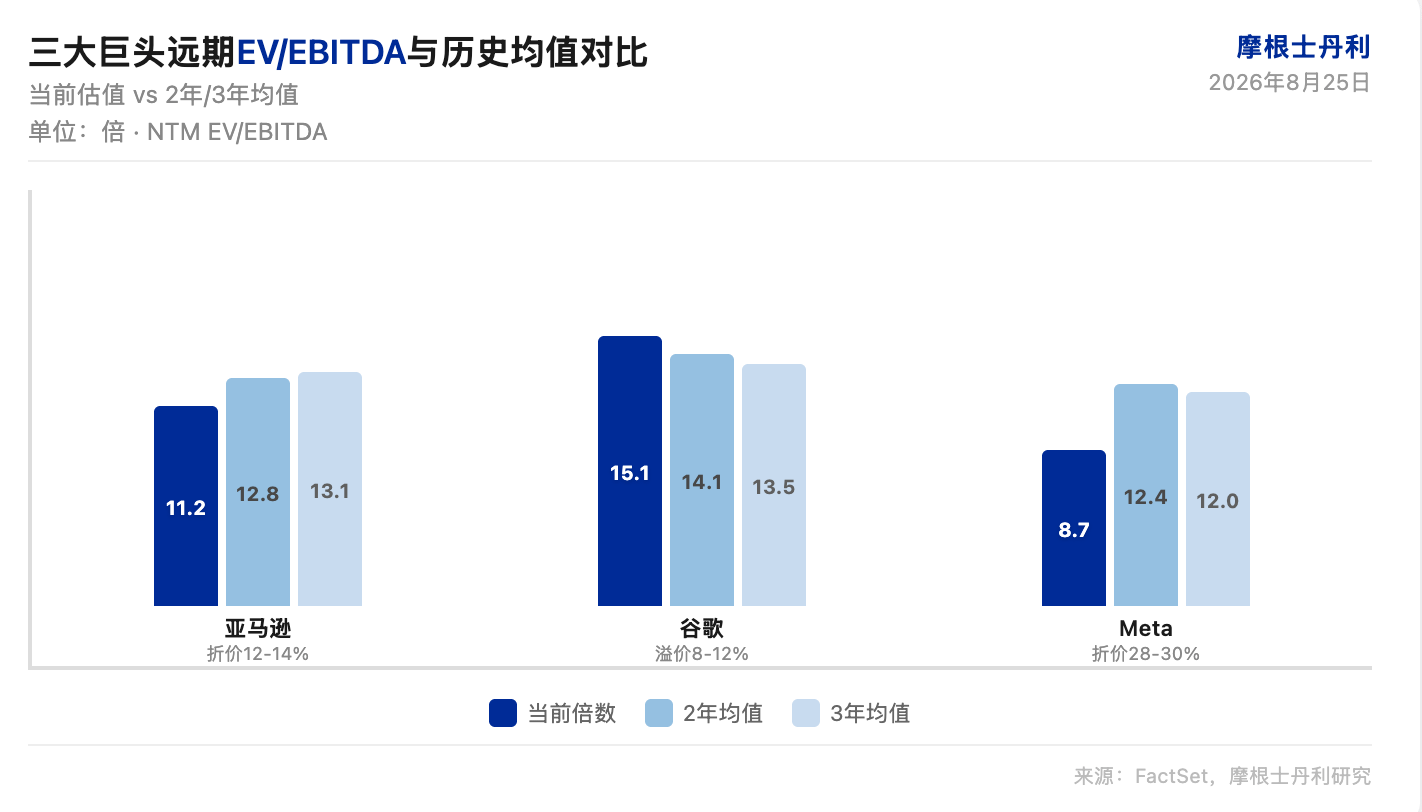
Google’s valuation premium comes from the market’s reassessment of AI capabilities. Upscaling external sales of TPU (Morgan Stanley had previously raised its per-GW revenue assumption from $20 billion to $27 billion), iterations of the Gemini models, and expansion of cloud business profit margins together support the valuation. The market is willing to price in growth driven by AI in advance.
Meta is heading in a different valuation direction. At 8.7x forward EV/EBITDA today, it trades at a 30% discount versus the 2-year average and a 28% discount versus the 3-year average. Although Meta has made good monetization progress with AI advertising tools, the market’s concerns about competition in social media advertising continue to weigh on the valuation. Amazon is in the middle: at 11.2x forward EV/EBITDA today, it is at discounts of 12% and 14% versus the 2-year and 3-year averages, respectively.
Sector valuations show pricing divergence between revenue and profits
Morgan Stanley data shows that the current forward EV/EBITDA multiple for the internet sector is 9% lower than the 5-year average and 16% lower than the 10-year average. Over the same period, the EV/Sales multiple is 16% higher than the 5-year average and 17% higher than the 10-year average. Revenue multiples are expanding while profit multiples are contracting, and the market’s requirements for earnings quality are increasing.
E-commerce and digital media are the sub-sectors with the most concentrated valuation discounts. In the digital media segment, the median forward EV/EBITDA is about 9.6x, and companies such as SNAP are still loss-making. The e-commerce segment also faces valuation pressure, mainly due to a slowdown in consumer spending and intensified competition.
SBC adjustments reveal the real valuation pressure
After adjusting for stock-based compensation (SBC) as a cash outlay, the true valuations of each sub-sector are significantly higher than the apparent figures.
After adjustments, the average EV/EBITDA multiple in the digital media sector rose by about 36%, the e-commerce sector rose by about 30%, and the travel and shared-economy sector rose by about 44%. SBC’s share among technology companies continues to expand. The gap between valuation multiples calculated using cash profits and those calculated using reported profits is widening. Simply looking at reported EV/EBITDA may underestimate the true valuation pressure. Only by treating SBC as a cash outlay and recalculating can the cost actually borne by shareholders be reflected.
Valuation repair requires higher earnings, not mean reversion
Morgan Stanley believes that the internet sector’s valuation repair requires new catalysts. Key variables to watch in the next few quarters include: the release schedule and market acceptance of Google’s Gemini 4; whether the growth rate of Amazon’s AWS stabilizes; Meta’s progress in monetizing AI advertising tools; and the continuing impact of changes in the interest-rate environment on high-valuation growth stocks.
In the short term, overall sector valuations are within a reasonable range. E-commerce and digital media trade at discounts, but the discounts themselves are not a reason to buy. Valuation repair needs to be driven by upward revisions to earnings expectations, not by a simple mean reversion.

Disclaimer
This article is a compilation and interpretation by ChaoXiang Research of a third-party brokerage research report (Morgan Stanley, August 25, 2026), combined with information from the public markets. The ratings, target prices, earnings forecasts, and related judgments cited in the text are the views of the brokerage’s analysts only; they represent the position of their respective institutions, not the views of ChaoXiang Research, and do not constitute any investment advice.
There are risks in the market; decisions must be independent. This article should not be used as a basis for buying or selling any securities.