I initially looked at Dusk staking expecting the usual story: lock tokens, secure the network, earn rewards. While researching Dusk for a CreatorPad task, though, one detail caught my attention more than the reward rate the maturity window.
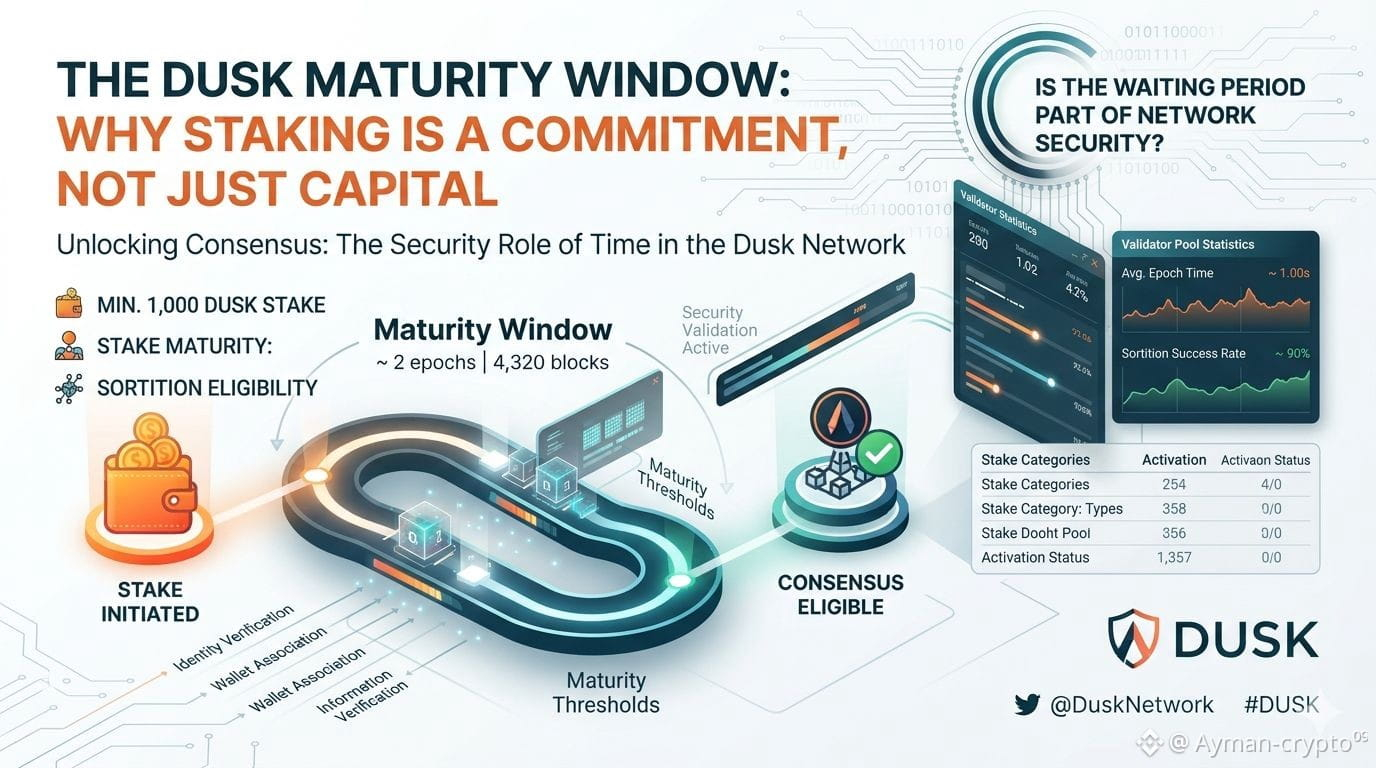
Dusk requires at least 1.000 DUSK to stake, but newly staked tokens do not immediately become eligible for consensus duties. They go through roughly two epochs, around 4.320 blocks, before becoming eligible for sortition. That delay makes more sense when viewed as a security mechanism: staking is not simply about putting capital at risk: the network also needs time to recognize and activate that stake within its consensus process. I also found the penalty design interesting. Poor performance or missed duties can move part of the stake into a claimable rewards pool rather than treating every failure as a simple burn.
Most people probably notice the minimum stake and potential rewards first. Reading deeper, I started seeing the maturity period as a quiet but important part of the incentive design. It creates a gap between commitment and responsibility, making consensus participation less like flipping a switch and more like entering a process.
That left me with a different question: if staking is partly about proving commitment over time, should the waiting period itself be considered part of network security?
#dusk $DUSK @Dusk
Dusk requires at least 1.000 DUSK to stake, but newly staked tokens do not immediately become eligible for consensus duties. They go through roughly two epochs, around 4.320 blocks, before becoming eligible for sortition. That delay makes more sense when viewed as a security mechanism: staking is not simply about putting capital at risk: the network also needs time to recognize and activate that stake within its consensus process. I also found the penalty design interesting. Poor performance or missed duties can move part of the stake into a claimable rewards pool rather than treating every failure as a simple burn.
Most people probably notice the minimum stake and potential rewards first. Reading deeper, I started seeing the maturity period as a quiet but important part of the incentive design. It creates a gap between commitment and responsibility, making consensus participation less like flipping a switch and more like entering a process.
That left me with a different question: if staking is partly about proving commitment over time, should the waiting period itself be considered part of network security?
#dusk $DUSK @Dusk