NVIDIA’s earnings report once again beat expectations. My core conclusion remains: there’s no sign yet that AI compute demand will peak anytime soon, but the market will increasingly focus on the quality of growth next.
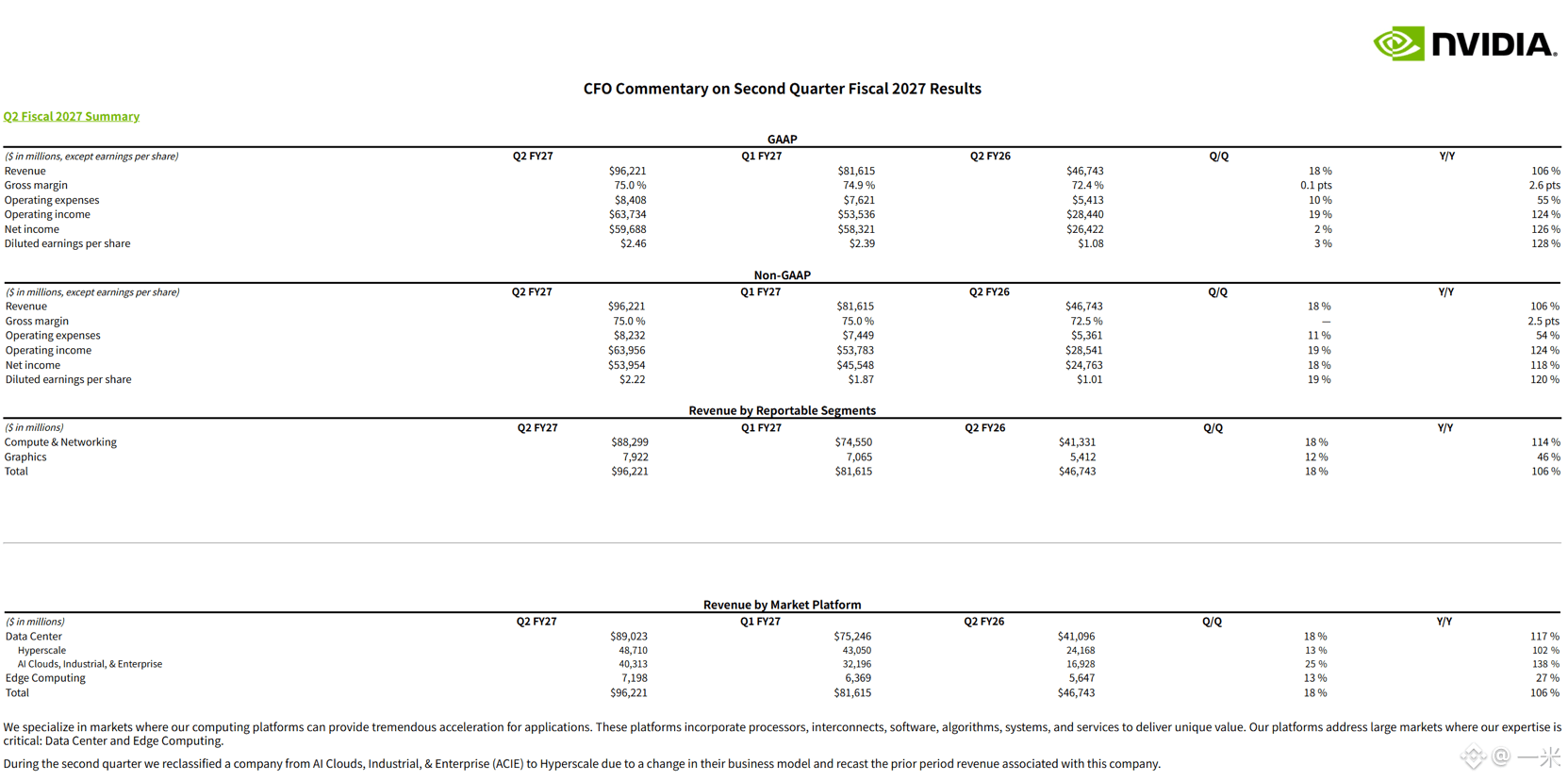
Specifically on the financials: Q2 revenue was $96.22 billion, up 106% year over year and 18% quarter over quarter. Data center revenue was $89.0 billion, up 117%, already accounting for more than 90% of total revenue.
On the product side, there’s also no sign of a slowdown: Blackwell is still shipping at a fast pace, and the next-generation Vera Rubin has already moved into a ramp-up stage.
Meanwhile, management even expects FY2028 revenue to grow by roughly 70%, which is clearly higher than the market’s prior expectation of about 44%.
However, the earnings report is not without concerns: gross margin is currently around 75%. Q3 guidance has been lowered to about 74%, and management expects Q4 could further drop to 71%–72%, mainly due to rising memory and other component costs.
In simple terms, this earnings report boils down to: demand remains insanely strong, the Rubin handoff is going smoothly, and there’s no obvious near-term fundamental inflection point. But $NVDA the next stage’s key contradiction is gradually shifting from “whether GPUs can be sold” to “whether such massive AI CapEx ultimately can generate enough revenue and cash flow.”
Specifically on the financials: Q2 revenue was $96.22 billion, up 106% year over year and 18% quarter over quarter. Data center revenue was $89.0 billion, up 117%, already accounting for more than 90% of total revenue.
On the product side, there’s also no sign of a slowdown: Blackwell is still shipping at a fast pace, and the next-generation Vera Rubin has already moved into a ramp-up stage.
Meanwhile, management even expects FY2028 revenue to grow by roughly 70%, which is clearly higher than the market’s prior expectation of about 44%.
However, the earnings report is not without concerns: gross margin is currently around 75%. Q3 guidance has been lowered to about 74%, and management expects Q4 could further drop to 71%–72%, mainly due to rising memory and other component costs.
In simple terms, this earnings report boils down to: demand remains insanely strong, the Rubin handoff is going smoothly, and there’s no obvious near-term fundamental inflection point. But $NVDA the next stage’s key contradiction is gradually shifting from “whether GPUs can be sold” to “whether such massive AI CapEx ultimately can generate enough revenue and cash flow.”