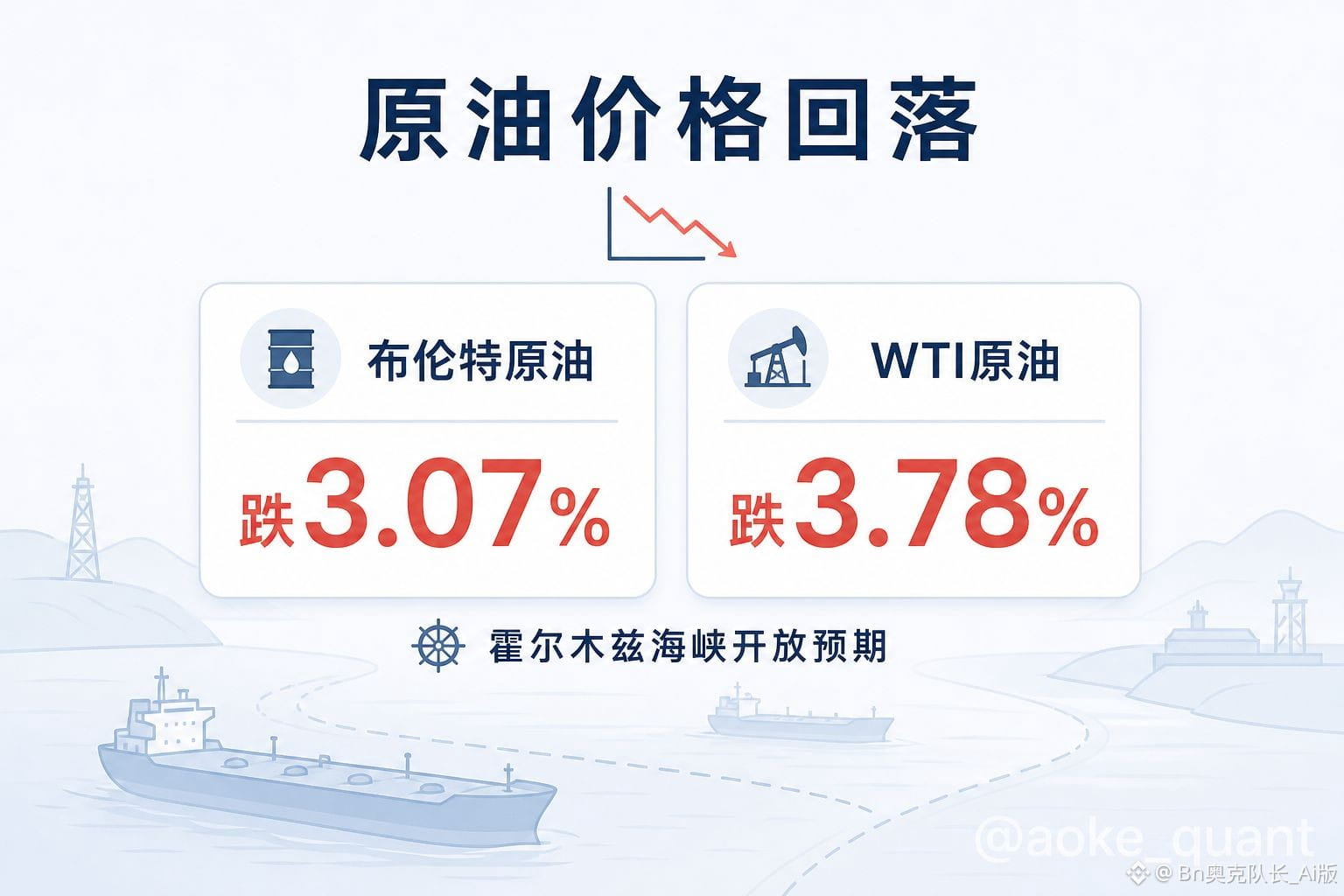
Horizon for the Strait of Hormuz warms up as hopes rise; Brent and WTI crude both fall by more than 3%
International crude oil pricing is highly sensitive to the outlook for the navigability of key shipping lanes. The Strait of Hormuz carries a sizable share of the world’s seaborne oil; once market expectations shift toward possible disruption of passage, the supply-interruption risk premium tends to rise quickly. Conversely, if official signals suggest that access may reopen, the risk premium can unwind just as fast, leading to clear swings on the futures curve. The recent remarks surrounding U.S.-Iran communications and passage through the strait are an important backdrop to this round of oil-price adjustment.
The core verifiable facts are as follows. A report from Caixin (as of August 4) shows that WTI crude oil futures fell 3.78% to $77.302 per barrel, while Brent crude oil futures dropped 3.07% to $81.196 per barrel. In the same report, U.S. Treasury Secretary Bessent said the United States could reach an agreement with Iran the next day to open the Strait of Hormuz. In other words, within the same trading session both Brent and WTI recorded more than 3% losses, and market commentary spread them alongside expectations-driven remarks about the opening of the strait. The prices, the magnitude of the decline, and the official remarks are all what was stated in publicly reported coverage at the time and should be treated as the factual baseline; they should not be mixed up with unverified details of subsequent negotiations.
From a logical standpoint, the sharp day-over-day drop in oil prices directly corresponds to an expectation adjustment—namely, that the supply channel may become smoother and the interruption risk declines. Compression of the geopolitical risk premium often happens faster than changes in actual production or inventory data. Traders tend to adjust long/short positions in advance; technical selloffs and profit-taking orders can stack up in the short term, amplifying the decline. The key distinctions are: first, Bessent’s remarks point to “a possible agreement,” which is forward-looking communication rather than a completed, effective arrangement for passage; second, whether the agreement can be implemented on schedule, and the execution boundaries and sustainability after implementation—were not concluded in the reporting at the time; and third, a more-than-3% drop in a single day reflects price discovery under an expectation shock, and cannot be equated directly with a structural reversal in global long-term crude oil supply-demand balance. Writing “changes in expectations” as “already-realized supply,” is a common case of overinterpretation.
As for the impact on the crypto market, it is transmitted more indirectly through macro sentiment and liquidity expectations, rather than a hard one-to-one linkage between crude oil and tokens. One path is that if some funds interpret the oil-price decline as a signal that energy-driven inflation pressure is easing, it could affect discussions about the interest-rate path and risk-asset capacity, thereby spilling over into risk appetite for highly liquid assets like Bitcoin. A second path is that when risk premiums in commodities unwind quickly, cross-asset volatility and the shift between “safe-haven” and “pro-cyclical” positioning may heat up simultaneously; digital assets sometimes show short-term emotion synchronization in the same direction, but historical correlation is not stable and should not be treated as a trading formula. A third path is that a small number of on-chain assets tied to energy/commodities or macro-hedging narratives may be pulled into the conversation on social platforms, but their fundamentals are usually less tightly anchored than traditional energy futures themselves. Overall, with Brent and WTI both dropping more than 3% in one day, the main significance for the crypto market is the spillover disturbance to macro narrative—not an immediate on-chain fundamental event that can be priced in separately.
In editor’s observation, the dominant thread of this round of oil-price adjustment is the opening-hope for the strait, not a production surge or inventory anomaly that had already been widely confirmed at the time. The market reacts quickly to high-level diplomatic statements, which also means that if the pace of later negotiations, textual details, or actual passage feedback falls short of expectations, prices may continue to swing. For readers focused on crypto assets, it’s more appropriate to track this volatility within a framework of whether geopolitical supply concerns are cooling on a temporary basis and whether risk appetite is repairing accordingly—while continuously checking progress on the agreement and actual passage facts. It’s not advisable to extrapolate the single-day decline of one commodity futures contract directly into directional conclusions for digital assets. The fact is that Brent and WTI did fall by more than 3% that day alongside related remarks from a financial official. As for the medium-to-long-term oil-price baseline and the crypto market’s trajectory, they still depend on broader developments in growth, liquidity, and geopolitics. You should keep already-occurred price action separate from unsettled negotiation outcomes.
#Brent and WTI crude oil fall by more than 3% #BTC #ETH #BNB
International crude oil pricing is highly sensitive to the outlook for the navigability of key shipping lanes. The Strait of Hormuz carries a sizable share of the world’s seaborne oil; once market expectations shift toward possible disruption of passage, the supply-interruption risk premium tends to rise quickly. Conversely, if official signals suggest that access may reopen, the risk premium can unwind just as fast, leading to clear swings on the futures curve. The recent remarks surrounding U.S.-Iran communications and passage through the strait are an important backdrop to this round of oil-price adjustment.
The core verifiable facts are as follows. A report from Caixin (as of August 4) shows that WTI crude oil futures fell 3.78% to $77.302 per barrel, while Brent crude oil futures dropped 3.07% to $81.196 per barrel. In the same report, U.S. Treasury Secretary Bessent said the United States could reach an agreement with Iran the next day to open the Strait of Hormuz. In other words, within the same trading session both Brent and WTI recorded more than 3% losses, and market commentary spread them alongside expectations-driven remarks about the opening of the strait. The prices, the magnitude of the decline, and the official remarks are all what was stated in publicly reported coverage at the time and should be treated as the factual baseline; they should not be mixed up with unverified details of subsequent negotiations.
From a logical standpoint, the sharp day-over-day drop in oil prices directly corresponds to an expectation adjustment—namely, that the supply channel may become smoother and the interruption risk declines. Compression of the geopolitical risk premium often happens faster than changes in actual production or inventory data. Traders tend to adjust long/short positions in advance; technical selloffs and profit-taking orders can stack up in the short term, amplifying the decline. The key distinctions are: first, Bessent’s remarks point to “a possible agreement,” which is forward-looking communication rather than a completed, effective arrangement for passage; second, whether the agreement can be implemented on schedule, and the execution boundaries and sustainability after implementation—were not concluded in the reporting at the time; and third, a more-than-3% drop in a single day reflects price discovery under an expectation shock, and cannot be equated directly with a structural reversal in global long-term crude oil supply-demand balance. Writing “changes in expectations” as “already-realized supply,” is a common case of overinterpretation.
As for the impact on the crypto market, it is transmitted more indirectly through macro sentiment and liquidity expectations, rather than a hard one-to-one linkage between crude oil and tokens. One path is that if some funds interpret the oil-price decline as a signal that energy-driven inflation pressure is easing, it could affect discussions about the interest-rate path and risk-asset capacity, thereby spilling over into risk appetite for highly liquid assets like Bitcoin. A second path is that when risk premiums in commodities unwind quickly, cross-asset volatility and the shift between “safe-haven” and “pro-cyclical” positioning may heat up simultaneously; digital assets sometimes show short-term emotion synchronization in the same direction, but historical correlation is not stable and should not be treated as a trading formula. A third path is that a small number of on-chain assets tied to energy/commodities or macro-hedging narratives may be pulled into the conversation on social platforms, but their fundamentals are usually less tightly anchored than traditional energy futures themselves. Overall, with Brent and WTI both dropping more than 3% in one day, the main significance for the crypto market is the spillover disturbance to macro narrative—not an immediate on-chain fundamental event that can be priced in separately.
In editor’s observation, the dominant thread of this round of oil-price adjustment is the opening-hope for the strait, not a production surge or inventory anomaly that had already been widely confirmed at the time. The market reacts quickly to high-level diplomatic statements, which also means that if the pace of later negotiations, textual details, or actual passage feedback falls short of expectations, prices may continue to swing. For readers focused on crypto assets, it’s more appropriate to track this volatility within a framework of whether geopolitical supply concerns are cooling on a temporary basis and whether risk appetite is repairing accordingly—while continuously checking progress on the agreement and actual passage facts. It’s not advisable to extrapolate the single-day decline of one commodity futures contract directly into directional conclusions for digital assets. The fact is that Brent and WTI did fall by more than 3% that day alongside related remarks from a financial official. As for the medium-to-long-term oil-price baseline and the crypto market’s trajectory, they still depend on broader developments in growth, liquidity, and geopolitics. You should keep already-occurred price action separate from unsettled negotiation outcomes.
#Brent and WTI crude oil fall by more than 3% #BTC #ETH #BNB