Yesterday I worked out that Dusk block rewards do not move with usage. Today I went back to the same explorer page and read the fee column instead, because that is the other half of the same question.
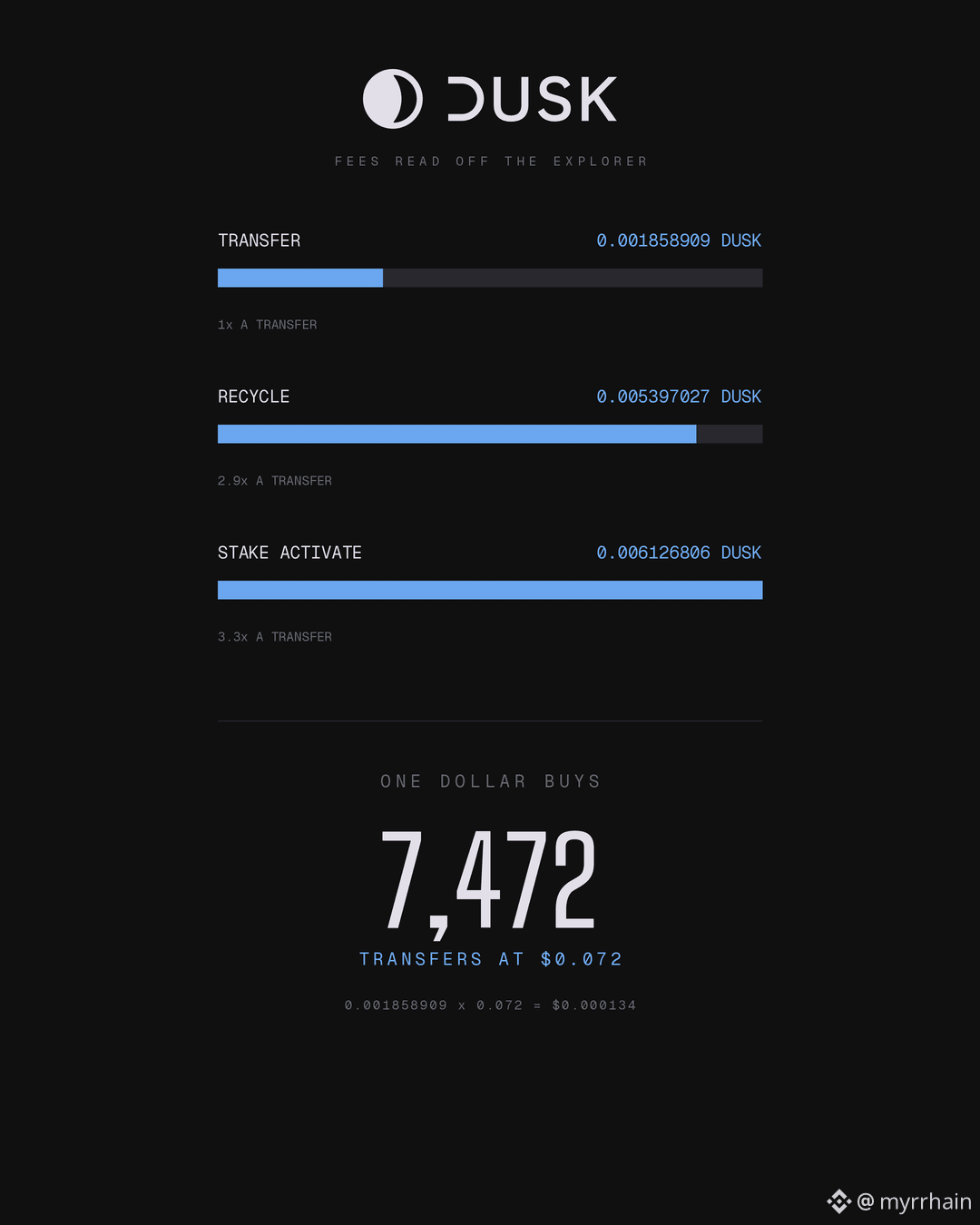
Four real transactions, with the fees exactly as shown. A transfer cost 0.001858909 DUSK. A recycle cost 0.005397027. A stake activation cost 0.006126806. Three different operation types, three different costs, all of them tiny.
Turning that into money at the 0.072 price on the same screen, a transfer costs about 0.000134 dollars. That means roughly 7,470 transfers for a single dollar.
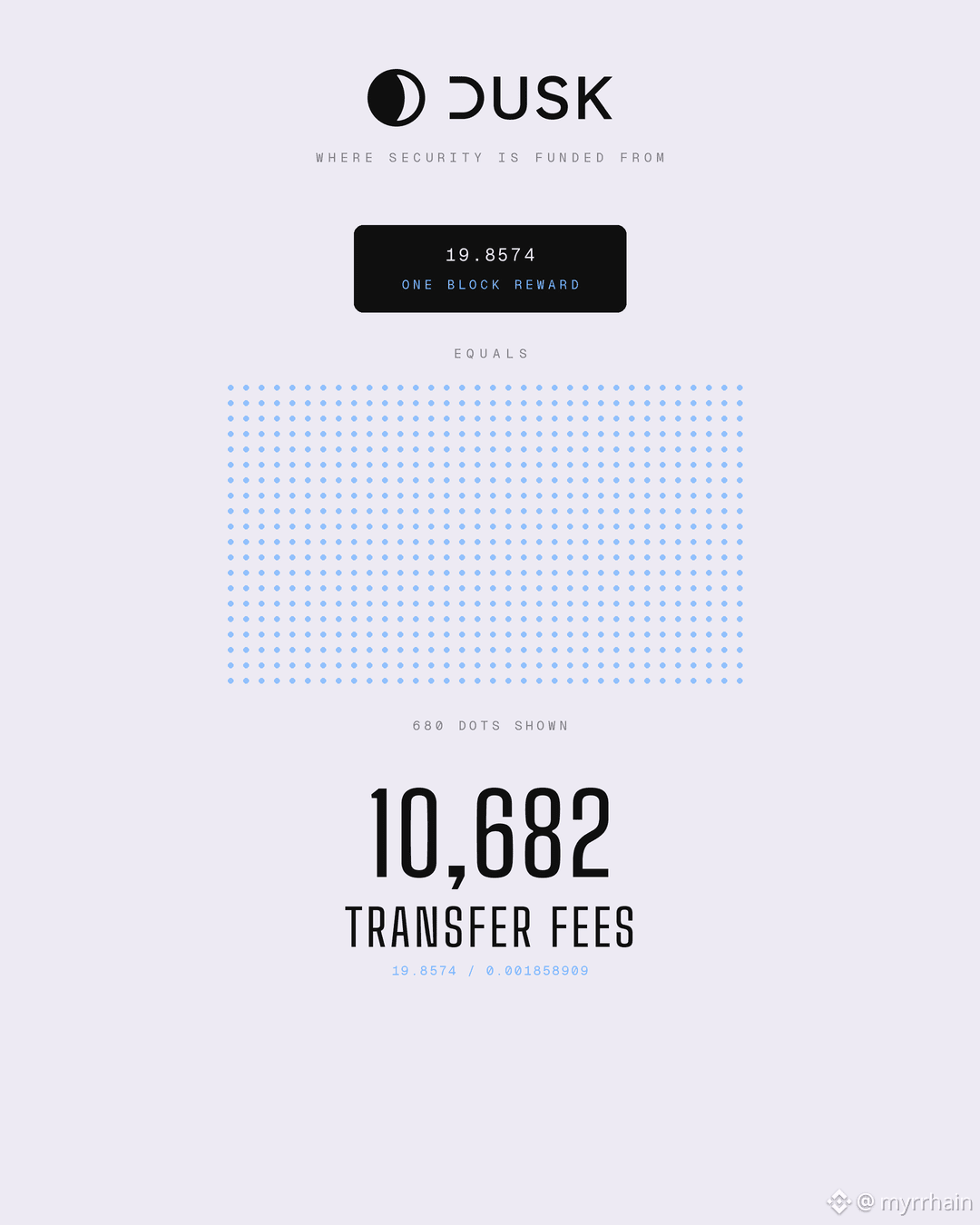
Then I put it next to yesterday's number and the design snapped into focus. A block on Dusk pays 19.8574 DUSK to whoever produced it. Divide that by the transfer fee and one block reward is worth about 10,680 transfers. The reward for producing a block dwarfs the fees inside it by four orders of magnitude.
Which tells you where security is actually funded from. Not from users, from emission.
For a chain built for regulated settlement I think that is the correct choice, and it connects directly to yesterday's finding. Fixed block reward means validator revenue does not rise with congestion. Emission funded security means user cost does not rise with congestion either. Both sides of the trade are insulated from load. A venue quoting settlement fees to institutional clients can put a number in a contract and expect it to hold, which is worth more to that customer than a throughput record.
Limits on this. Four transactions is a small sample and fees vary with the computation a transaction actually performs, so treat these as representative rather than fixed. The dollar figures move with price. And an emission funded model has to be read alongside the emission schedule, which I have not measured.
Anyone know how Dusk fees scale with contract complexity rather than transaction type?
@Dusk $DUSK #dusk