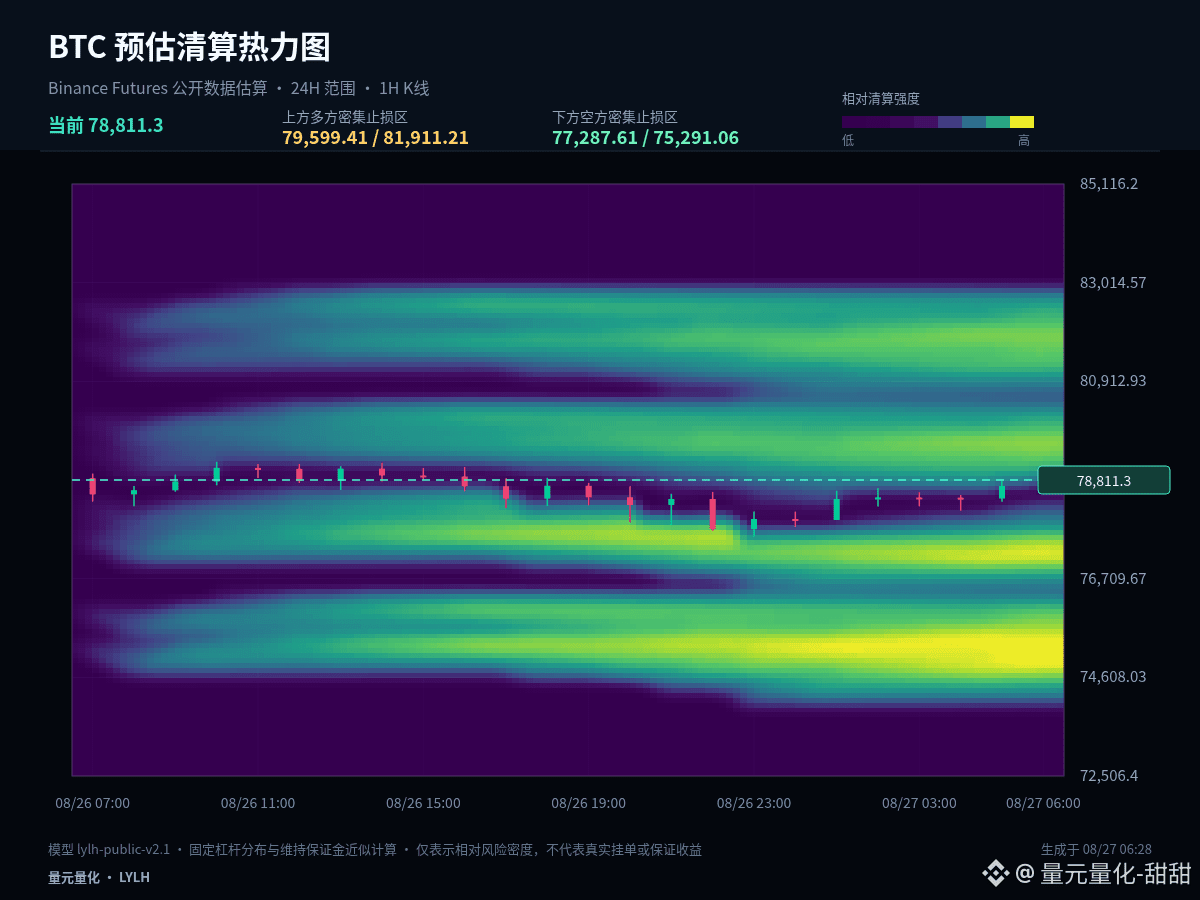
$BTC #BTC After the momentum picks up, then prepare to enter—more importantly, you need to first assess the position. In the current 1 hour: +0.12%, and in 24 hours: +0.23%. The space that has already been covered cannot simply be reused as the next segment that can be replicated.
$BTC #BTC is still repeatedly changing hands within the past-24-hour range, and there isn’t a clear directional advantage. The middle area tests patience the most; waiting for boundary signals is usually more effective.
The rhythm that favors the bulls is: after returning to around 78,442.09, sell pressure weakens, and then attempt 79,251.6 again. If it doesn’t pull back and instead accelerates straight up, the risk/reward ratio of chasing prices will deteriorate.
My scenario planning isn’t about committing to only one direction. If price breaks above 79,251.6 and can hold, it means the upside space has been reopened. If it breaks below 77,632.58 and fails to reclaim it on the retest, then the structure weakens further. If it moves between the two, continue monitoring how it closes on either side of 78,442.09.
For those who already hold positions, the focus is to manage based on whether support has failed—not to be carried away by every fluctuation. For those with no position, prioritize waiting for a breakout with a retest, or for support confirmation. Spot can be scaled in, while for futures you should shorten the decision chain: first determine the stop-loss level, then decide whether to participate.
Missing a segment of the market won’t directly cause losses. It’s the lack of a plan—chasing at the end of a volatility move—that makes your position passive. Risk control still comes before the conclusion: execute only when conditions appear, re-evaluate promptly when the price invalidates the setup; the larger the volatility, the more you should restrain the size of a single position. The above is an intraday projection based on the current 1-hour and 24-hour data; it does not constitute a promise of returns.
#IranSaysHormuzOmanDealNotFinalized
$BTC #BTC is still repeatedly changing hands within the past-24-hour range, and there isn’t a clear directional advantage. The middle area tests patience the most; waiting for boundary signals is usually more effective.
The rhythm that favors the bulls is: after returning to around 78,442.09, sell pressure weakens, and then attempt 79,251.6 again. If it doesn’t pull back and instead accelerates straight up, the risk/reward ratio of chasing prices will deteriorate.
My scenario planning isn’t about committing to only one direction. If price breaks above 79,251.6 and can hold, it means the upside space has been reopened. If it breaks below 77,632.58 and fails to reclaim it on the retest, then the structure weakens further. If it moves between the two, continue monitoring how it closes on either side of 78,442.09.
For those who already hold positions, the focus is to manage based on whether support has failed—not to be carried away by every fluctuation. For those with no position, prioritize waiting for a breakout with a retest, or for support confirmation. Spot can be scaled in, while for futures you should shorten the decision chain: first determine the stop-loss level, then decide whether to participate.
Missing a segment of the market won’t directly cause losses. It’s the lack of a plan—chasing at the end of a volatility move—that makes your position passive. Risk control still comes before the conclusion: execute only when conditions appear, re-evaluate promptly when the price invalidates the setup; the larger the volatility, the more you should restrain the size of a single position. The above is an intraday projection based on the current 1-hour and 24-hour data; it does not constitute a promise of returns.
#IranSaysHormuzOmanDealNotFinalized