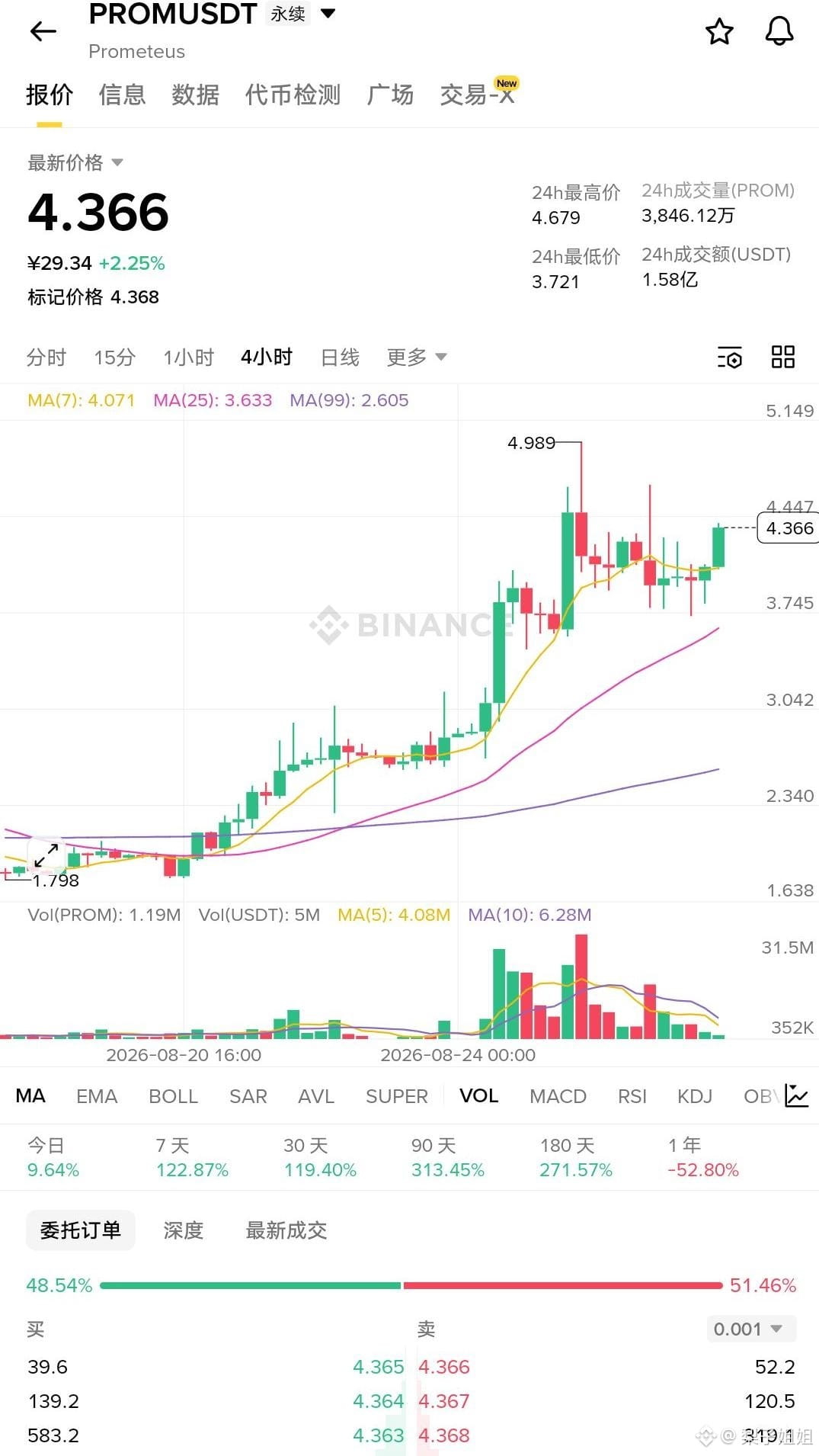
PROM contract fee rates are only 0.005%—calm seas; yet the spot leverage long/short ratio surged 231% in just 12 hours to 45.9. Same leverage, one cool and one hot. This 7-day move from 1.81 to 4.99, with the current price at 4.35, is not at all cooked up by contract longs burning their positions.
What stands out most is the contradiction in timing: a one-hour strong push of +8.8%, and contract open interest rising in sync by +8.2%—straight into bull_strong, sounding like the brightest longs in the entire room. But on the very same chart, the 4-hour timeframe only labels it as exhausting. Retail traders are using spot leverage to add at the top, in the most expensive spot, feeding the most crowded positions.
The direction of the chips doesn’t line up either: the near-term five sampled spot large orders show net outflow; the aggressive buy/sell ratio is 0.865, and the order book imbalance 0.813—everything is stacked on the sell side. RSI is 73.8 (overbought), ATR shows extreme volatility, and whale accounts’ long/short ratio is 0.766, lower than the whole market’s 0.856—big players are even less likely to chase highs than retail.
So this is the tail end of a trend being mistaken for the trend itself. I’m shorting around 4.35: the price has returned to 87% of the previous high; above that sits the leveraged trapped-longs supply—there’s both enough crowding and enough room for favorable odds.
If you want me to admit I’m wrong, there’s only one condition: spot large orders turn into sustained net inflows and volume expands to break and hold above the 4.99 prior high—that would be real incremental capital, not leverage short-covering. Until then, the higher the rebound, the better the short entry. #prom $PROM
What stands out most is the contradiction in timing: a one-hour strong push of +8.8%, and contract open interest rising in sync by +8.2%—straight into bull_strong, sounding like the brightest longs in the entire room. But on the very same chart, the 4-hour timeframe only labels it as exhausting. Retail traders are using spot leverage to add at the top, in the most expensive spot, feeding the most crowded positions.
The direction of the chips doesn’t line up either: the near-term five sampled spot large orders show net outflow; the aggressive buy/sell ratio is 0.865, and the order book imbalance 0.813—everything is stacked on the sell side. RSI is 73.8 (overbought), ATR shows extreme volatility, and whale accounts’ long/short ratio is 0.766, lower than the whole market’s 0.856—big players are even less likely to chase highs than retail.
So this is the tail end of a trend being mistaken for the trend itself. I’m shorting around 4.35: the price has returned to 87% of the previous high; above that sits the leveraged trapped-longs supply—there’s both enough crowding and enough room for favorable odds.
If you want me to admit I’m wrong, there’s only one condition: spot large orders turn into sustained net inflows and volume expands to break and hold above the 4.99 prior high—that would be real incremental capital, not leverage short-covering. Until then, the higher the rebound, the better the short entry. #prom $PROM