


Stay updated with the latest global market trends as of February 4th — at the same time frame, gold has experienced an epic surge, breaking through $5088 per ounce in London, while Bitcoin has dropped below $73,000, erasing all gains since Trump's election, with 160,000 people liquidated. This strong divergence hides the logic of capital flow in the global financial market. In this article, we will analyze the core reasons for the divergence between gold and Bitcoin using the latest market data and authoritative analyst opinions, predicting short-term trends to help everyone understand the current market landscape.
1. Core Market Analysis: Gold Soars vs Bitcoin Plummets, The Truth Behind February's Divergence (Data + Insights)
Combining the latest market data as of February 4 at 3 PM, along with recent industry dynamics, we break down the core logic behind the recent market differentiation between gold and Bitcoin, with each part accompanied by precise data and in-depth viewpoints, clearly presenting the essence of the differences in their trajectories:
(I) Recent gold market: Epic surge, breaking through the $5000 barrier (safe-haven property maximized)
Since 2026, gold has entered a "surge mode", especially on February 4, when the increase reached a new high, becoming the most resilient asset in the global financial market, driven by safe-haven demand and central bank hoarding of gold. The specific market data and logic are as follows:
Core market data (February 4 real-time):
London Gold Spot (International Gold Spot): The trading quote is $5088.77/ounce, with a daily change of +$142.53, a change rate of 2.88%, intraday high of $5089.69, low of $4945.16, up $142.53 from yesterday's close;
New York Gold (International Gold Futures): The trading quote is $5083.5/ounce, with a daily change of +$148.5, a change rate of 3.01%, intraday high reaching $5109.3, setting a new historical high;
Domestic Gold: Shanghai Gold Spot (Gold T+D) quote is 1140.03 yuan/gram, change rate of 6.02%; Shanghai Gold Futures (Shanghai Gold) quote is 1141.7 yuan/gram, change rate of 7.29%, following the surge in international gold;
Long-term trend: Since 2022 when central banks around the world began "panic gold hoarding", the gold price increase has continued to expand, rising 13% in 2023, 27% in 2024, nearly 65% in 2025, and breaking through $5000 in February 2026, continuing the bull market pattern.
Core rising logic (differentiated analysis):
The recent surge in gold is fundamentally due to the "triple positive resonance", rather than short-term speculation, which is also the key reason for its differentiation from Bitcoin:
Surge in safe-haven demand: Global geopolitical tensions and economic headwinds are rising, combined with the risk aversion triggered by the widespread decline in the crypto market, resulting in a large amount of capital flowing from high-risk assets (such as Bitcoin) to gold, driving prices up;
Central bank gold hoarding continues: Since the Western countries imposed sanctions on Russia in 2022, the annual demand for gold by central banks has jumped from about 400 tons to over 1000 tons, continuously buying to absorb market supply, becoming the core support for the long-term bull market in gold;
Institutional capital layout: Some institutions (such as Jefferies) have cleared their Bitcoin positions, opting to allocate physical gold and gold mining stocks, further pushing up gold prices, especially after the threat of quantum computing to Bitcoin has emerged, gold's "safety attribute" has become more favored.
(II) Recent Bitcoin market: Plummeting below $73,000, wiping out all gains, increasing volatility (risk attributes highlighted)
In stark contrast to the surge in gold, Bitcoin has continued to weaken recently, dropping below $73,000 on February 3, setting a new low since November 2024, erasing all gains since Trump's election, as market sentiment has plummeted to rock bottom, with the specific market data and logic as follows:
Core market data (February 3 - February 4):
Bitcoin price: On February 3, the US stock market fell below $73,000 at one point, down over $6000, nearly 8% from the intraday high of $79,100 earlier in the Asian market; on February 4, there was a slight rebound but still under pressure, cumulatively down over 15% since 2026;
Liquidation data: From February 3 to February 4, over 160,000 people were liquidated in the entire network within 24 hours, with liquidation amounts exceeding 11.2 billion yuan, resulting in the clearance of a large number of bottom-fishing positions, further exacerbating the selling pressure;
In comparison to gold: The Bitcoin-to-gold ratio fell to 19.26 in January 2026, down 6.5% relative to gold this year, while gold increased by 55% during the same period, indicating that investors are reassessing Bitcoin's status as "digital gold";
Related currencies: Ethereum's decline is sharper, dropping below $2110 on February 3, hitting the lowest level since May 2025, down slightly over 10% from the intraday high, while altcoins performed even worse, with some small-cap coins plummeting nearly 70% over the past year.
Core falling logic (in-depth analysis):
The recent decline in Bitcoin is fundamentally due to the "triple pressure accumulation", breaking the previous narrative of "digital gold", which is also the core reason for its differentiation from gold:
Quantum computing threat emerges: Coinbase's chief researcher warns that about 32.7% of Bitcoin's supply faces potential quantum computing attack risks, involving about 6.51 million Bitcoins, shaking the foundation of its value storage and triggering institutional withdrawals;
Institutional position adjustments: Jefferies strategy director Christopher Wood has cleared all Bitcoin positions, shifting to gold, leading some institutions to follow suit, causing the support for Bitcoin ETF's continuous buying to weaken;
Market sentiment is sluggish: The cryptocurrency market has been in a downward cycle since October 2025, deemed by analysts as a "comprehensive crypto winter", with retail participation declining, and leverage liquidations exacerbating selling pressure, making it difficult to form an effective rebound in the short term;
Attribute differences are prominent: Buyers of gold are mainly central banks and sovereign wealth funds, with low leverage ratios and long investment horizons, while Bitcoin ETF buyers still view it as a risk asset with high leverage and trading activity, and its volatility is far greater than that of gold.
(III) Key comparison: The market differentiation between gold and Bitcoin, predicting future trends
Combining authoritative analyst views, summarizing the core differences between gold and Bitcoin and predicting future trends, focusing on an ordinary person's perspective, without hype or speculation, concentrating on objective analysis:
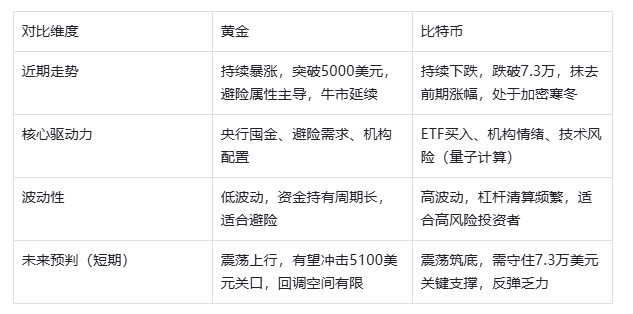
Core viewpoint: The market differentiation between gold and Bitcoin essentially highlights the attribute differences between "safe-haven assets" and "high-risk assets". Currently, global financial market risk aversion is rising, with capital continually flowing from high-risk cryptocurrencies to low-volatility gold, making this differentiation pattern difficult to reverse in the short term. For investors, it is essential to clarify their own risk tolerance: those who prefer stable risk aversion should focus on the long-term allocation value of gold; those who prefer high risk and high returns should be cautious of Bitcoin's short-term volatility risks and wait for clear signals of market bottoming before cautiously intervening.
II. Conclusion summary
In today's global financial market, the differentiation has become the norm—gold has opened an epic bull market due to its safe-haven attributes, breaking through the $5000 barrier, becoming the core asset for central banks and institutions; Bitcoin, affected by multiple factors such as quantum computing threats, institutional withdrawals, and sluggish market sentiment, has dropped below $73,000, erasing all previous gains, with 160,000 people liquidated and the crypto winter still ongoing.
The differences in the trajectories of the two are never a debate of "which is more valuable" but rather a difference in the adaptability of "asset attributes". The core value of gold is "safe-haven preservation of value", which will continue to be highlighted in an environment of economic headwinds and geopolitical tensions; the core value of Bitcoin is "speculative attributes + technological narrative", which is greatly influenced by institutional sentiment, technological changes, and market cycles, with volatility far exceeding that of gold.
In the future, two key signals need to be closely monitored: whether gold can stabilize above the $5000 mark and hit new highs at $5100; whether Bitcoin can hold the crucial support at $73,000 to avoid further declines. For ordinary investors, it is crucial to rationally assess the risks and opportunities of both, avoid blindly chasing highs and killing lows, and develop allocation strategies based on their own risk tolerance, which is currently the most prudent choice in the market.