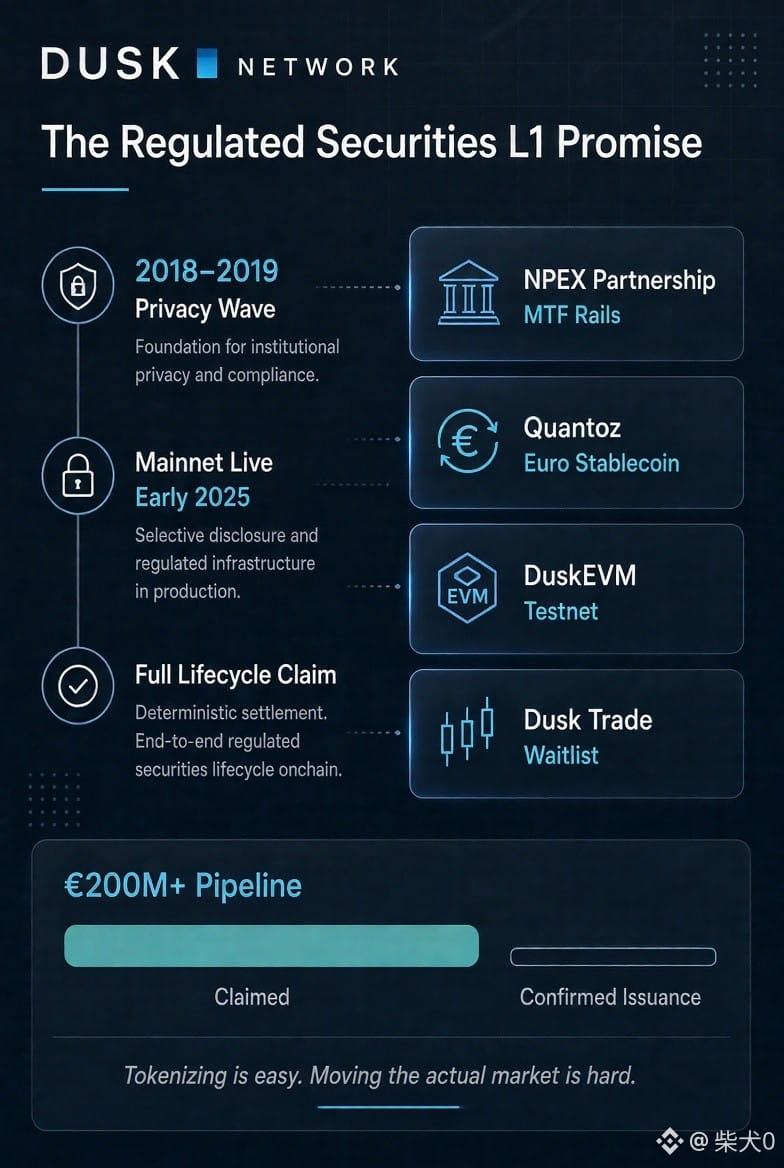
Was reviewing some old notes from the 2018-2019 privacy wave the other day and Dusk kept surfacing. Eight years in, mainnet live since early 2025, still pitching the same core promise: the L1 that finally lets regulated securities live fully onchain with privacy, selective disclosure, and deterministic settlement. NPEX partnership for the MTF rails, Quantoz for the euro stablecoin, DuskEVM on testnet, Dusk Trade on waitlist. The stack looks complete on paper.
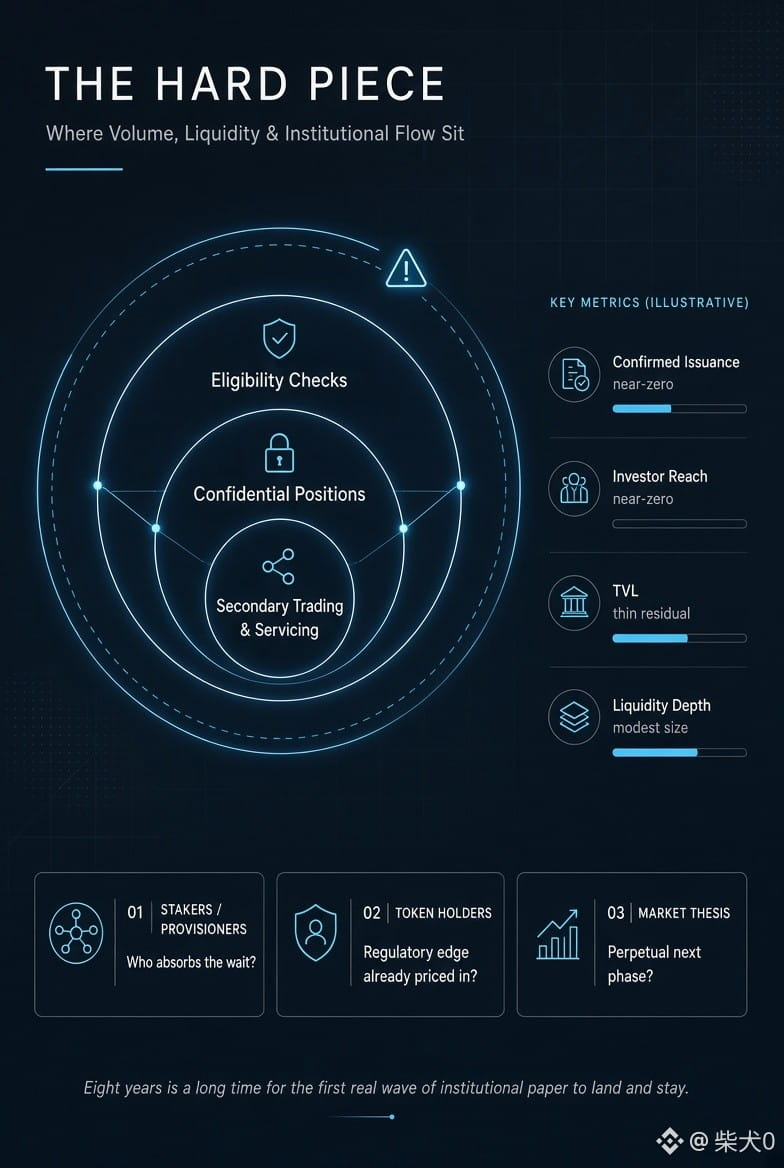
But here’s the part that sits wrong. Tokenizing is easy. Moving the actual market—eligibility checks, ownership controls, confidential positions, real secondary trading, servicing—onto one network without leaking data or breaking compliance is the hard piece they claim to own. So how does Dusk actually deliver that volume? The €200M+ pipeline from NPEX has been talked about for a while. Website metrics still read like zeros on confirmed issuance and investor reach. TVL reports stay thin. Liquidity is the kind that moves on modest size. Institutional capital is patient until it isn’t.
If the licenses and the venue don’t convert into live issuance and continuous settlement flow, who eats the cost of the wait? The provisioners staking DUSK for rewards? The holders who treated the regulatory edge as already priced in? Or does the whole thesis just sit in perpetual “next phase” while newer RWA rails ship simpler products?
I’ve watched too many chains build the perfect compliance layer only to discover institutions still need deep books and proven recovery paths before they move real size. Dusk says the full lifecycle runs on their rails. Fair enough. But if the secondary market never thickens and the gated volume never compounds into open activity, the reaction from the market won’t be polite. It’ll just be quiet rotation. Eight years is a long time to still be waiting for the first real wave of institutional paper to land and stay.
#dusk $DUSK @Dusk
But here’s the part that sits wrong. Tokenizing is easy. Moving the actual market—eligibility checks, ownership controls, confidential positions, real secondary trading, servicing—onto one network without leaking data or breaking compliance is the hard piece they claim to own. So how does Dusk actually deliver that volume? The €200M+ pipeline from NPEX has been talked about for a while. Website metrics still read like zeros on confirmed issuance and investor reach. TVL reports stay thin. Liquidity is the kind that moves on modest size. Institutional capital is patient until it isn’t.
If the licenses and the venue don’t convert into live issuance and continuous settlement flow, who eats the cost of the wait? The provisioners staking DUSK for rewards? The holders who treated the regulatory edge as already priced in? Or does the whole thesis just sit in perpetual “next phase” while newer RWA rails ship simpler products?
I’ve watched too many chains build the perfect compliance layer only to discover institutions still need deep books and proven recovery paths before they move real size. Dusk says the full lifecycle runs on their rails. Fair enough. But if the secondary market never thickens and the gated volume never compounds into open activity, the reaction from the market won’t be polite. It’ll just be quiet rotation. Eight years is a long time to still be waiting for the first real wave of institutional paper to land and stay.
#dusk $DUSK @Dusk